
The IOE entrance paper, the central admission clock, what a BE actually costs, and the rules that quietly cost people seats. Every figure is cited to the official document it came from, with the date it was read.
Answers
59
Sections
6
Sourced
IOE docs
Updated
August 2026
Why this exists
Most of this is published only in Nepali, in a PDF, once a year
The Institute of Engineering publishes everything that matters about BE admission: the exam pattern, the syllabus, the fee tables, the admission timetable and the reservation rules. It publishes them in Nepali, in annual PDFs, in a legacy font that will not copy and paste. So most students never read them and rely on whatever a coaching centre said.
These pages are those documents, read page by page and written out in English with the page reference and the date attached. Where we state something about this college, it is marked and it comes last. Where the official document contradicts us, the official document wins, and we say so on the page.
Browse
6 sections
IOE entrance examThe paper, the syllabus, the marks, the centres, and what to carry.12 answers
Central admissionPriority order, the merit lists, the windows, and the rules that cost people seats.20 answers
Fees and scholarshipsWhat a BE actually costs, from IOE’s own published tables.11 answers
Programmes and seatsCivil, Computer and Electronics: what the four years contain.8 answers
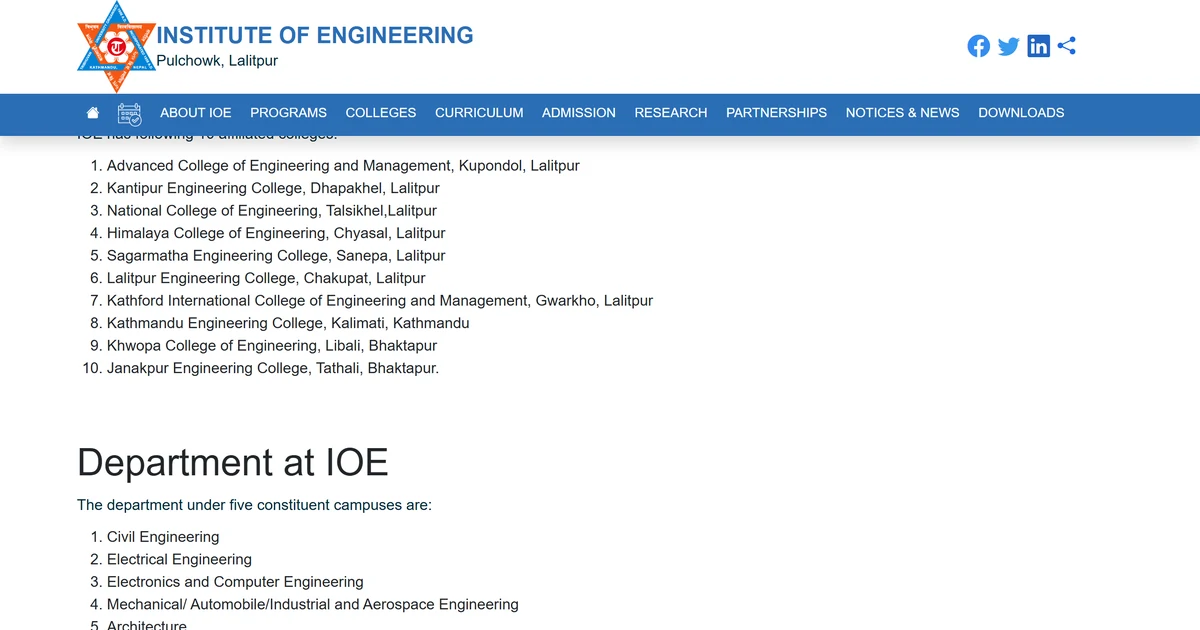
Colleges and affiliationWho is affiliated to what, and what affiliation actually means.6 answers
Yes. The official booklet contains model questions, and their section headers confirm the paper structure: Section A is 1 mark × 60, Section B is 2 marks × 40.
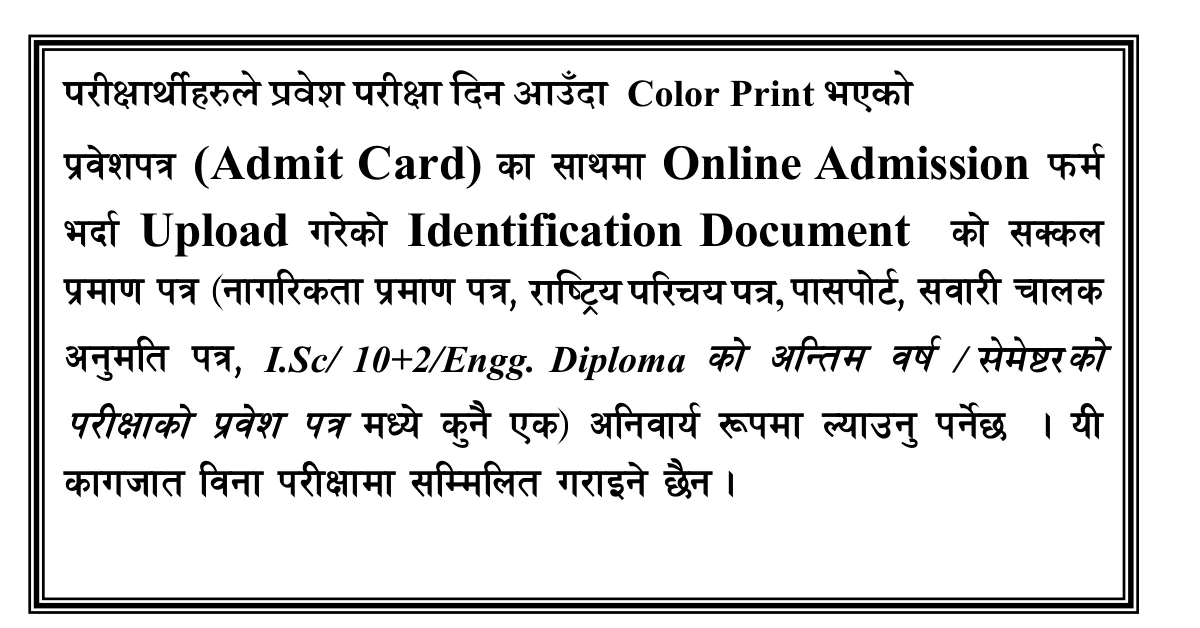
Your admit card and the original of the ID you uploaded with your application. Without it you are not permitted to sit. Centres run in assigned shifts across four days.
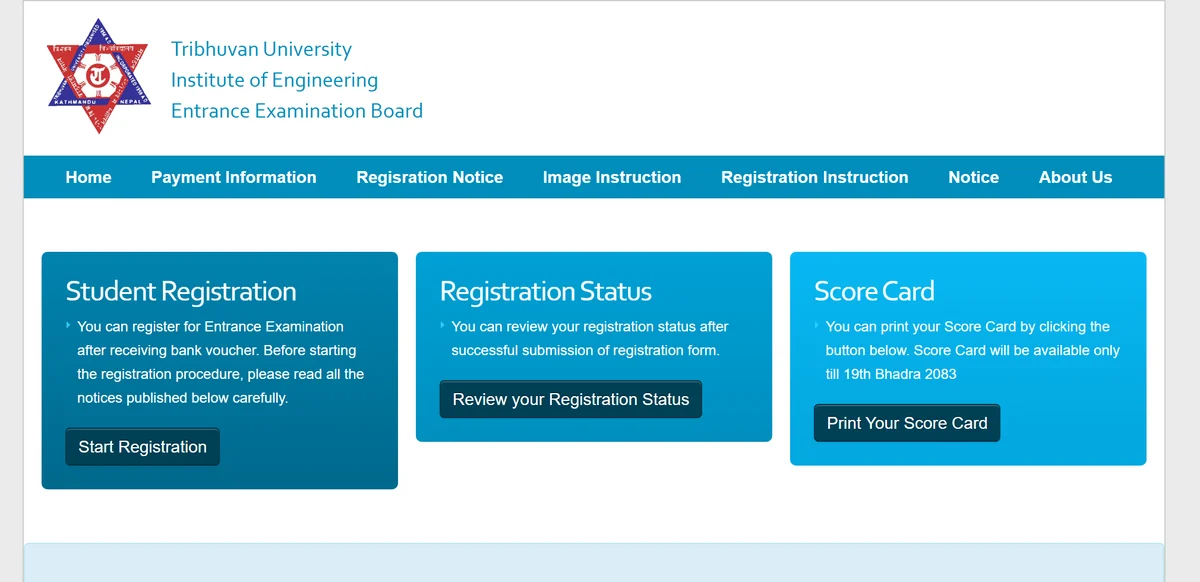
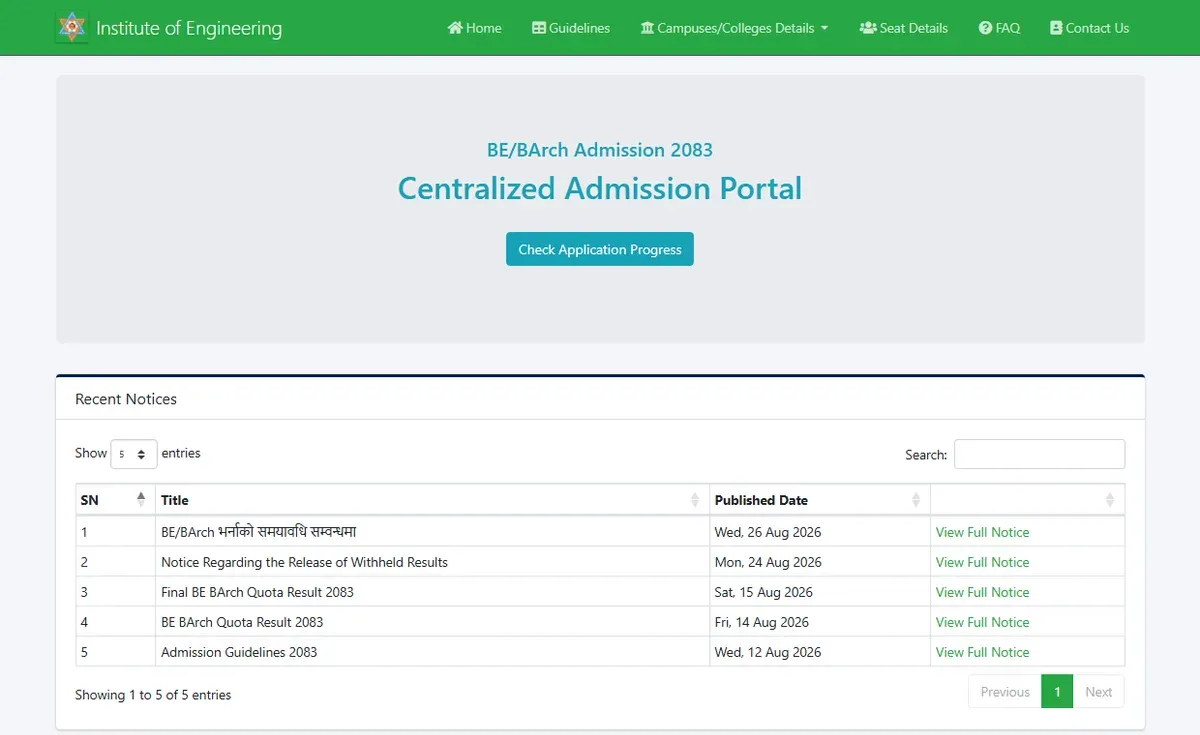
Both on entrance.ioe.edu.np. Campus and college admission then runs on a separate portal, admission.ioe.edu.np, and confusing the two is the usual cause of panic.
You need Physics, Chemistry and Mathematics in classes 11 and 12, and either 45% of total marks or a minimum C grade in every subject under letter grading. Candidates still awaiting results may apply.
A three-level tie-break: total marks to three decimal places, then Mathematics, Physics, Chemistry and English in that order, then +2 marks followed by SEE marks.
Central admission
Priority order, the merit lists, the windows, and the rules that cost people seats.
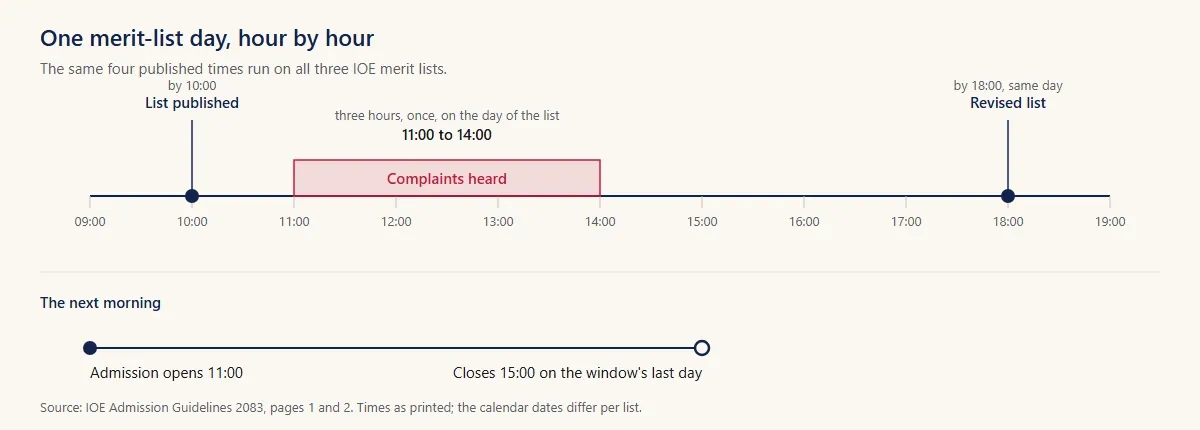
Three centrally scheduled lists, each published by 10:00 with a complaint hour from 11:00 to 14:00 and a revised list by 18:00. Anything after the third list is run by the individual campus.
Put the college you genuinely want first. A lower choice cannot pull you out of a higher one you already qualified for, and your rank alone decides whether you qualify.
Every merit list has a published complaint window of 11:00 to 14:00 on the day it appears, with a revised list by 18:00. It is the only fast route to a correction.
Not until your name is recorded on the central admission portal. A campus that fails to record you leaves you not admitted, and the procedure puts that on the campus.
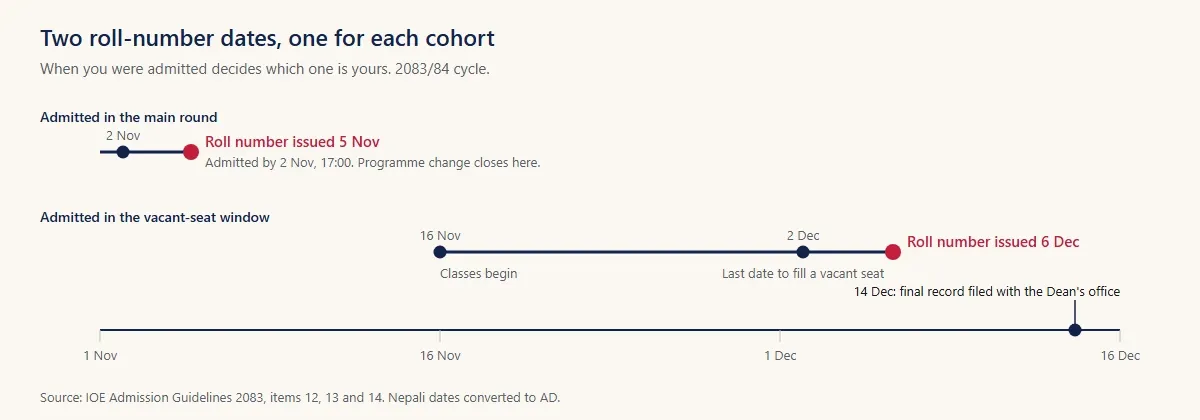
Two. A campus may take extra applications alongside its second and third lists if it announces them in advance, and vacant seats can be filled up to 2 December on terms that refund nothing.
Until 5 November, when Unique IOE Roll Numbers are issued. After that the programme on your roll number is the one you graduate in. Full Fee to Regular remains possible.
Generally no. Regular-to-Regular transfer is not done. One narrow route exists into a full-fee programme elsewhere, and it requires paying the remaining fee in a lump sum.
Originals plus one attested copy of your SEE and +2 transcripts, board certificates, character certificates and citizenship. Equivalence and migration certificates apply only if you came from outside TU or NEB.
At IOE constituent campuses, yes. If the Full Fee and sponsored quota of a programme is not filled to 60% within the first three lists, the campus may suspend it for that year and must refund admission fees in full.
Yes. Permanent IOE teachers and staff past probation may apply for reserved seats with prior written approval from the Dean’s office, and their children apply with a recommendation letter.
20% of Regular seats at constituent campuses are reserved for deprived communities, and that 20% is itself divided nine ways — women 20%, Janajati 16%, Madhesi 14%, Tharu 10%, Dalit 9%, disabled 9%, Muslim 7%, remote region 7%, other 8%.
No. An applicant admitted under a reserved quota at one campus cannot later be admitted under a reserved quota at another, and reserved names are published only for the first three lists.
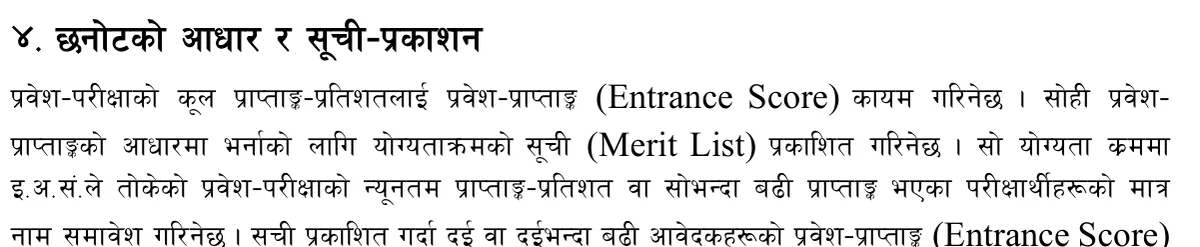
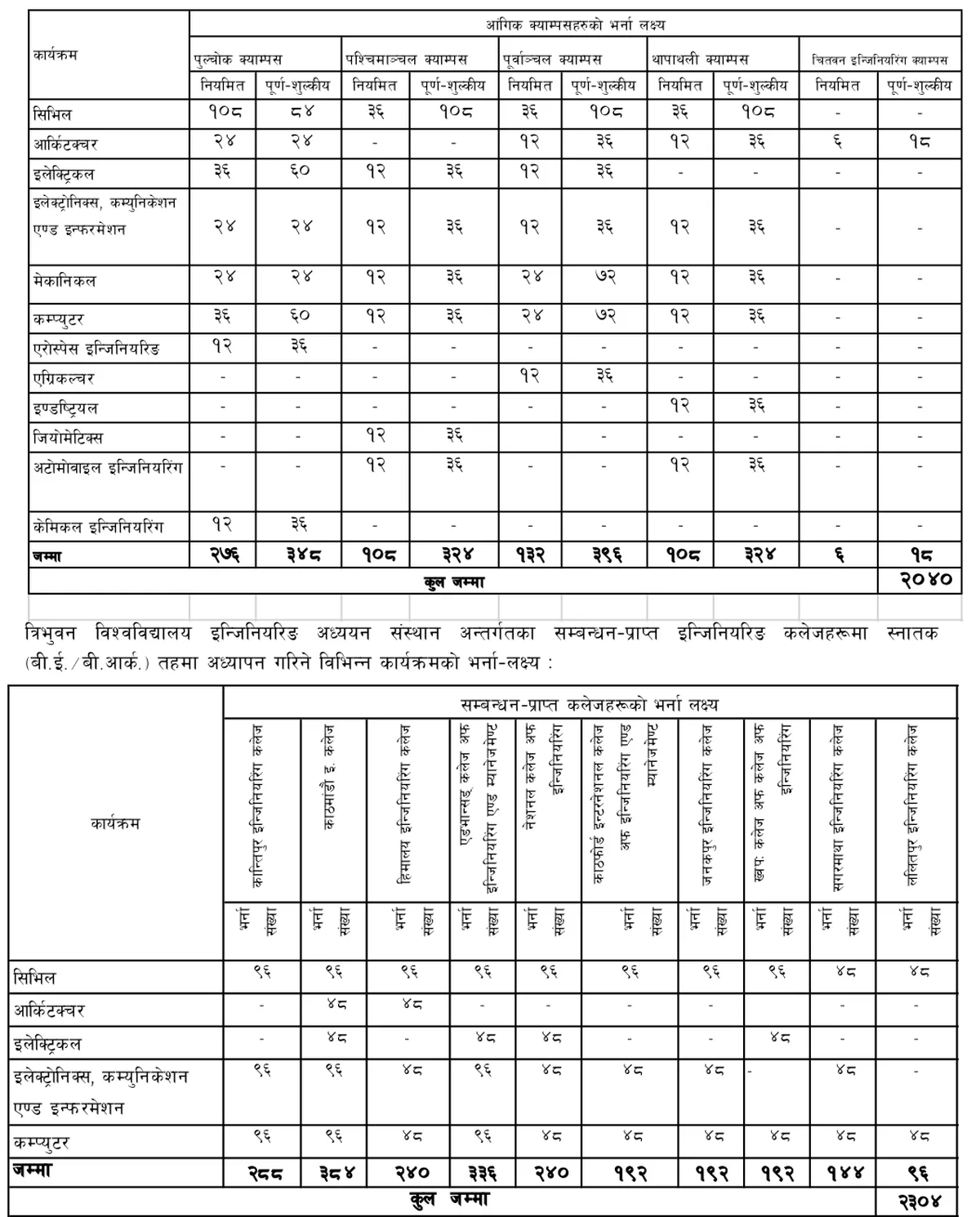
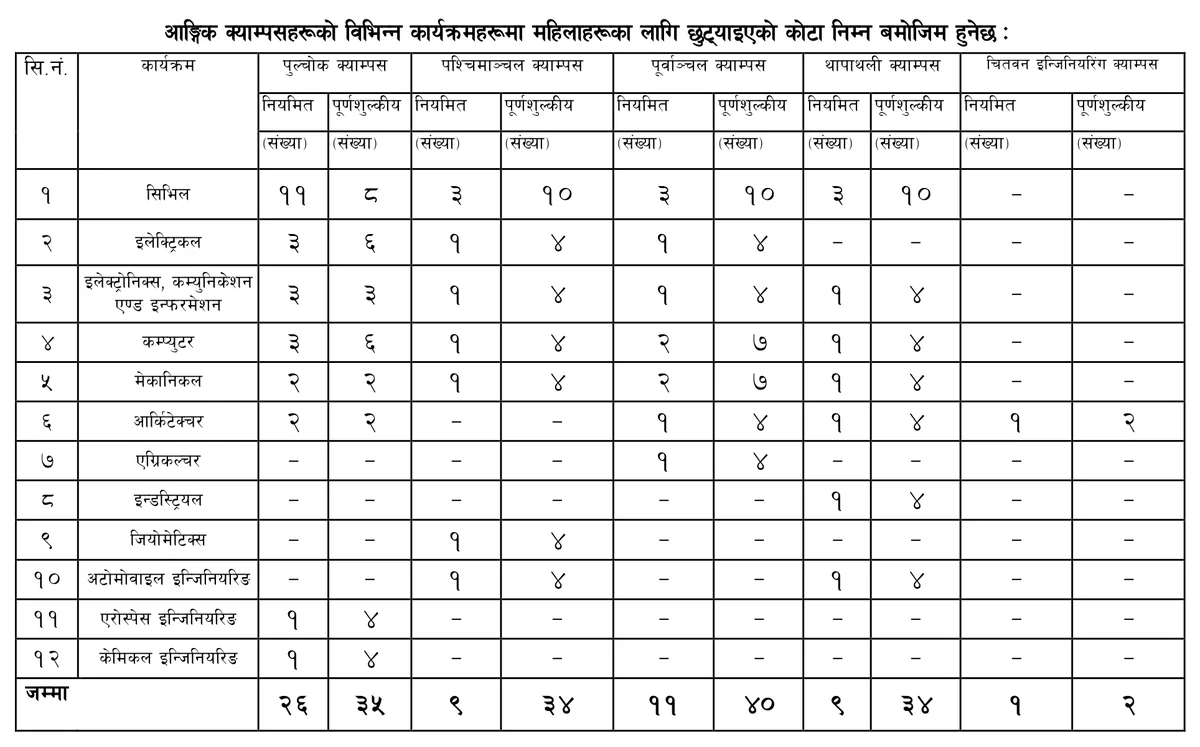
10% of seats in both Regular and Full Fee programmes, published per campus. Across the five constituent campuses that is 56 Regular and 145 Full Fee seats.
Yes. Campuses may conduct a subject-related Aptitude Test for applicants named for Architecture admission, and it can run as late as the morning after the priority deadline.
Two seats across all IOE campuses for permanent teachers and staff past probation, plus two scholarship seats on the Regular side for TU and IOE staff and their children.
You submit a copy of your transcripts, certificates and citizenship with the TU registration form, then attend in person on a stated date with four photographs for your campus ID and library card.
One-twelfth of the full-fee seats at constituent campuses is reserved for foreign nationals, with three different entrance routes depending on where you studied and whether your country is in SAARC.
Fees and scholarships
What a BE actually costs, from IOE’s own published tables.
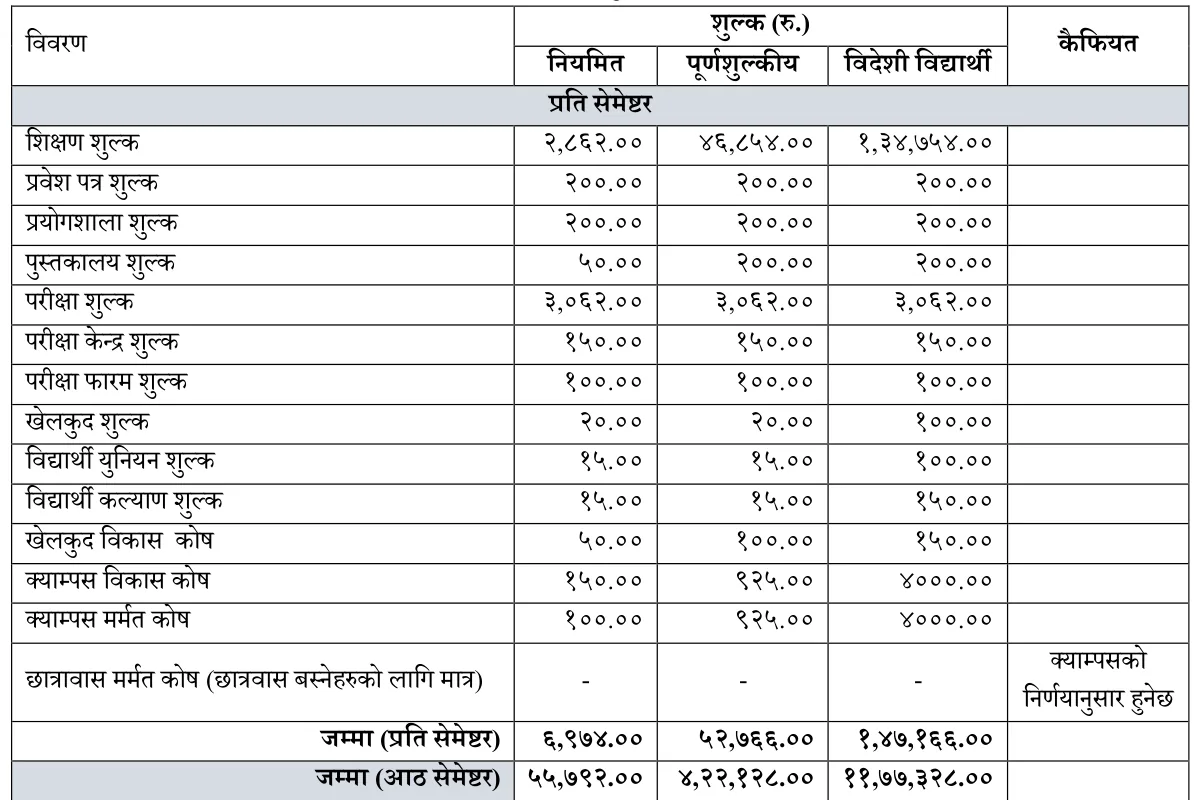
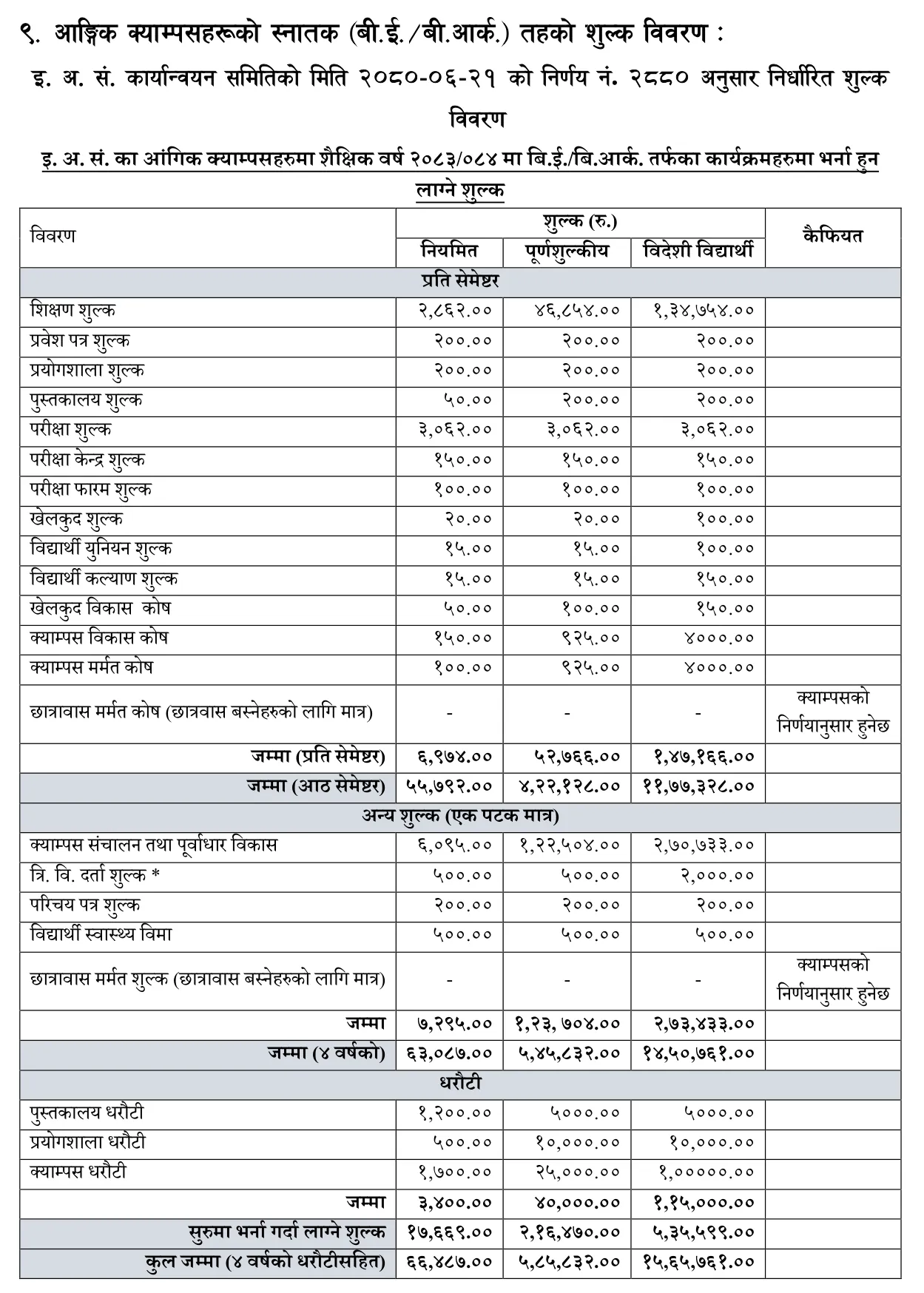
At an IOE constituent campus, about Rs 63,087 for four years on a Regular seat and about Rs 5,45,832 on a Full Fee seat, with Rs 2,16,470 payable on the first day of a Full Fee admission.
Regular seats are heavily subsidised and allocated on merit; Full Fee seats cost roughly nine times as much for the same degree. They are separate seat pools with separate counts.
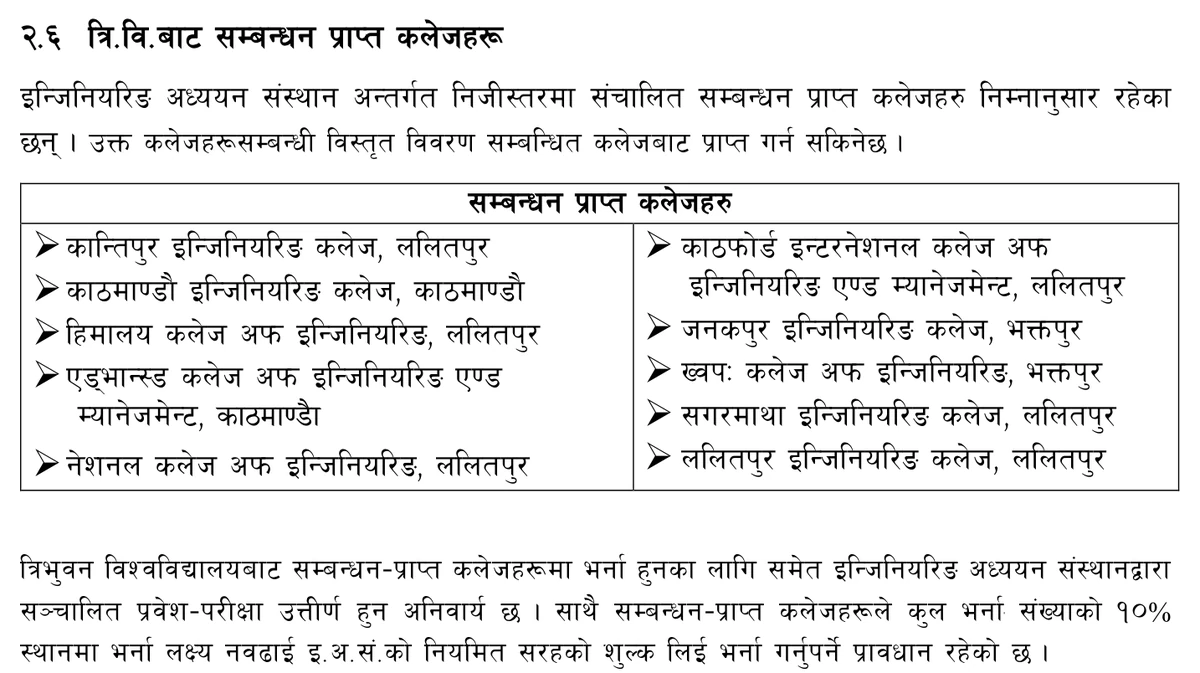
Yes. IOE requires each affiliated college to admit 10% of its total intake at a fee equivalent to IOE’s Regular rate, without raising its admission target.
Three different things are called a scholarship: a subsidised Regular seat, rank-banded pricing at private colleges, and discretionary support assessed case by case.
Before classes start, 10% of the total fee or Rs 15,000 is deducted, whichever is less. Within seven days of classes starting it is 25% or Rs 35,000, whichever is less. After that, nothing is refunded at all.
Five separate provisions at constituent campuses, sized as percentages of each programme’s regular student count: 25% on merit from TU, 20% free tuition, 15% and 10% funded from the full-fee side, and 25% of full-fee students.
Yes. Scholarships are reassessed on each semester’s results, none are given to a student who fails a semester examination, and you cannot hold two at once.
Nepal Engineering Council registration, field study tours, extra subjects and additional practical classes, hostel charges, and TU registration if you are not already registered.
Programmes and seats
Civil, Computer and Electronics: what the four years contain.
BCE is Civil, BCT is Computer, and BEI is Electronics, Communication and Information Engineering. The codes are widely mixed up, including by directory sites.
Yes. A four-year programme must be completed within eight academic years, and a five-year programme within ten. There is no provision for re-examination after that.
If you did not appear in at least one subject of a regular semester exam, you cannot be admitted to a class more than one level above. And if you do not fill the enrolment form for the next part, you are not admitted to it at all.
At least 70%, and you must also pass the Internal Assessment in every subject. Fail the internal assessment and you are barred from that subject’s semester examination.
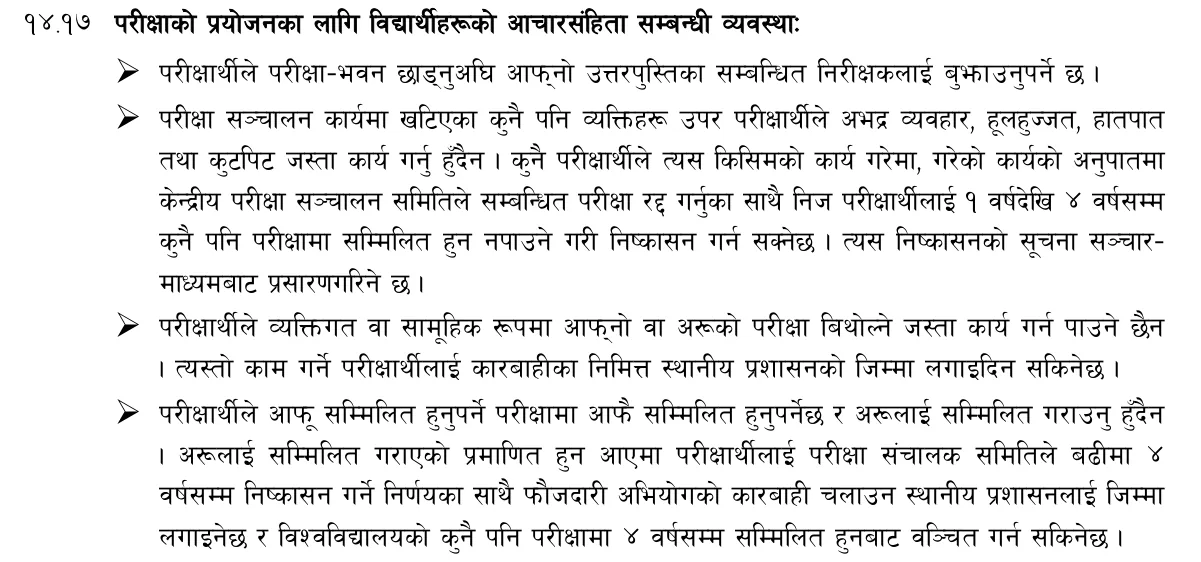
Cancellation of that examination plus expulsion from sitting any examination for one to four years, publicised through the media. Impersonation can also be referred for criminal prosecution.
Students must follow university rules, wear the prescribed uniform, carry their ID card, pay dues on time and clear library books. Penalties run from a warning to expulsion from the university.
Colleges and affiliation
Who is affiliated to what, and what affiliation actually means.
Because Tribhuvan University sets the curriculum, the examinations and the degree, those three are identical everywhere. What differs is cost, commute, teaching, laboratories and whether hostel or transport exists at all.
Tribhuvan University awards the degree and sets the curriculum, examinations and calendar. The college supplies the teaching. That distinction decides which questions are worth asking.
They are the same institution. The college was established in 2058 BS as Janakpur Engineering College and renamed in 2082 BS; IOE’s records still carry the former name.
IOE’s own booklet states that arranging daily transport to and from campus is the student’s own responsibility. Anything a college provides is above that baseline.