
Is there an IOE quota for government employees, and what is a sponsored seat?

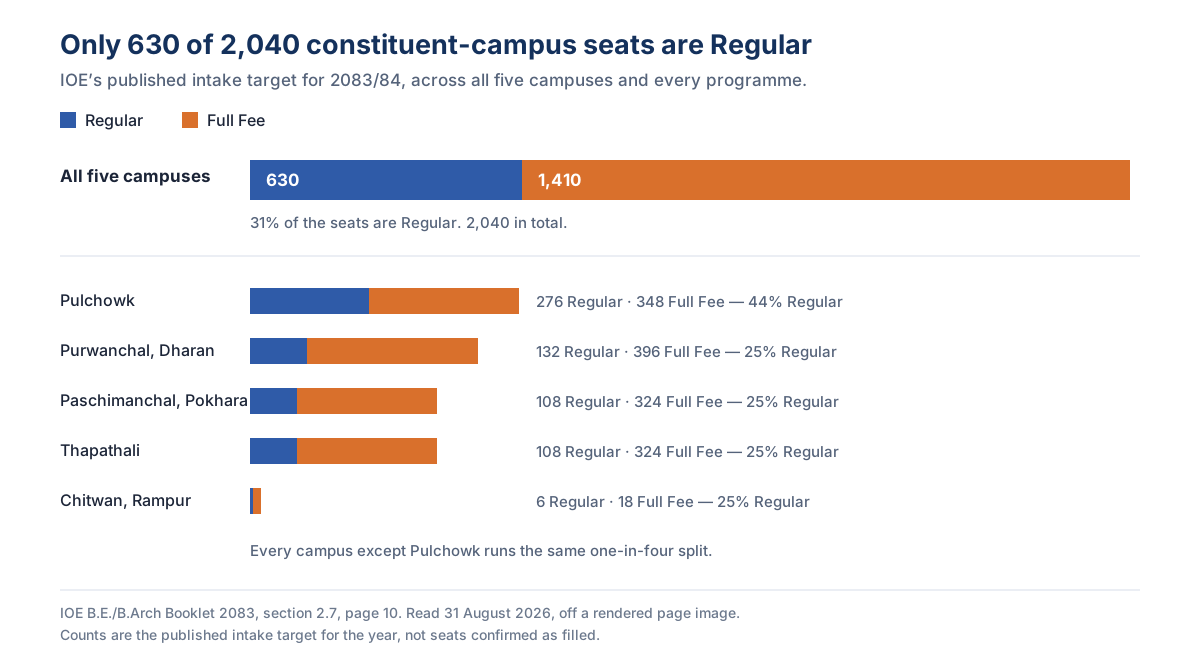
Yes, and it is two separate provisions rather than one. Each reserves a number of seats equal to one twelfth of the full-fee seats at IOE constituent campuses: one for employees a government office sponsors, one for people from listed disadvantaged communities a government body funds. Tuition on the first runs 30% above the ordinary full-fee rate.
IOE reserves two separate blocks of sponsored seats, and each is a number of seats equal to one twelfth of the full-fee seats at its constituent campuses. The first is for employees working in government offices and government-owned institutions whom their own institution wants to sponsor and send to study. The second is for people from the Dalit, caste, Janajati and other communities the Government of Nepal lists as under-represented on ethnic, geographic or economic grounds, who did not come through on the Regular side, and whom a government body wants to sponsor by paying their fees. Both sit on the full-fee side, both require passing the IOE entrance examination, and both are filled by competition among the sponsored applicants themselves. Tuition on the first block runs thirty per cent above the ordinary full-fee rate.
What the two provisions cover
- First provision
- Employees working in government offices and government-owned institutions, sponsored by their own institution. One twelfth of the full-fee seats
- Second provision
- People from the communities the Government of Nepal lists as under-represented by caste, geography or economic position, who were not admitted on the Regular side, sponsored by a government body. A separate one twelfth of the full-fee seats
- Both require
- A pass in the IOE entrance examination, and a sponsoring institution that is district-level or recommended by a district-level institution
- Selection
- Competition among the sponsored applicants for those seats, not against the open list
It is a quota for the employee, not for the employee’s child
The first provision is written for the member of staff themselves, described in the booklet as sponsorship for their own advancement, and the departmental approval it asks for is a letter permitting that person to take a four-year bachelor’s programme, or five years for Architecture. A separate and much smaller provision covers the children of IOE’s own teachers and staff, and it is not this one.
What the sponsoring institution has to provide
- A departmental approval letter allowing the candidate to take the bachelor-level full-fee programme for four years, or five for Architecture.
- The original of the sponsorship letter itself, submitted with the application form.
- For the second provision, the nomination letter with a copy of the sponsoring institution’s decision attached.
- The sponsoring institution must be district-level, or recommended by a district-level institution.
- For the second provision, the same government or community schooling evidence the inclusive quota requires.
Why a sponsored seat costs more, not less
The booklet sets the tuition fee for the sponsored quota under the first provision at thirty per cent above the tuition fee of the individual full-fee programme. Full-fee tuition is Rs 46,854 a semester, so the sponsored rate works out at roughly Rs 60,910, though the booklet prints the percentage rather than the amount. Sponsorship is a route to a seat, not a discount on one.
Payment is only accepted from the sponsor
For a seat under the government and government-owned institution quota, payment is accepted only by cheque from the sponsoring institution. A candidate who pays personally has not paid in the form the provision recognises, which makes the sponsor’s finance timetable part of your admission timetable.
What happens if the quota is not filled?
The seats do not stay empty. Where the block set aside this way is not filled, admission is made in merit order from among those who applied to the ordinary full-fee programme. That also connects to a clause worth knowing: if the full-fee and sponsored quota of a programme is under sixty per cent filled within the first three lists, a constituent campus may suspend that programme for the year.
When are the documents due?
All of them must be submitted before the first-phase admission lists are published, within the date on which applications were called, and the five-day rule that governs every reserved route applies as well. A departmental approval letter and an institutional decision are both slower to obtain than anything a school issues, so this route in particular cannot be started after the result.
Section 6.4 of the BE/B.Arch Booklet 2083, page 17, read off a rendered page image. The thirty per cent tuition premium is in the notes to section 9, page 21, and applies to the first provision only. The Rs 60,910 figure is arithmetic on the booklet’s own Rs 46,854 full-fee tuition line and is not itself printed. The booklet notes that its provisions may be amended by the authority.
Sources
- IOE B.E./B.Arch Booklet 2083published 7 August 2026 · read 18 August 2026
Last reviewed by Ram Raj Thapa, Admissions Officer, Imperial College of Engineering. Every figure on this page is cited to the document it came from.