icenepal.com/ioe-entrance-guide · the official notice trail
A date-safe route from eligibility to enrollment: the official notice trail, the preparation that transfers across years, and what happens between your rank and an ICE merit list.
Find your form number in the official alphabetical pass list to read your rank.
The entrance portal served scorecards to the end of 4 September 2026 and does not serve them now. The pass list stays online, and the rank on it is what admission reads.
Send us the rank with the programme you want, and we will tell you where you stand.
The IOE entrance cycle is annual. Application dates, examination dates, fees, eligibility wording, syllabus details and result instructions all change. Check the official entrance portal and the IOE admission and scholarship page before acting on any date. The booklet overrides any summary on a college website, including this one.
IOE entrance eligibility
ICE guides applicants using the common BE entry route: +2 or equivalent with Physics, Chemistry and Mathematics, or a related engineering diploma, together with the minimum academic result stated by IOE and a valid entrance score. Confirm the exact wording, grade conversion and document rules in the current official booklet.
The paper itself
100 questions, 140 marks, and 10% off for a wrong answer
Most students meet the negative marking for the first time in the exam hall. It is in the official booklet, so here it is in advance, with the marks each subject actually carries.
Mode
Computer-based, answered by mouse
Duration
2 hours
Questions
100 in total: 60 worth 1 mark, 40 worth 2 marks
Full marks
140
Wrong answer
10% of marks deducted
Options
4 per question
IOE B.E./B.Arch Booklet 2083, the examination scheme table on printed page 3.
What the 10% deduction means in practice
Blind guessing costs you. But the penalty is 10% of the marks rather than the whole mark, so a narrowed guess between two plausible options is still worth taking. The candidates who lose most to this rule are the ones who fill every remaining blank in the last two minutes out of habit.
Source: IOE B.E./B.Arch Booklet 2083, page 3, published 7 August 2026. Verify the current year's pattern in that year's booklet before relying on it.
Official syllabus
Where the 140 marks actually sit
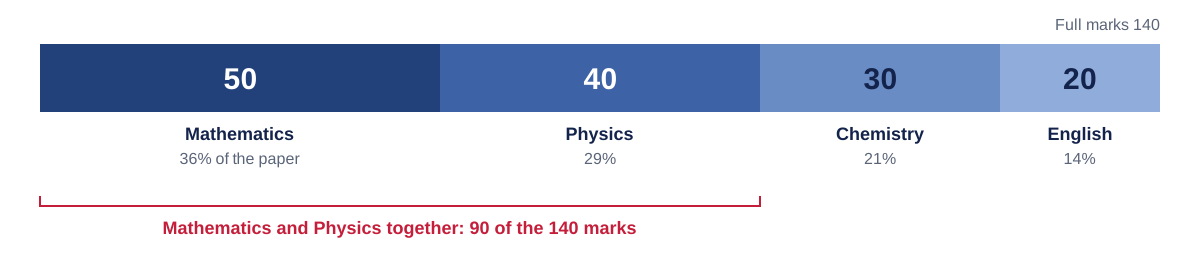
Mathematics and Physics together are 90 of the 140. That is where revision time earns the most, and it is the single most useful thing to know before building a study plan.
Mathematics · 50 marks
Set, logic and functions · Algebra · Trigonometry · Coordinate geometry · Calculus · Vectors and their products · Statistics and probability
Physics · 40 marks
Mechanics · Heat and thermodynamics · Geometric and physical optics · Waves and sound · Electricity and magnetism · Modern physics
Grammar I and II · Phonetics, including syllable stress and vowel sounds · Comprehension, with General and Technical English
The 140 marks, drawn to scale. Mathematics and Physics together are 90 of them.
English is the one people skip
At 20 marks it is the smallest block, and the phonetics topics — which syllable carries the stress, which pairs share an initial vowel sound — are learnable in an afternoon and appear in the booklet's own model questions. Comprehension explicitly covers Technical English, not only general passages.
The booklet includes model questions
Their headers confirm the structure better than any description: Section A is 1 mark × 60, Section B is 2 marks × 40. Both sections mix all four subjects rather than blocking them, so practise switching subject question by question. Work them under the real constraint, which is 100 questions in 120 minutes.
Source: Detail Syllabus of B.E./B.Arch. Entrance Examination-2083, in the same booklet. Topic lists above are summarised; the booklet carries the full sub-topic detail.
Exam day
The document without which you will not be allowed to sit
Bring your admit card and the original of the identification document you uploaded with your online application. The booklet is explicit that candidates without it are not admitted to the examination. Any one of these is accepted:
The entrance runs in assigned shifts across four days, and your date, time and centre are given to you rather than chosen. In 2083 the first two days ran at the Information and Communication Technology Centre at Pulchowk, Lalitpur, and the next two at Paschimanchal Campus Pokhara, Purwanchal Campus Dharan and Thapathali Campus, with two shifts on the first and third days and four on the second and fourth, the earliest starting at 07:00.
Plan travel around the shift you are given, including for an early start, and if you are travelling to Pokhara or Dharan treat the day before as part of the exam. Each year's centres and shift pattern are published on the entrance portal.
Source: IOE B.E./B.Arch Booklet 2083, page 3, published 7 August 2026.
The whole journey
From the exam form to your seat
Read the current booklet
Eligibility, syllabus, application documents, fees and deadlines are all in it, and they change year to year.
Submit the online application
On the official IOE entrance portal, inside the published window.
Prepare from the official syllabus
Build a timed plan around the subjects and question format in that year’s booklet, not from someone’s notes.
Sit the entrance examination
It is computer-based. Follow the admit-card, identification and examination-centre instructions.
Read your score and rank
Save the result document, then ask colleges what it realistically gets you.
Apply to ICE
Follow the published college merit lists, complete document verification, and pay by the stated deadline.
Study smart
Five habits that actually move your score
Take one diagnostic test first, then fix the topics losing you the most marks.
Study from the official syllabus, so coaching notes cannot quietly shrink your scope.
Practise timed question sets, and review why each wrong answer was wrong.
Keep an error notebook for formulas, recurring misconceptions and rushed mistakes.
Reserve the last stretch for mixed mocks, steady sleep and document readiness.
Find your form number in the alphabetical pass list to read your rank, save your scorecard, then send the rank to us with your preferred programme. Civil Engineering has 96 seats; Computer Engineering and Electronics, Communication & Information Engineering have 48 seats each. Cutoffs vary by year, so last year's merit list is context, not a guarantee.
Next in the official sequence: the Centralized Admission Monitoring Committee has published the admission schedule for constituent and affiliated colleges, and it runs to a fixed clock. Priority amendment closed at 3:00 pm on 22 August, the first list came out on 23 August, the second on 30 August and the revised third on 6 September. Admission from the second list ran to 3:00 pm on 2 September and from the third to 3:00 pm on 8 September, the last hour on the central schedule. Fourth and later lists follow each campus's own published timetable, and vacant seats can be filled up to 2 December 2026. Read those dates on the ICE notice board rather than acting on forwarded messages.
Yes. A valid IOE entrance score is required, and seats are given strictly on merit.
Is the IOE entrance result 2083 published?
Yes. IOE published the B.E./B.Arch entrance result 2083 on 4 August 2026 (19 Shrawan 2083). The pass list is alphabetical with form number, district and rank. Open the official notice to read your rank. The portal served scorecards to the end of 4 September 2026 and does not serve them now, but the pass list stays online and the rank on it is what every merit list is filled by.
What happens after the result?
The Centralized Admission Monitoring Committee published the admission schedule on 12 August 2026. Applications for the first three lists ran 14 to 18 August and priority amendment closed at 3:00 pm on 22 August. The first merit list came out on 23 August, the second on 30 August and the revised third on 6 September, and admission from the third ran to 3:00 pm on 8 September. Fourth and later lists follow each campus's own published timetable, and vacant seats can be filled up to 2 December 2026. Send your rank now for programme guidance; formal enrollment completes inside the admission window of the list that names you.
How many questions are in the IOE entrance, and is there negative marking?
The paper is computer-based, runs 2 hours, and has 100 questions: 60 worth 1 mark and 40 worth 2 marks, for 140 marks in total. There are 4 options per question and 10% of the marks is deducted for a wrong answer. Source: IOE B.E./B.Arch Booklet 2083, page 3.
How are the 140 marks split between subjects?
Mathematics 50, Physics 40, Chemistry 30 and English 20. Mathematics and Physics together are 90 of the 140, which is worth knowing when you plan revision. The full topic list for each subject is in the official syllabus section above.
What must I bring to the examination centre?
Your admit card and the original of the identification document you uploaded with your application: citizenship certificate, passport, driving licence, or your I.Sc / 10+2 / Engineering Diploma final-year admit card. The booklet states that candidates without it are not permitted to sit.
Which programme is easiest to get with my rank?
Cutoffs change each year. Civil has more seats than the other ICE programmes, but the useful answer depends on that year's applicants and merit lists. Send your rank for current guidance.
Last reviewed by Imperial College of Engineering. Every figure on this page is cited to the document it came from.
What is the IOE entrance Mathematics syllabus?Seven areas worth 50 marks: sets and functions, algebra, trigonometry, coordinate geometry, calculus, vectors, and statistics and probability.
What is the IOE entrance Physics syllabus?Six areas worth 40 marks: mechanics, heat and thermodynamics, optics, waves and sound, electricity and magnetism, and modern physics.
Is there an aptitude test for B.Arch admission at IOE?Yes. A campus or college may conduct a subject-related Aptitude Test for applicants whose names are published for Architecture admission. In the 2083 cycle it ran inside the priority-amendment window, from 19 August 2026 at 10:00 to 22 August at 15:00, and that window has closed.