
What is the IOE entrance Physics syllabus?
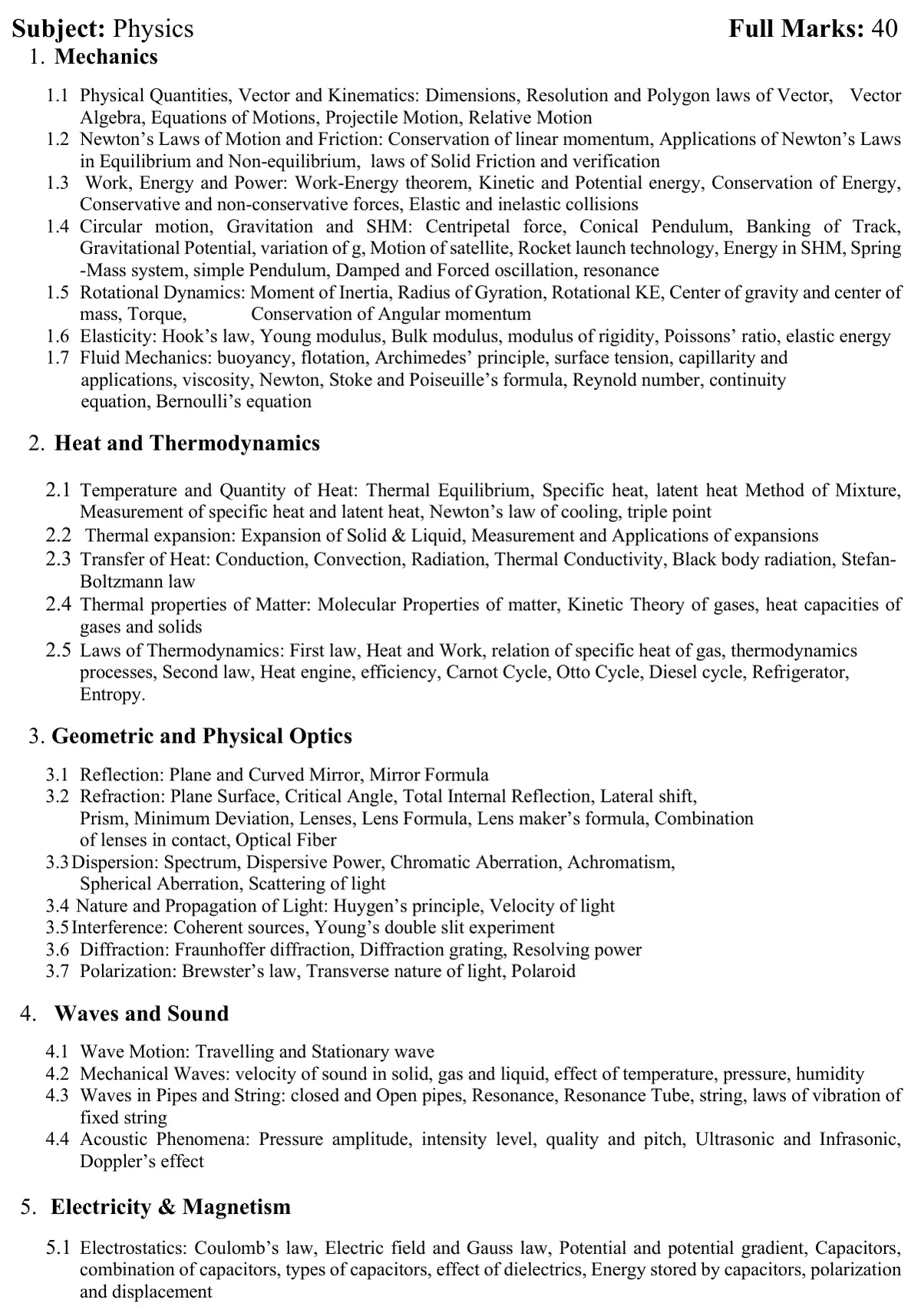
Six areas worth 40 marks: mechanics, heat and thermodynamics, optics, waves and sound, electricity and magnetism, and modern physics.
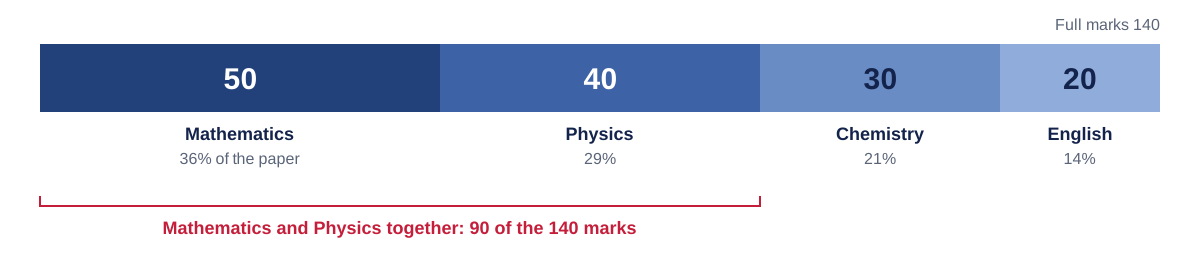
Physics carries 40 of the 140 marks on the IOE entrance paper, 29% of the total and second only to Mathematics. The official syllabus, printed in IOE’s own booklet as the Detail Syllabus of B.E./B.Arch. Entrance Examination-2083, divides it into six areas holding 35 numbered sub-topics: Mechanics with seven, Heat and Thermodynamics with five, Geometric and Physical Optics with seven, Waves and Sound with four, Electricity and Magnetism with seven, and Modern Physics with five. Modern Physics is the one to read twice. Its last sub-topic, Recent Trends in Physics, opens into six further named topics that no +2 course treats as examinable, and it is the part of this syllabus most often left out of coaching notes. Mechanics, Optics and Electricity and Magnetism are the three widest areas at seven sub-topics each. Everything below is the booklet’s own list, in its own order and wording.
1. Mechanics
- 1.1 Physical quantities, vector and kinematics: dimensions, resolution and polygon laws of vector, vector algebra, equations of motion, projectile motion, relative motion.
- 1.2 Newton’s laws of motion and friction: conservation of linear momentum, applications of Newton’s laws in equilibrium and non-equilibrium, laws of solid friction and verification.
- 1.3 Work, energy and power: work-energy theorem, kinetic and potential energy, conservation of energy, conservative and non-conservative forces, elastic and inelastic collisions.
- 1.4 Circular motion, gravitation and SHM: centripetal force, conical pendulum, banking of track, gravitational potential, variation of g, motion of satellite, rocket launch technology, energy in SHM, spring-mass system, simple pendulum, damped and forced oscillation, resonance.
- 1.5 Rotational dynamics: moment of inertia, radius of gyration, rotational KE, centre of gravity and centre of mass, torque, conservation of angular momentum.
- 1.6 Elasticity: Hook’s law, Young modulus, bulk modulus, modulus of rigidity, Poissons’ ratio, elastic energy.
- 1.7 Fluid mechanics: buoyancy, flotation, Archimedes’ principle, surface tension, capillarity and applications, viscosity, Newton, Stoke and Poiseuille’s formula, Reynold number, continuity equation, Bernoulli’s equation.
2. Heat and Thermodynamics
- 2.1 Temperature and quantity of heat: thermal equilibrium, specific heat, latent heat, method of mixture, measurement of specific heat and latent heat, Newton’s law of cooling, triple point.
- 2.2 Thermal expansion: expansion of solid and liquid, measurement and applications of expansions.
- 2.3 Transfer of heat: conduction, convection, radiation, thermal conductivity, black body radiation, Stefan-Boltzmann law.
- 2.4 Thermal properties of matter: molecular properties of matter, kinetic theory of gases, heat capacities of gases and solids.
- 2.5 Laws of thermodynamics: first law, heat and work, relation of specific heat of gas, thermodynamic processes, second law, heat engine, efficiency, Carnot cycle, Otto cycle, Diesel cycle, refrigerator, entropy.
3. Geometric and Physical Optics
- 3.1 Reflection: plane and curved mirror, mirror formula.
- 3.2 Refraction: plane surface, critical angle, total internal reflection, lateral shift, prism, minimum deviation, lenses, lens formula, lens maker’s formula, combination of lenses in contact, optical fibre.
- 3.3 Dispersion: spectrum, dispersive power, chromatic aberration, achromatism, spherical aberration, scattering of light.
- 3.4 Nature and propagation of light: Huygen’s principle, velocity of light.
- 3.5 Interference: coherent sources, Young’s double slit experiment.
- 3.6 Diffraction: Fraunhoffer diffraction, diffraction grating, resolving power.
- 3.7 Polarization: Brewster’s law, transverse nature of light, polaroid.
4. Waves and Sound
- 4.1 Wave motion: travelling and stationary wave.
- 4.2 Mechanical waves: velocity of sound in solid, gas and liquid, effect of temperature, pressure, humidity.
- 4.3 Waves in pipes and string: closed and open pipes, resonance, resonance tube, string, laws of vibration of fixed string.
- 4.4 Acoustic phenomena: pressure amplitude, intensity level, quality and pitch, ultrasonic and infrasonic, Doppler’s effect.
5. Electricity and Magnetism
- 5.1 Electrostatics: Coulomb’s law, electric field and Gauss law, potential and potential gradient, capacitors, combination of capacitors, types of capacitors, effect of dielectrics, energy stored by capacitors, polarization and displacement.
- 5.2 DC circuits: Ohm’s law, resistivity and conductivity, work and power, galvanometer and ohm meter, internal resistance, Joule’s law, Kirchhoff’s law and applications.
- 5.3 Thermoelectric effect: Seebeck effect, thermocouples, Peltier effect, thermopile, Thomson effect.
- 5.4 Magnetic effect: force on a conductor and charge, torque, Hall’s effect, Biot-Savart’s law, Ampere’s law, force between parallel conductors.
- 5.5 Magnetic properties of matter: earth magnetism, magnetic materials, permeability, susceptibility, hysteresis.
- 5.6 Electromagnetic induction: Faraday’s law, induced emf, AC generators, self and mutual induction, energy stored by inductor, transformer.
- 5.7 Alternating currents: RMS value, phasor diagram of capacitance, inductance and resistance, quality factor, power factor.
6. Modern Physics
- 6.1 Electrons: Millikan’s experiment, cathode rays, specific charge.
- 6.2 Photons and quantization of energy: photoelectric effect, Plank’s constant, Bohr’s theory, spectral series, De Broglie theory, uncertainty principle, X-ray and Bragg’s law, laser.
- 6.3 Solids and semiconductor devices: intrinsic and extrinsic semiconductors, P-N junction, rectification, Zener diode, transistor, logic gates.
- 6.4 Radioactivity and nuclear reaction: atomic mass, isotopes, nuclear density, Einstein’s mass energy relation, mass defect, fission and fusion, law of radioactive disintegration, carbon dating, health hazard.
- 6.5 Recent trends in physics, itself listed in six parts: 6.5.1 particle physics (particle and anti-particle, quarks, lepton, baryon, mesons, Higgs boson); 6.5.2 universe (Big Bang and Hubble’s law, dark matter, gravitational wave, black hole); 6.5.3 seismology (pressure wave, surface wave, internal wave); 6.5.4 telecommunication (radio, TV and mobile, GPS and remote sensing); 6.5.5 environment (energy crisis, environment pollution, ozone layer); 6.5.6 new technology and materials (nano-technology, super conductor and perfect conductor).
Which sub-topics are people surprised to find listed?
Several items sit outside what a +2 course emphasises, and the booklet names them explicitly rather than implying them. Fluid mechanics carries Reynold number, Stoke’s and Poiseuille’s formulae and Bernoulli’s equation. Electricity and magnetism gives the thermoelectric effect a sub-topic of its own covering Seebeck, Peltier, Thomson and the thermopile, alongside Hall’s effect, Biot-Savart’s law and hysteresis. Modern physics carries Millikan’s experiment, Bragg’s law, the uncertainty principle, logic gates and carbon dating.
None of that is obscure, but it is the part of the syllabus most likely to be skimmed on the assumption that the paper follows the school course. It does not. The syllabus is set for this examination, and Recent Trends in Physics alone runs to six named topics that a school textbook would treat as general reading.
What do the Physics model questions look like?
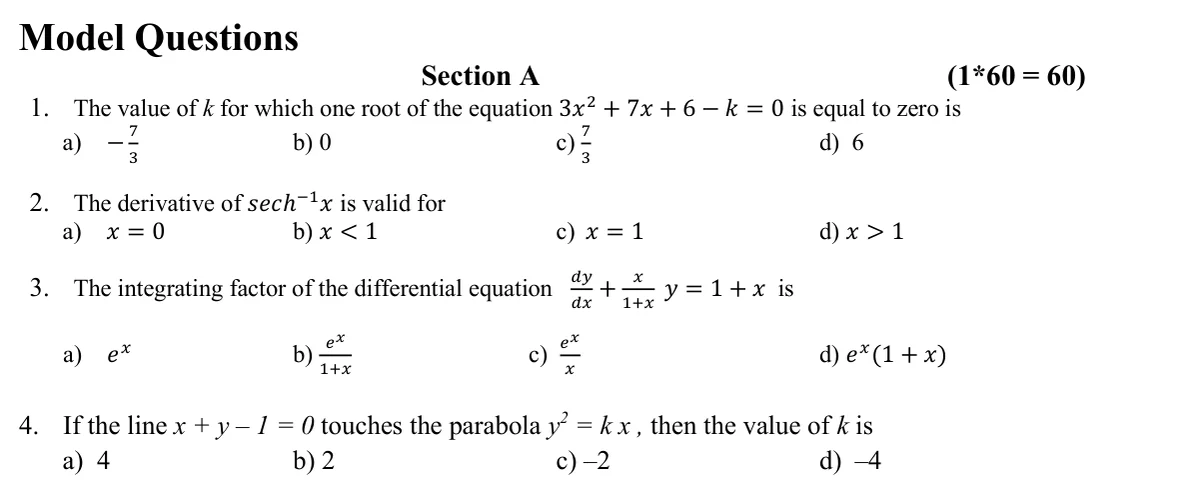
Four of the booklet’s sample questions are Physics. In Section A, at 1 mark: why two ice blocks join when pressed together, and how many different combinations three equal resistors allow. Both are single-step and both come straight off the syllabus, from Heat and Thermodynamics and from DC circuits respectively.
The Section B pair, reproduced as printed: “To what depth, below the surface of a sea should a rubber ball be taken so that its volume decreases by 1%? Bulk modulus of the rubber is 9 x 10⁸ Nm⁻².” And: “The ratio of the areas within the electron orbits for the first excited state to the ground state for the hydrogen atom is — (a) 16:1, (b) 8:1, (c) 4:1, (d) 2:1.” The first needs the bulk-modulus relation rearranged before pressure converts to depth; the second needs the n² dependence of orbit radius squared into an area ratio. That is the Section B pattern across every subject: a standard relation, then one transformation.
Reproduced from the Detail Syllabus of B.E./B.Arch. Entrance Examination-2083, Physics, Full Marks 40, printed pages 27 and 28 of the booklet, and checked against rendered images of both pages. Spellings such as “Hook’s law”, “Millikan’s”, “Poissons’ ratio” and “Fraunhoffer” follow the booklet. Model questions transcribed from the booklet’s Model Questions section, printed pages 29 to 31, which is set in Latin type and extracts reliably. Where this page and the booklet differ, the booklet governs.
Sources
- IOE B.E./B.Arch Booklet 2083published 7 August 2026 · read 18 August 2026
Last reviewed by Ram Raj Thapa, Admissions Officer, Imperial College of Engineering. Every figure on this page is cited to the document it came from.