
What is the IOE entrance Mathematics syllabus?
Seven areas worth 50 marks: sets and functions, algebra, trigonometry, coordinate geometry, calculus, vectors, and statistics and probability.
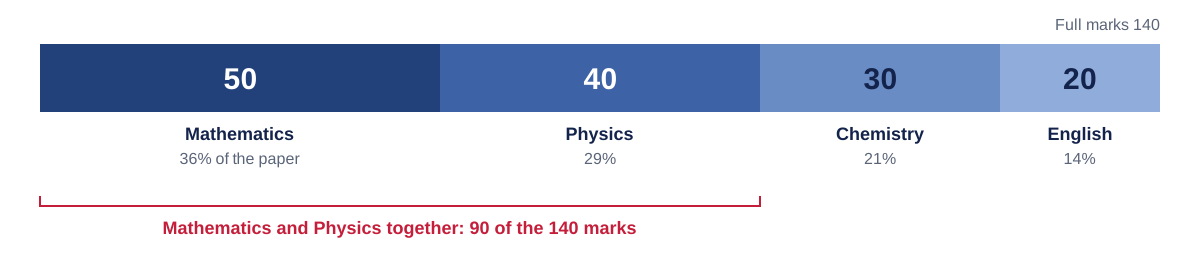
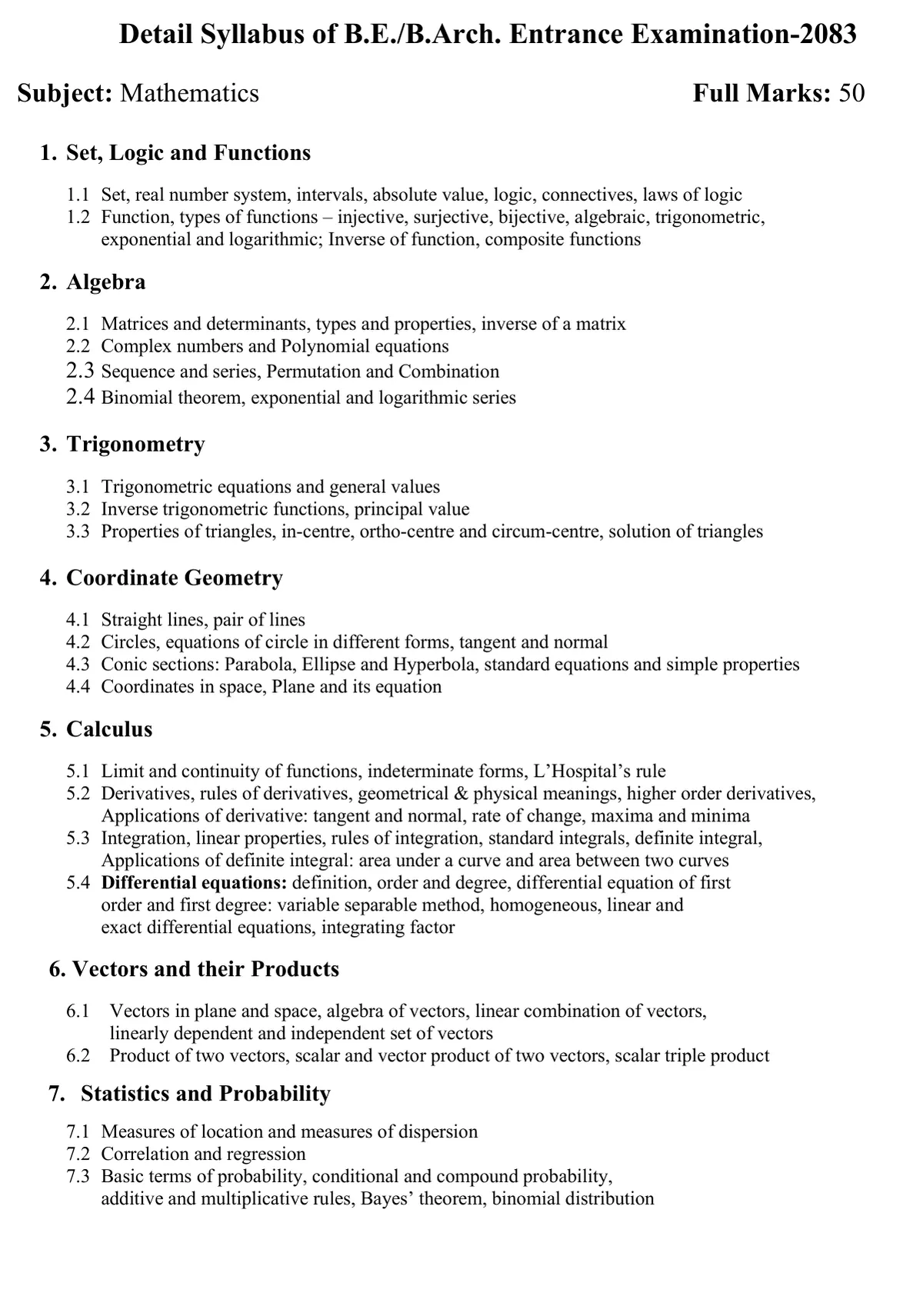
Mathematics carries 50 of the 140 marks on the IOE entrance paper. That is 36% of the total and more than any other subject. The official syllabus, printed in IOE’s own booklet as the Detail Syllabus of B.E./B.Arch. Entrance Examination-2083, divides it into seven areas holding 22 numbered sub-topics between them: Set, Logic and Functions with two, Algebra with four, Trigonometry with three, Coordinate Geometry with four, Calculus with four, Vectors and their Products with two, and Statistics and Probability with three. The document assigns no marks to any individual area, so that sub-topic count is the only weighting the source itself supplies, and it puts Algebra, Coordinate Geometry and Calculus jointly widest. The whole subject is printed on a single page of the booklet. Everything below is that page’s own list, area by area and in its own order, reproduced rather than summarised.
1. Set, Logic and Functions
- 1.1 Set, real number system, intervals, absolute value, logic, connectives, laws of logic.
- 1.2 Function, types of functions: injective, surjective, bijective, algebraic, trigonometric, exponential and logarithmic. Inverse of function, composite functions.
2. Algebra
- 2.1 Matrices and determinants, types and properties, inverse of a matrix.
- 2.2 Complex numbers and polynomial equations.
- 2.3 Sequence and series, permutation and combination.
- 2.4 Binomial theorem, exponential and logarithmic series.
3. Trigonometry
- 3.1 Trigonometric equations and general values.
- 3.2 Inverse trigonometric functions, principal value.
- 3.3 Properties of triangles, in-centre, ortho-centre and circum-centre, solution of triangles.
4. Coordinate Geometry
- 4.1 Straight lines, pair of lines.
- 4.2 Circles, equations of circle in different forms, tangent and normal.
- 4.3 Conic sections: parabola, ellipse and hyperbola, standard equations and simple properties.
- 4.4 Coordinates in space, plane and its equation.
5. Calculus
- 5.1 Limit and continuity of functions, indeterminate forms, L’Hospital’s rule.
- 5.2 Derivatives, rules of derivatives, geometrical and physical meanings, higher order derivatives. Applications of derivative: tangent and normal, rate of change, maxima and minima.
- 5.3 Integration, linear properties, rules of integration, standard integrals, definite integral. Applications of definite integral: area under a curve and area between two curves.
- 5.4 Differential equations: definition, order and degree. Differential equation of first order and first degree: variable separable method, homogeneous, linear and exact differential equations, integrating factor.
6. Vectors and their Products
- 6.1 Vectors in plane and space, algebra of vectors, linear combination of vectors, linearly dependent and independent set of vectors.
- 6.2 Product of two vectors, scalar and vector product of two vectors, scalar triple product.
7. Statistics and Probability
- 7.1 Measures of location and measures of dispersion.
- 7.2 Correlation and regression.
- 7.3 Basic terms of probability, conditional and compound probability, additive and multiplicative rules, Bayes’ theorem, binomial distribution.
Which of those areas does the paper actually ask about?
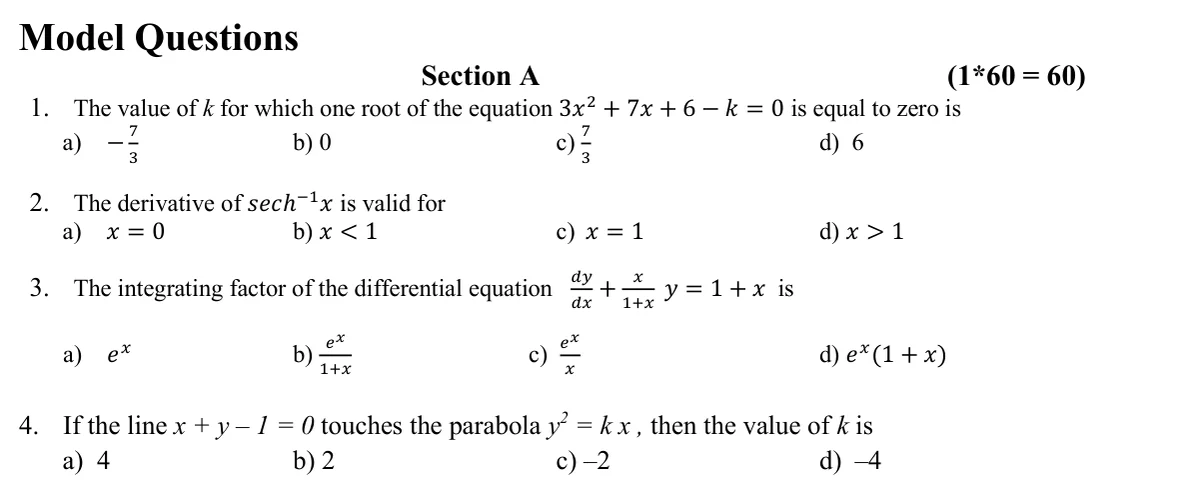
The booklet prints its own model questions, and they are the most useful thing in it for planning revision, because they show the difference between the two sections rather than describing it. Section A carries 60 questions at 1 mark each; Section B carries 40 at 2 marks. The Section A samples are single-step, taking one identity, one standard result or one substitution. The Section B samples take two or three steps before they reach an option.
Six of the sample questions are Mathematics, and they land unevenly across the syllabus. In Section A: a polynomial-equation question (area 2), two calculus questions (area 5), and a conic-sections question (area 4). In Section B, at two marks each: a probability question (area 7) and a vector projection (area 6). Trigonometry and Set, Logic and Functions supply no sample question at all, which is a fact about a small sample rather than a prediction about the paper.
Two of the booklet’s own Mathematics samples, reproduced as printed. From Section A: “If the line x + y – 1 = 0 touches the parabola y² = kx, then the value of k is — (a) 4, (b) 2, (c) –2, (d) –4.” From Section B: “If a lottery ticket is drawn at random from a lottery box containing 10 prizes and 25 blanks, what is the probability of getting a prize?” The first is a tangency condition you either know or derive in one line; the second is a probability question that needs the total counted before the ratio is formed.
One sample question reaches outside the printed syllabus
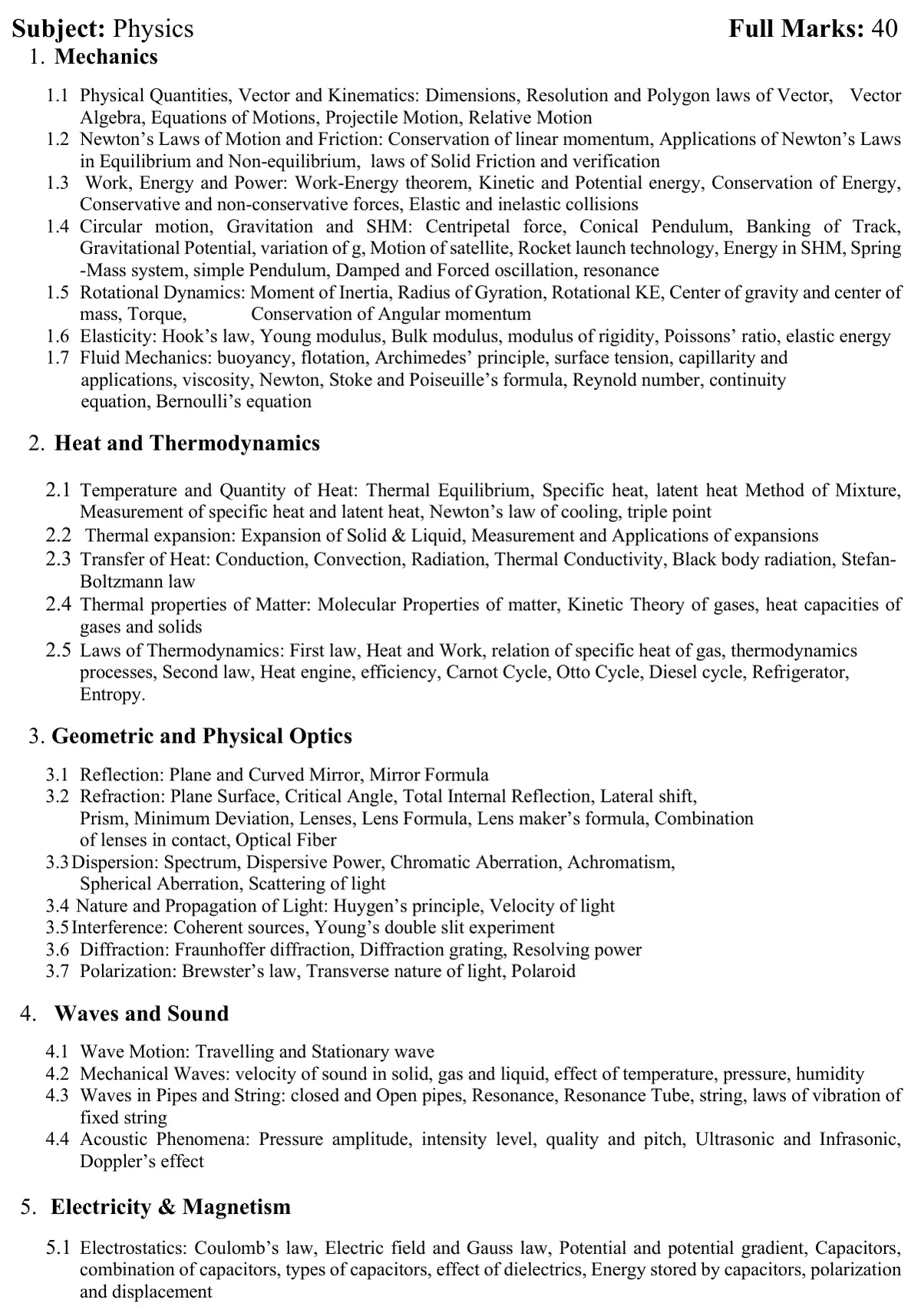
Sub-topic 1.2 names the types of function on syllabus: injective, surjective, bijective, algebraic, trigonometric, exponential and logarithmic. Hyperbolic functions are not among them, and they appear nowhere else in the seven areas. The booklet’s second sample question nonetheless asks for the domain on which the derivative of sech⁻¹x is valid. Read the syllabus as the scope and the model questions as evidence of how it is interpreted, because on this one point they do not agree.
What the negative marking means for a Mathematics guess
At 1 mark, a wrong Section A answer costs 0.1 of a mark; at 2 marks, a wrong Section B answer costs 0.2. The penalty scales with the reward, so there is no section where guessing is systematically safer than another. What changes between the sections is the time cost of a wrong guess rather than the mark cost, and Section B is where a wrong guess also costs you the two or three minutes you spent reaching it.
Reproduced from the Detail Syllabus of B.E./B.Arch. Entrance Examination-2083, Mathematics, Full Marks 50, printed page 26 of the booklet, and checked against a rendered image of that page. The model questions are transcribed from the booklet’s own Model Questions section, printed pages 29 to 31; the section headers there read “Section A (1*60 = 60)” and “Section B (2*40 = 80)”, which independently confirms the 140-mark structure. These pages are set in Latin type rather than the legacy Nepali fonts used elsewhere in the booklet, so they extract reliably. Where this page and the booklet differ, the booklet governs.
Sources
- IOE B.E./B.Arch Booklet 2083published 7 August 2026 · read 18 August 2026
Last reviewed by Ram Raj Thapa, Admissions Officer, Imperial College of Engineering. Every figure on this page is cited to the document it came from.