
Does IOE publish model questions for the entrance exam?
Yes. The official booklet contains model questions, and their section headers confirm the paper structure: Section A is 1 mark × 60, Section B is 2 marks × 40.
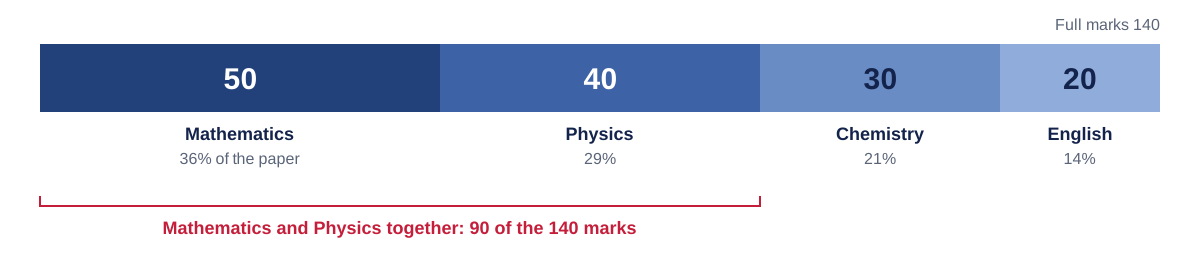
IOE publishes model questions, and it does not publish past papers. The official B.E./B.Arch booklet carries a Model Questions section at the end of the syllabus, and its two section headers are the clearest statement of the paper’s structure that exists anywhere: Section A is printed as (1*60 = 60) and Section B as (2*40 = 80), which is 60 one-mark questions and 40 two-mark questions for 140 marks. The published set runs 19 numbered items, 11 in Section A and 8 in Section B, and it covers all four subjects. The Entrance Examination Board’s own portal carries the booklet, the syllabus, notices and a score card, and no archive of previous years’ papers, so a file circulating as an IOE past paper is a reconstruction by whoever posted it. These 19 are the only questions IOE has set its name to.
| Section A | Section B | |
|---|---|---|
| Questions | 60 | 40 |
| Marks each | 1 | 2 |
| Section total | 60 | 80 |
| Items in the model set | 11 | 8 |
Scroll the table sideways for Section B.
How are the model questions ordered?
By subject, within each section. Section B is the clearest case: its eight items run two Mathematics, then two Physics, then two Chemistry, then two English, in that order. Section A opens with four Mathematics items and closes with three English ones, with the physical-science items between them.
The booklet does not say whether the 100 questions of the real paper follow the same grouping, so treat the ordering as a property of the sample rather than a promise about the day. What it does tell you is that all four subjects sit in both sections, at both mark weights.
What do the questions actually look like?
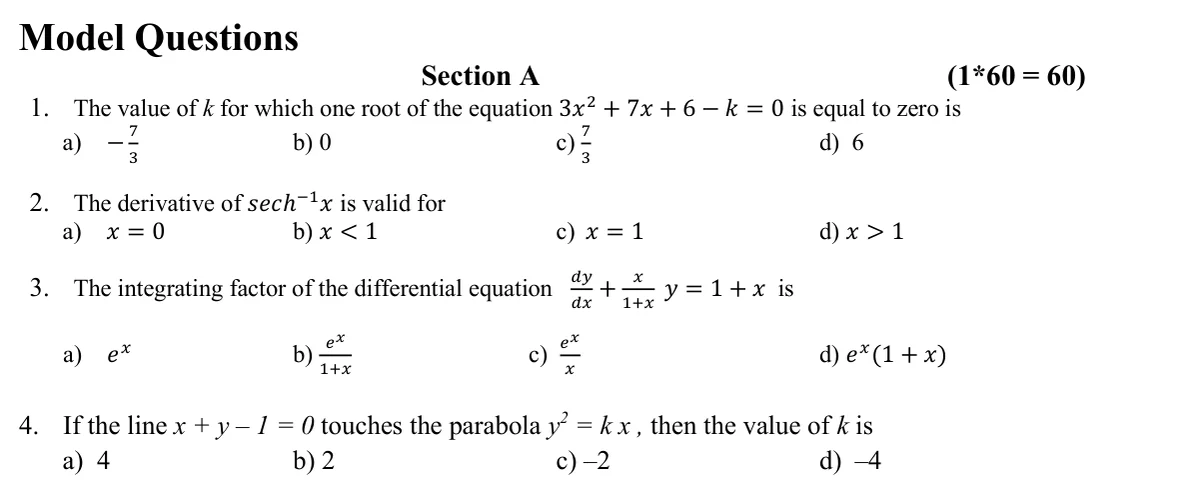
Section A items are single-step. The samples include finding the value of k for which one root of a quadratic equals zero, the validity domain of the derivative of an inverse hyperbolic function, the integrating factor of a first-order differential equation, and the value of k for which a given line touches a parabola.
Section B items at two marks take two or three steps before they reach an option: a probability from a stated lottery composition of 10 prizes and 25 blanks, the projection of one vector on another, the sea depth at which a rubber ball loses 1% of its volume given a bulk modulus, and a stoichiometry item asking for a molecule count from 21 grams of magnesium carbonate and 50 ml of 12N hydrochloric acid.
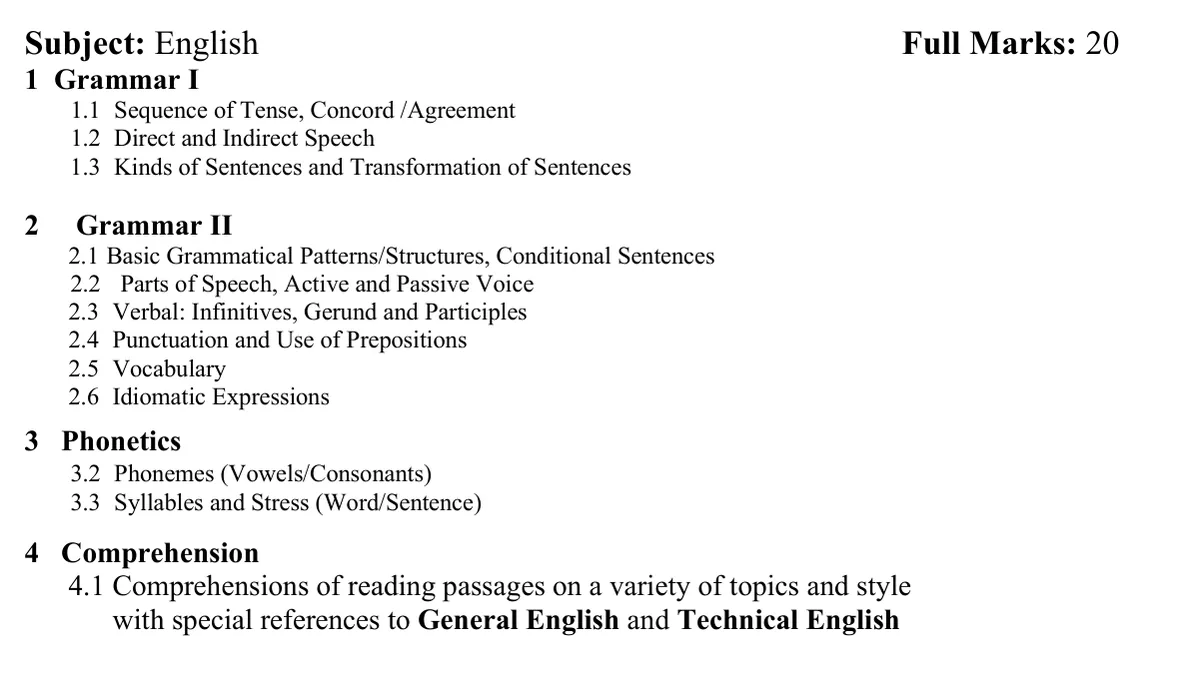
English appears at both weights. Section A carries a preposition item, a word-stress item and an initial-vowel-sound item; Section B carries a tense item and a full comprehension passage with a question under it.
How should you use them?
One hundred questions in 120 minutes is about 72 seconds each, including the two-mark items, so practise the samples against a clock rather than untimed. The more useful drill is deciding fast whether to answer at all, because 10% of a question’s marks comes off a wrong answer and a click cannot be taken back once it is made.
Model questions transcribed from the booklet’s own Model Questions section, printed pages 29 to 31, which is set in Latin type and extracts reliably. Item counts are of the numbered items as printed. The portal’s notice list was read on 31 August 2026 and carried ten notices, none of them a past paper; a future year may change that.
Sources
- IOE B.E./B.Arch Booklet 2083published 7 August 2026 · read 18 August 2026
- IOE Entrance Examination Board portalread 18 August 2026
Last reviewed by Ram Raj Thapa, Admissions Officer, Imperial College of Engineering. Every figure on this page is cited to the document it came from.