
What is the IOE entrance English syllabus?
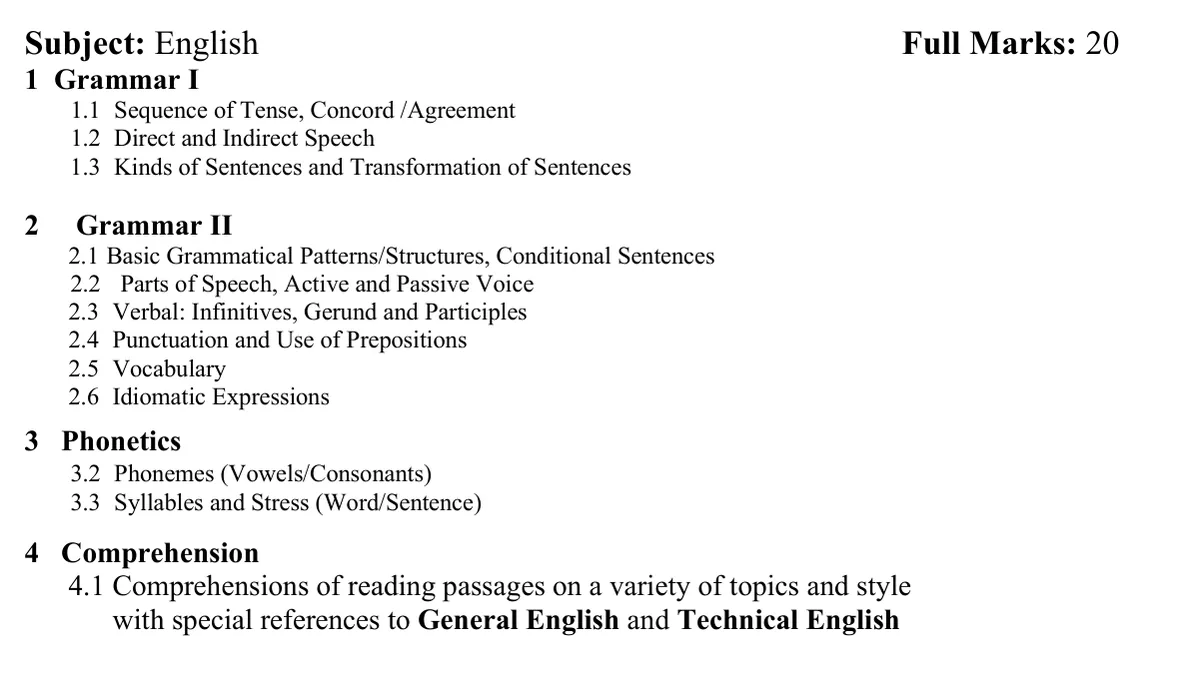
Four areas worth 20 marks: grammar in two parts, phonetics, and comprehension covering both General and Technical English.
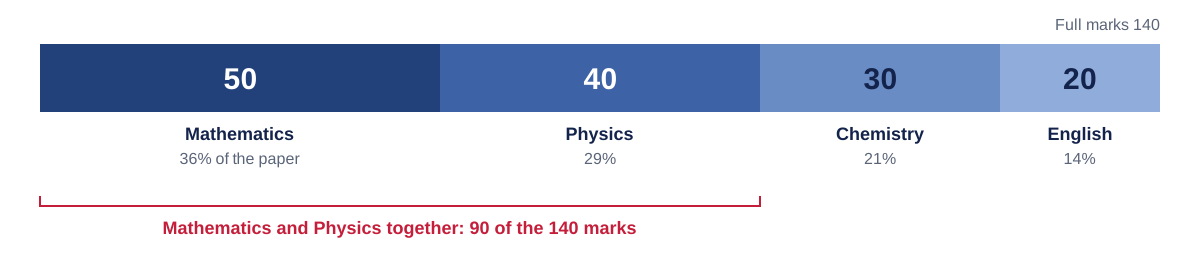
English carries 20 of the 140 marks on the IOE entrance paper, 14% of the total and the smallest block of the four. The official syllabus, printed in IOE’s own booklet as the Detail Syllabus of B.E./B.Arch. Entrance Examination-2083, fits it into four areas and 12 numbered sub-topics: Grammar I with three, Grammar II with six, Phonetics with two, and Comprehension with one. That whole list occupies less than half a printed page, which makes English the only subject on this paper whose scope a candidate can hold in their head. It is also the one most candidates ignore entirely. Phonetics is the reason not to: it is two sub-topics, it is closed and learnable, and it supplies two of the five English questions the booklet prints as samples, in forms a +2 course rarely practises.
1. Grammar I
- 1.1 Sequence of tense, concord and agreement.
- 1.2 Direct and indirect speech.
- 1.3 Kinds of sentences and transformation of sentences.
2. Grammar II
- 2.1 Basic grammatical patterns and structures, conditional sentences.
- 2.2 Parts of speech, active and passive voice.
- 2.3 Verbal: infinitives, gerund and participles.
- 2.4 Punctuation and use of prepositions.
- 2.5 Vocabulary.
- 2.6 Idiomatic expressions.
3. Phonetics
- 3.2 Phonemes (vowels and consonants).
- 3.3 Syllables and stress, at word and sentence level.
The numbering is the booklet’s. Area 3 opens straight at 3.2, with no 3.1 printed anywhere, so Phonetics is two sub-topics rather than three despite what the numbers suggest.
4. Comprehension
- 4.1 Comprehension of reading passages on a variety of topics and style, with special reference to General English and Technical English.
Technical English is named in the syllabus itself, so reading practice on technical prose is on syllabus rather than optional. The booklet’s own comprehension sample is a general passage about how English names animals, which suggests the "variety of topics" half of that sentence is meant literally.
Which of the 20 marks are the easiest to win?
Phonetics, by a distance. It appears in the booklet’s model questions in forms most +2 students have never practised: which syllable carries the stress in a given word, and which word pairs share the same initial vowel sound. There is a finite amount of it, it is explicitly on the syllabus, and it is over-represented in the official samples relative to its two sub-topics. A candidate who spends one focused session on syllable stress and vowel-sound pairs is preparing for questions that are demonstrably asked.
The booklet’s own English samples
Because the syllabus is short, the model questions tell you almost everything about how these 20 marks are examined. Three of the five are reproduced here exactly as the booklet prints them, and they map onto three of the four listed areas.
| Model question as printed | Options | What it tests |
|---|---|---|
| He is one person, I count ………… in times of difficulty. | at / in / with / on | Prepositions, listed under Grammar II |
| The word ‘procrastination’ has its stress on the ………… syllable. | 2nd / 3rd / 4th / 5th | Word stress, listed under Phonetics |
| Which of the following pairs have the same initial vowel sound? | ago, alone / inn, eel / owl, all / up, on | Vowel sounds, listed under Phonetics |
Scroll the table sideways for What it tests.
English appears in both sections, not only in Section A
The three samples above sit in Section A, where questions carry 1 mark each. Two more English samples sit in Section B at 2 marks each: a tense-completion item, “It …… two weeks since he left the city”, and a full comprehension passage of two paragraphs followed by a question on it. So English is not purely a Section A subject, and the comprehension work in particular carries double marks and takes real reading time inside a paper that allows about 72 seconds a question.
What follows for revision is that English is unusually efficient relative to its weight, because most of it is small decidable questions, and that the 10% negative marking applies to a lot of individually cheap decisions. A guessed preposition costs 0.1 of a mark and there are many of them. A guessed comprehension answer costs 0.2, and by then you have also spent the reading time.
Reproduced from the Detail Syllabus of B.E./B.Arch. Entrance Examination-2083, English, Full Marks 20, printed page 29 of the booklet, and checked against a rendered image of that page. Model questions transcribed verbatim from the booklet’s Model Questions section, printed pages 29 to 31, which is set in Latin type and extracts reliably; the ellipses are the booklet’s own. The missing 3.1 under Phonetics is the booklet’s numbering, not an omission here. Where this page and the booklet differ, the booklet governs.
Sources
- IOE B.E./B.Arch Booklet 2083published 7 August 2026 · read 18 August 2026
Last reviewed by Ram Raj Thapa, Admissions Officer, Imperial College of Engineering. Every figure on this page is cited to the document it came from.