What is the IOE entrance Chemistry syllabus?
Three areas worth 30 marks: physical chemistry, inorganic chemistry and organic chemistry.
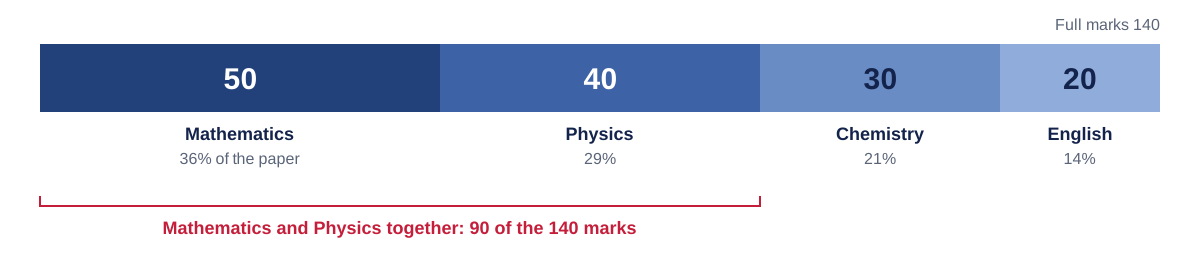
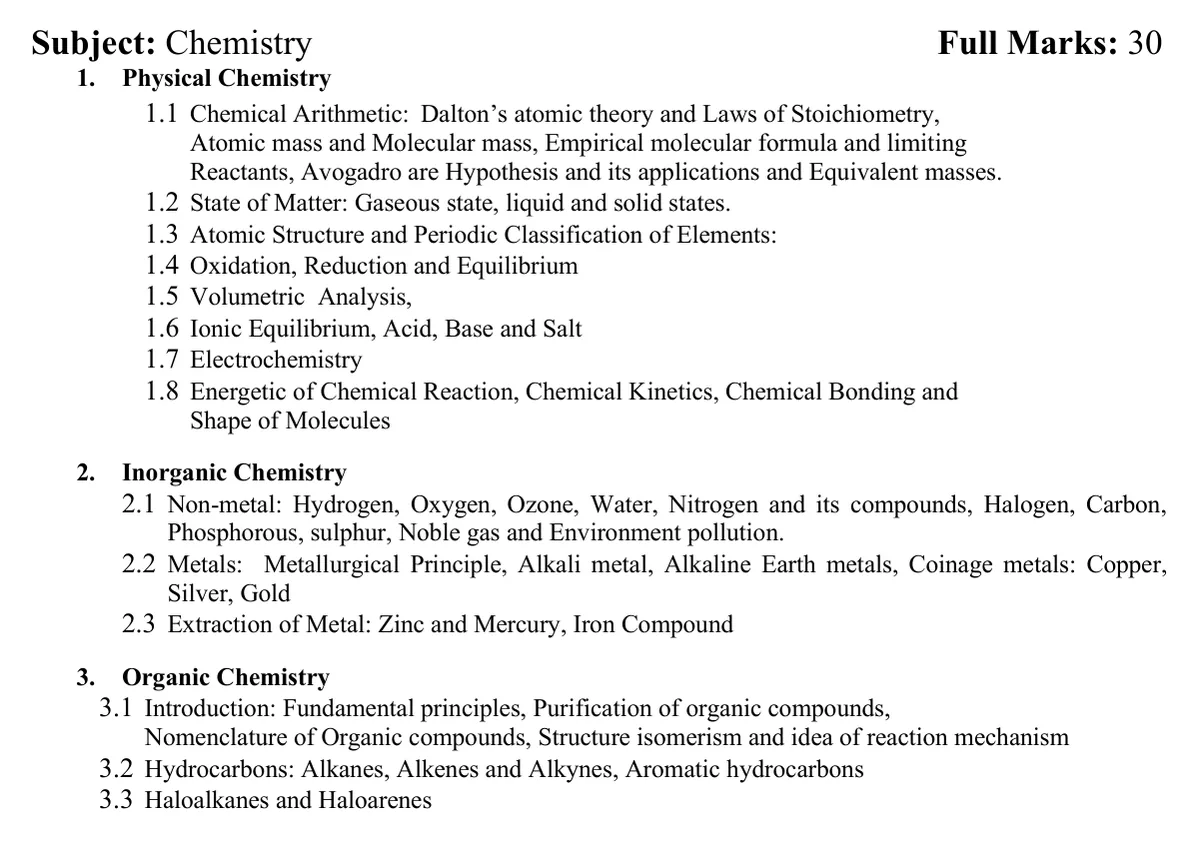
Chemistry carries 30 of the 140 marks on the IOE entrance paper, 21% of the total, ahead of English and behind Physics. The official syllabus, printed in IOE’s own booklet as the Detail Syllabus of B.E./B.Arch. Entrance Examination-2083, divides it into the three conventional branches and 17 numbered sub-topics: Physical Chemistry with eight, Inorganic Chemistry with three, and Organic Chemistry with six. Physical chemistry is therefore both the widest branch on paper and, on the evidence of the booklet’s own sample questions, the one the higher-value items draw on. Inorganic chemistry is narrower than most candidates expect, naming three sub-topics in total and specifying the extraction of only zinc, mercury and iron compounds. Organic chemistry sits between the two at six sub-topics, running from nomenclature and reaction mechanism through to nitro compounds and amines. Everything below is the booklet’s own list, in its own order and wording.
1. Physical Chemistry
- 1.1 Chemical arithmetic: Dalton’s atomic theory and laws of stoichiometry, atomic mass and molecular mass, empirical molecular formula and limiting reactants, Avogadro’s hypothesis and its applications, and equivalent masses.
- 1.2 State of matter: gaseous state, liquid and solid states.
- 1.3 Atomic structure and periodic classification of elements.
- 1.4 Oxidation, reduction and equilibrium.
- 1.5 Volumetric analysis.
- 1.6 Ionic equilibrium, acid, base and salt.
- 1.7 Electrochemistry.
- 1.8 Energetics of chemical reaction, chemical kinetics, chemical bonding and shape of molecules.
2. Inorganic Chemistry
- 2.1 Non-metal: hydrogen, oxygen, ozone, water, nitrogen and its compounds, halogen, carbon, phosphorous, sulphur, noble gas and environment pollution.
- 2.2 Metals: metallurgical principle, alkali metal, alkaline earth metals, coinage metals (copper, silver, gold).
- 2.3 Extraction of metal: zinc and mercury, iron compound.
3. Organic Chemistry
- 3.1 Introduction: fundamental principles, purification of organic compounds, nomenclature of organic compounds, structure isomerism and idea of reaction mechanism.
- 3.2 Hydrocarbons: alkanes, alkenes and alkynes, aromatic hydrocarbons.
- 3.3 Haloalkanes and haloarenes.
- 3.4 Alcohols, phenols and ethers.
- 3.5 Aldehydes, ketones, carboxylic acid and derivatives, aliphatic and aromatic.
- 3.6 Nitro compounds and amines: aromatic and aliphatic.
What do the Chemistry model questions look like?
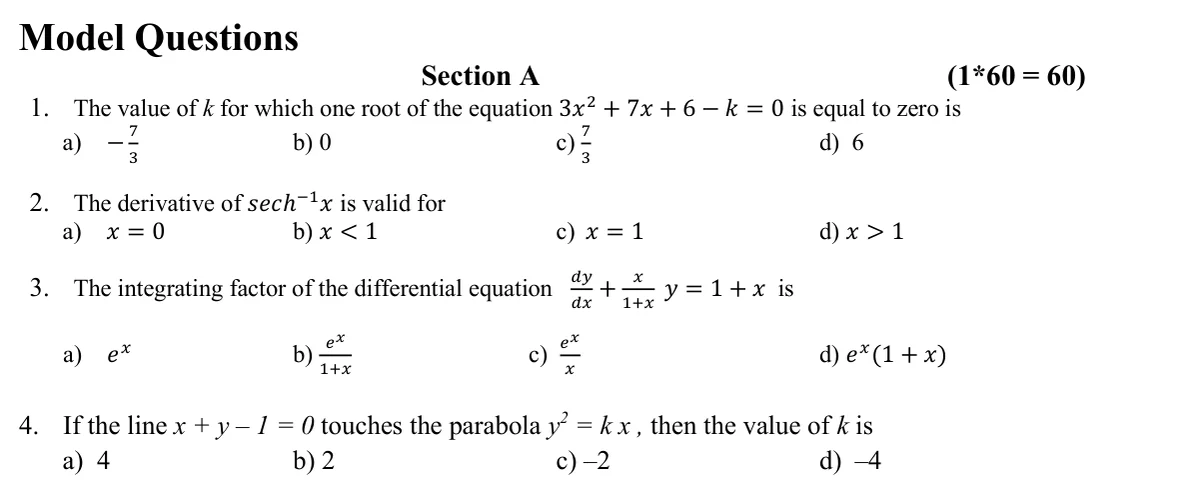
Four of the booklet’s sample questions are Chemistry, and they are calculation-led rather than recall-led. The two Section A items, at 1 mark, ask what a haloalkane is treated with in Williamson’s synthesis, and how many electrons a p-orbital can accommodate. Those map onto organic sub-topic 3.3 and physical sub-topic 1.3.
The two Section B items, at 2 marks, are reproduced as printed: “21 grams of magnesium carbonate was treated with 50ml of 12N hydrochloric acid. How many molecules of untreated hydrochloric acid remain in this reaction?” And: “What weight of copper will be deposited by passing 2 Faraday of electricity through a solution of cupper salt? — (a) 20g, (b) 31.7g, (c) 63.5g, (d) 100g.” Both are physical chemistry, one stoichiometry and one electrochemistry, and both need a full calculation rather than a remembered fact.
What that says about where to spend revision time
On this sample, physical chemistry supplies three of the four Chemistry questions and both of the two-mark ones. It is also the widest branch in the syllabus at eight sub-topics of the seventeen. Those two facts point the same way, and they point away from the common revision plan of splitting Chemistry evenly across the three branches. Inorganic chemistry is worth reading properly rather than at length: three sub-topics, and the extraction sub-topic names only three substances.
Reproduced from the Detail Syllabus of B.E./B.Arch. Entrance Examination-2083, Chemistry, Full Marks 30, printed pages 28 and 29 of the booklet, and checked against rendered images of both pages. Spellings such as “phosphorous”, “cupper salt” and “Avogadro are Hypothesis” appear as printed in the booklet and have been left or lightly regularised without changing the topic named. Model questions transcribed from the booklet’s Model Questions section, printed pages 29 to 31, which is set in Latin type and extracts reliably. Where this page and the booklet differ, the booklet governs.
Sources
- IOE B.E./B.Arch Booklet 2083published 7 August 2026 · read 18 August 2026
Last reviewed by Ram Raj Thapa, Admissions Officer, Imperial College of Engineering. Every figure on this page is cited to the document it came from.