
Which BE programmes can you study under Tribhuvan University, and where?
Twelve, but only five of them at a private college. Civil, Architecture, Electrical, Electronics/Communication/Information and Computer run at both constituent campuses and affiliated colleges. Mechanical, Aerospace, Agriculture, Industrial, Geomatics, Automobile and Chemical run only at constituent campuses.
Twelve bachelor-level engineering and architecture programmes run under Tribhuvan University’s Institute of Engineering in 2083, across five constituent campuses and ten affiliated private colleges, for 4,344 places in total. The split between the two kinds of provider is the fact that decides where you can apply. Affiliated private colleges are permitted to run only five of the twelve: Civil, Architecture, Electrical, Electronics/Communication/Information, and Computer. The other seven, Mechanical, Aerospace, Agriculture, Industrial, Geomatics, Automobile and Chemical, exist only at the constituent campuses, and several of them at exactly one campus. If Mechanical Engineering is what you want under TU, no private college in the system offers it, and the decision becomes which of four campuses you can reach on your rank.
How many places each programme has
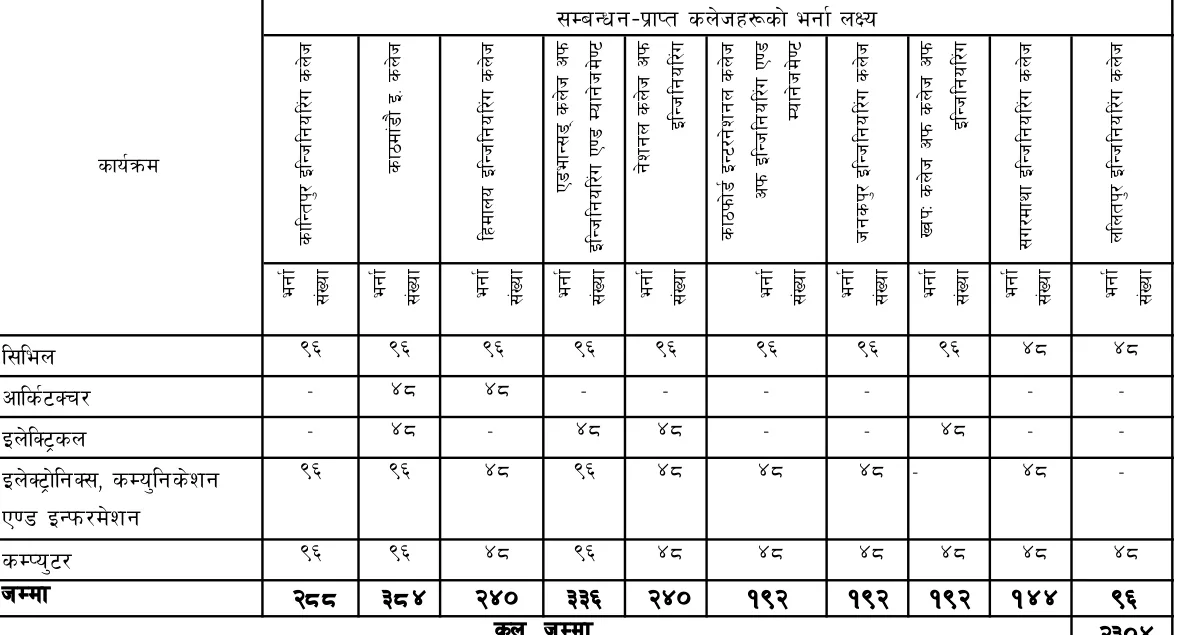
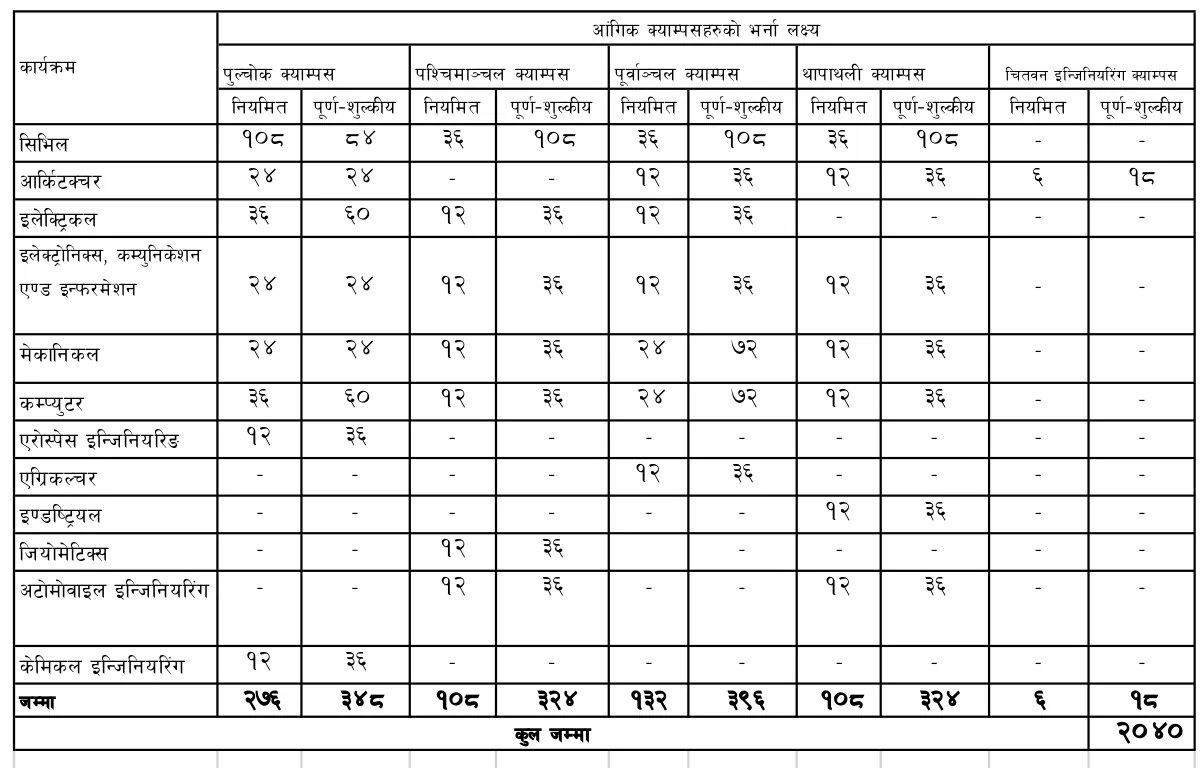
Both intake tables are printed on page 10 of IOE’s 2083 booklet. Adding them together gives the size of each programme across the whole system, which is the context missing from every discussion of cutoffs.
| Programme | Constituent campuses | Affiliated colleges | Total |
|---|---|---|---|
| Civil | 624 | 864 | 1,488 |
| Computer | 288 | 624 | 912 |
| Electronics, Communication & Information | 192 | 528 | 720 |
| Electrical | 192 | 192 | 384 |
| Architecture | 168 | 96 | 264 |
| Mechanical | 240 | — | 240 |
| Automobile | 96 | — | 96 |
| Aerospace | 48 | — | 48 |
| Agriculture | 48 | — | 48 |
| Chemical | 48 | — | 48 |
| Geomatics | 48 | — | 48 |
| Industrial | 48 | — | 48 |
| All programmes | 2,040 | 2,304 | 4,344 |
Scroll the table sideways for Affiliated colleges and Total.
Civil is a third of the whole system on its own. Computer and Electronics together are another 1,632 places, and everything else in the list is small: seven programmes have fewer than 250 seats each in the entire country under this university.
Where the constituent-campus programmes actually are
Programme availability differs campus by campus, and for the smaller programmes there is only one door. The table below is the first of the two on page 10, reproduced as the booklet prints it.
- Aerospace and Chemical
- Pulchowk Campus only
- Agriculture
- Purwanchal Campus, Dharan only
- Geomatics
- Paschimanchal Campus, Pokhara only
- Industrial
- Thapathali Campus only
- Automobile
- Paschimanchal and Thapathali
- Mechanical
- Pulchowk, Paschimanchal, Purwanchal and Thapathali
- Architecture
- All five constituent campuses except Paschimanchal, plus two private colleges
Chitwan Engineering Campus at Rampur is the newest and the smallest, and in 2083 it admits to Architecture alone, 6 Regular and 18 Full Fee places.
What this means for your priority order
You rank college-and-programme pairs on one form, so a programme that runs at one campus gives you one line rather than a shortlist. For Aerospace, Chemical, Agriculture, Geomatics or Industrial, that line either clears on your rank or the programme is out of reach for the year.
The three large programmes work the other way. Civil, Computer and Electronics run almost everywhere, so the question there is which provider, not whether a place exists.
Both intake tables from printed page 10 of the booklet, read off a rendered page image and verified by re-adding each table’s columns against its own printed totals: 2,040 for the constituent campuses and 2,304 for the affiliated colleges. Intakes are set for one academic year and change.
Sources
- IOE B.E./B.Arch Booklet 2083published 7 August 2026 · read 18 August 2026
Last reviewed by Ram Raj Thapa, Admissions Officer, Imperial College of Engineering. Every figure on this page is cited to the document it came from.