
How many IOE seats are there in 2083, by campus and programme?
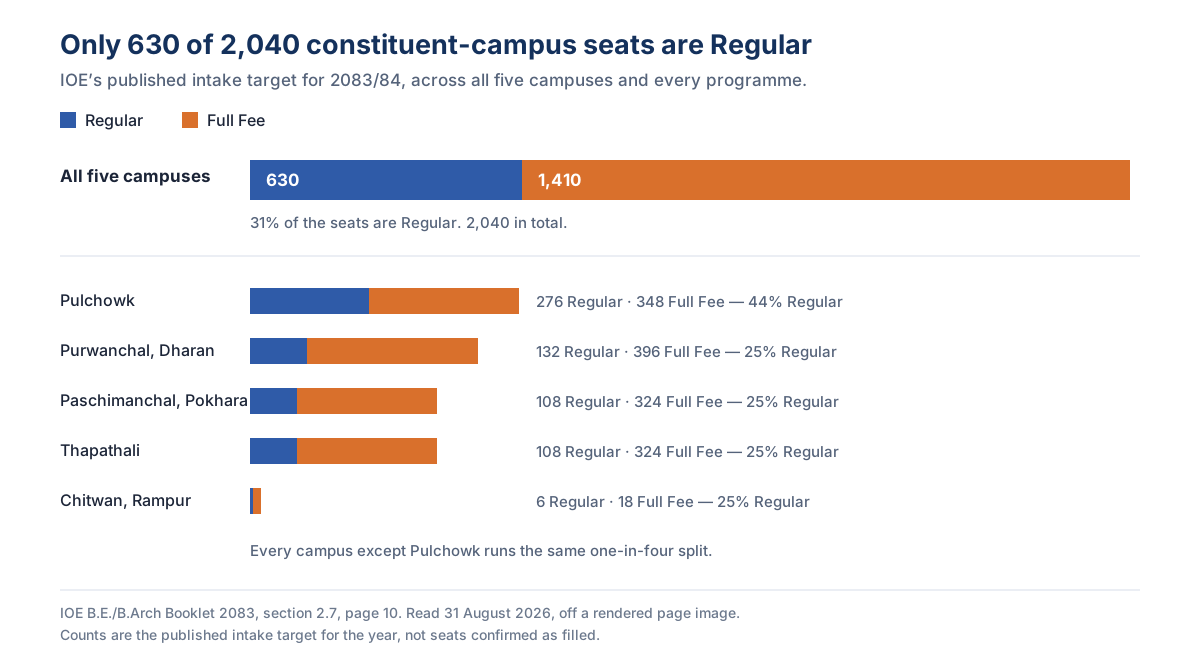
IOE lists 4,344 BE and BArch seats for 2083: 2,040 at its five constituent campuses, of which 630 are Regular and 1,410 Full Fee, and 2,304 at ten affiliated private colleges. The full table for every campus, college and programme is below.
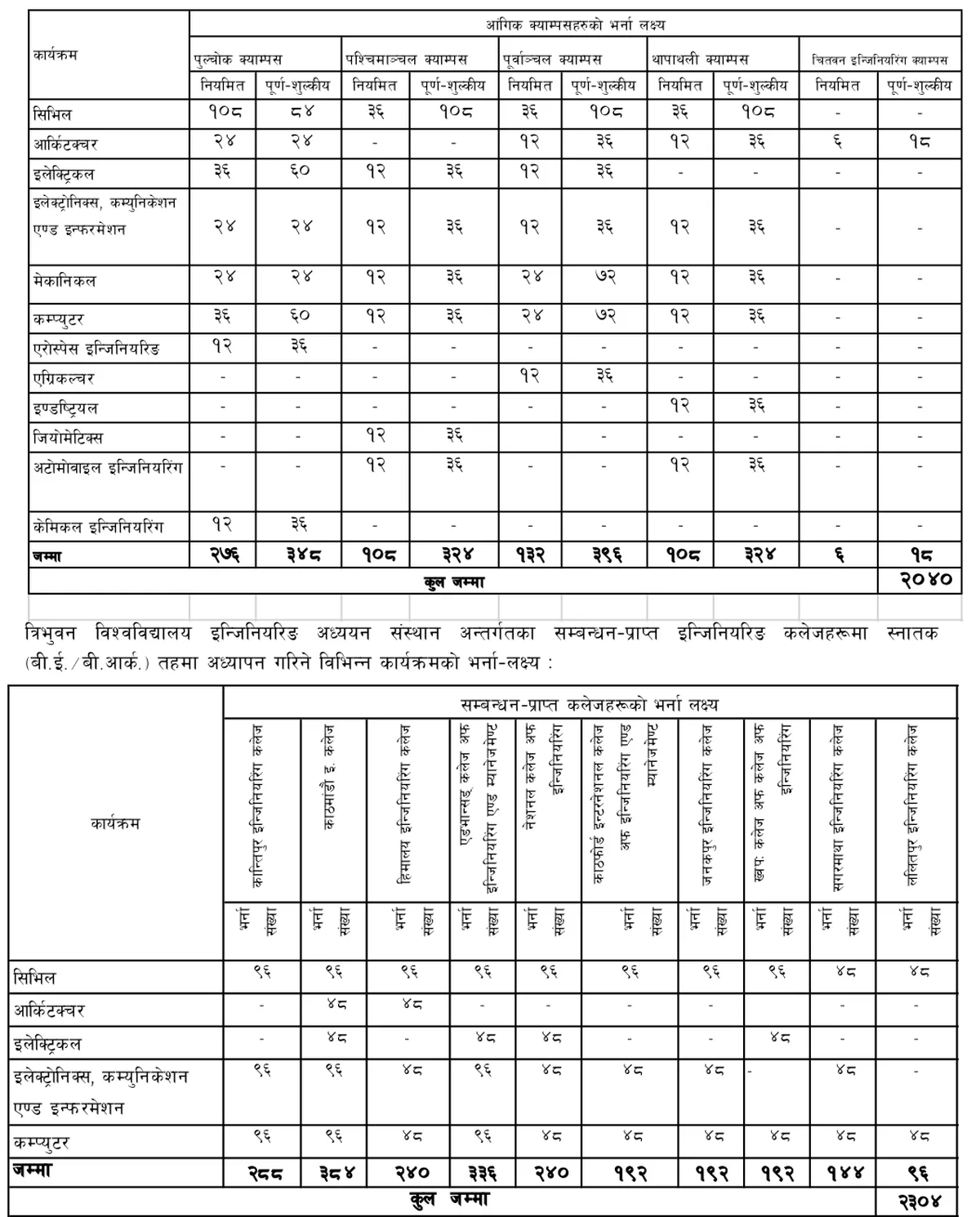
The IOE B.E./B.Arch Booklet 2083 sets the admission target for every programme at every campus on a single page, and the totals are 4,344 seats. The five constituent campuses hold 2,040 of them: Pulchowk 624, Purwanchal 528, Paschimanchal 432, Thapathali 432 and Chitwan 24. Only 630 of those 2,040 are Regular seats at the subsidised fee, and the other 1,410 are Full Fee. The ten affiliated private colleges hold the remaining 2,304, from 384 at Kathmandu Engineering College down to 96 at Lalitpur Engineering College. Civil is the largest programme in both groups, at 624 constituent seats and 864 affiliated ones. Every figure below was transcribed from the booklet page and each column was added up again against the total the booklet prints for it. All of them reconcile exactly.
How many seats does each constituent campus have?
Each cell reads Regular / Full Fee. A hyphen means the campus does not run that programme. The last row is the booklet’s own printed total for each campus.
| Programme | Pulchowk | Paschimanchal | Purwanchal | Thapathali | Chitwan |
|---|---|---|---|---|---|
| Civil | 108 / 84 | 36 / 108 | 36 / 108 | 36 / 108 | - |
| Architecture | 24 / 24 | - | 12 / 36 | 12 / 36 | 6 / 18 |
| Electrical | 36 / 60 | 12 / 36 | 12 / 36 | - | - |
| Electronics, Communication and Information | 24 / 24 | 12 / 36 | 12 / 36 | 12 / 36 | - |
| Mechanical | 24 / 24 | 12 / 36 | 24 / 72 | 12 / 36 | - |
| Computer | 36 / 60 | 12 / 36 | 24 / 72 | 12 / 36 | - |
| Aerospace | 12 / 36 | - | - | - | - |
| Agriculture | - | - | 12 / 36 | - | - |
| Industrial | - | - | - | 12 / 36 | - |
| Geomatics | - | 12 / 36 | - | - | - |
| Automobile | - | 12 / 36 | - | 12 / 36 | - |
| Chemical | 12 / 36 | - | - | - | - |
| All programmes | 276 / 348 | 108 / 324 | 132 / 396 | 108 / 324 | 6 / 18 |
Scroll the table sideways for Paschimanchal and Purwanchal and Thapathali and Chitwan.
Pulchowk is the only campus where Civil has more Regular seats than Full Fee ones, at 108 against 84, and it is the only constituent campus teaching Aerospace or Chemical. Chitwan Engineering Campus runs Architecture alone. Added across campuses, the programmes stand at Civil 624, Computer 288, Mechanical 240, Electrical 192, Electronics, Communication and Information 192, Architecture 168, Automobile 96, and 48 each for Aerospace, Agriculture, Industrial, Geomatics and Chemical.
How many are Regular and how many Full Fee?
| Campus | Regular | Full Fee | Total |
|---|---|---|---|
| Pulchowk | 276 | 348 | 624 |
| Paschimanchal | 108 | 324 | 432 |
| Purwanchal | 132 | 396 | 528 |
| Thapathali | 108 | 324 | 432 |
| Chitwan | 6 | 18 | 24 |
| Five constituent campuses | 630 | 1,410 | 2,040 |
Scroll the table sideways for Full Fee and Total.
Fewer than one constituent seat in three is Regular. Outside Pulchowk the ratio is fixed at one Regular seat for every three Full Fee seats, programme by programme, which is why a campus with 48 places in a programme has 12 Regular and 36 Full Fee. The two pools are separate lists with separate counts, and the Regular side is where the inclusive quota sits. By programme, the Regular seats across all five campuses are Civil 216, Computer 84, Mechanical 72, Electrical 60, Electronics, Communication and Information 60, Architecture 54, Automobile 24, and 12 each in the other five programmes.
How many seats do the affiliated colleges have?
Section 2.6 of the booklet names ten private colleges affiliated to Tribhuvan University under IOE, and the second table on page 10 gives each one a single admission figure per programme, without a Regular and Full Fee split. The college’s own fee applies, but every affiliated college must admit 10 per cent of its total intake at a fee equal to IOE’s Regular rate, without adding to its target. Admission to all of them also requires passing the IOE entrance examination.
| College | Civil | Architecture | Electrical | Electronics, Communication and Information | Computer | Total |
|---|---|---|---|---|---|---|
| Kantipur Engineering College | 96 | - | - | 96 | 96 | 288 |
| Kathmandu Engineering College | 96 | 48 | 48 | 96 | 96 | 384 |
| Himalaya College of Engineering | 96 | 48 | - | 48 | 48 | 240 |
| Advanced College of Engineering and Management | 96 | - | 48 | 96 | 96 | 336 |
| National College of Engineering | 96 | - | 48 | 48 | 48 | 240 |
| Kathford International College of Engineering and Management | 96 | - | - | 48 | 48 | 192 |
| Janakpur Engineering College | 96 | - | - | 48 | 48 | 192 |
| Khwopa College of Engineering | 96 | - | 48 | - | 48 | 192 |
| Sagarmatha Engineering College | 48 | - | - | 48 | 48 | 144 |
| Lalitpur Engineering College | 48 | - | - | - | 48 | 96 |
| Ten affiliated colleges | 864 | 96 | 192 | 528 | 624 | 2,304 |
Scroll the table sideways for Architecture and Electrical and Electronics, Communication and Information and Computer and Total.
The affiliated colleges teach five programmes between them, against twelve at the constituent campuses. Computer is the one programme all ten offer. Architecture is offered at two, Kathmandu and Himalaya, and Electrical at four.
What happens to seats that are not taken?
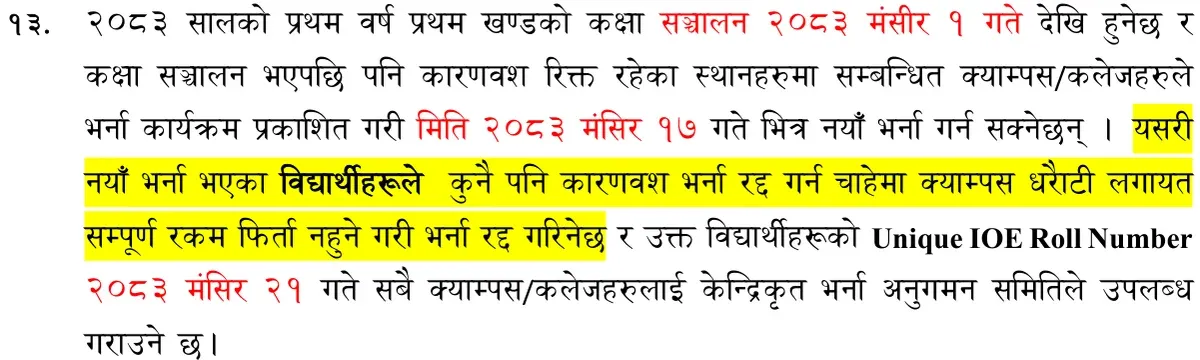
The seat count is fixed before admission starts, but who fills it moves across three central merit lists, published about a week apart. Each list fills the seats that students on the list before it did not take. After the third list, a campus that still has places runs its own fourth or later list on a schedule it has to publish in advance, still in entrance rank order and still recorded through the central portal. After classes begin on 16 November 2026, a campus may fill seats that have fallen vacant up to 2 December 2026. Nothing is refunded, campus deposit included, if a seat taken in that window is later cancelled.
The booklet also allows a campus to shrink a programme before the first round. Where fewer applicants give a programme’s Full Fee side as their first priority than it has Full Fee seats, the campus admission committee may set that programme at 24 seats (6 Regular and 18 Full Fee) or 48 (12 Regular and 36 Full Fee), with the reserved quota kept on the Regular side. So a printed figure is a ceiling rather than a promise, and the programme you want may run smaller than the table says.
How many of these seats are reserved?
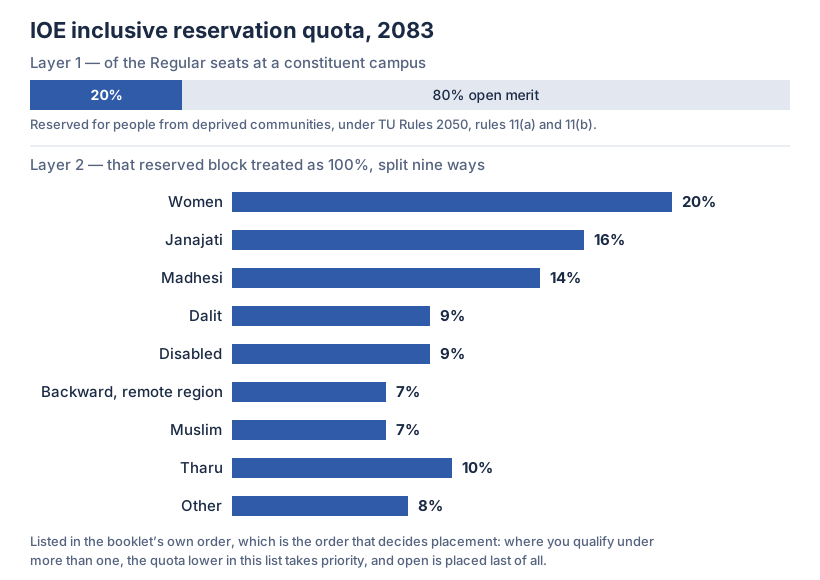
Reserved places are carved out of the numbers above rather than added to them. Twenty per cent of the Regular seats at the constituent campuses is reserved for the inclusive quota, which the booklet’s per-programme rows put at 119 seats. The women’s quota sets aside 56 Regular and 145 Full Fee seats across the same five campuses. Separate allocations exist for the children of staff, for foreign nationals and for sponsored government employees. A reserved seat that its own applicants do not fill is published to open applicants rather than held empty.
Read next
Seat figures from the IOE B.E./B.Arch Booklet 2083, section 2.7, page 10, and the list of affiliated colleges and the 10 per cent Regular-fee rule from section 2.6, page 9. The option to set a programme at 24 or 48 seats is note (a) under the page 10 table. Every figure was read off a rendered image of the page, because the booklet sets its numerals in a legacy Nepali font that does not survive copying. Each campus and college column was re-added against its printed total, and the constituent total reconciles to the printed 2,040 and the affiliated total to the printed 2,304. The 4,344 grand total and the programme and Regular subtotals are our own addition of those printed figures. The merit-list sequence, the fourth-list rules and the vacant-seat window to 2 December 2026 are from the Admission Guidelines 2083, notes to the schedule on pages 2 and 3 and items 5 and 13. The reserved-seat counts are from booklet sections 6.1 and 6.3, pages 13 to 15.
At Imperial College of Engineering
Janakpur Engineering College in the table above is this college, which students know as Imperial College of Engineering. Its 192 seats are the same figure IOE prints, across Civil, Computer and Electronics, Communication and Information.
Sources
- IOE B.E./B.Arch Booklet 2083published 7 August 2026 · read 18 August 2026
- IOE Admission Guidelines 2083 (Centralized Admission Monitoring Committee)published 12 August 2026 · read 18 August 2026
Last reviewed by Ram Raj Thapa, Admissions Officer, Imperial College of Engineering. Every figure on this page is cited to the document it came from.