


Nepal Telecom’s 2,216 km fibre highway targets two provinces
An agreement with the telecom regulator funds aerial and buried fibre, 28 DWDM systems and five routers to reach 194 local levels in Gandaki and Lumbini.
Nepal Telecom will lay about 2,216 km of optical fibre across Gandaki and Lumbini under an agreement with the Nepal Telecommunications Authority, Radio Nepal reported on 10 October. The money comes from the Rural Telecommunication Development Fund, up to Rs 2.01 billion, and the contract runs for three years.
- 2,216 kmoptical fibre planned (Radio Nepal)
- 2,028 kmaerial fibre (NepaliTelecom)
- 188 kmunderground fibre (NepaliTelecom)
- 28DWDM systems, with five routers (NepaliTelecom)
- 194local levels to be served (Radio Nepal)
- Rs 2.01 bnmaximum from the Rural Telecommunication Development Fund (Radio Nepal)
What was agreed
The agreement is part of the Information Highway Project, which is building a national fibre backbone. This section covers 194 local levels in the two provinces. NepaliTelecom reports that it will also connect 432 mobile base station (BTS) sites, the towers that phones talk to.
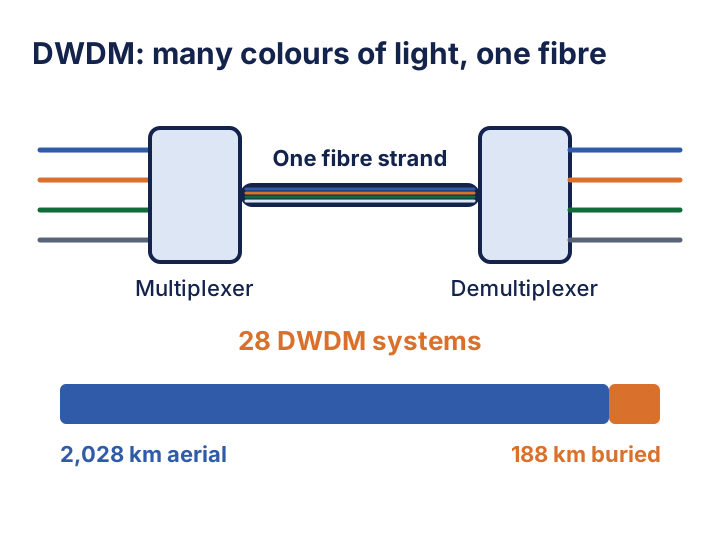
Most of the cable will hang on poles. NepaliTelecom gives the split as 2,028 km of aerial fibre and 188 km underground. The project also includes 28 DWDM systems and five routers, and NepaliTelecom says it is meant to support future 5G expansion.
The contract allows three years. NepaliTelecom reports that the communications minister directed the authorities to finish it a year earlier than that. A deadline is a target until the cable is installed, tested and handed over.
The engineering behind it: many colours on one strand
An optical fibre carries data as pulses of light inside a glass strand thinner than a hair. On its own, one strand with one laser carries one channel. DWDM, dense wavelength division multiplexing, puts many lasers on the same strand, each at a slightly different colour of infrared light. A multiplexer at one end combines them and a demultiplexer at the other end splits them apart again, so one strand carries dozens of independent channels.
That is why DWDM matters for a rural backbone. Digging or stringing new cable across hills is the expensive part. Adding colours to cable already in place is far cheaper, so the same route can grow with demand for years. Routers then sit at the points where the backbone meets local networks, and decide which way each packet of data travels.
Aerial and buried cable each have costs. Aerial fibre on existing poles is faster and cheaper to install and easier to reach for repairs, but storms, falling trees, landslides and vehicles can bring it down. Buried fibre is protected from most of that but costs more to lay and is harder to repair when it is cut. A route mostly in the air, like this one, is quick to build and needs a good repair plan.
A backbone is also only as reliable as its weakest stretch. If a district is fed by one cable path, a single cut takes it offline. Engineers add a second path, a ring, so traffic can go round the other way. The reports do not say how much of this route will be built as rings.
What it means for Nepal
Better backbone capacity in the hills affects everyday things: video classes in a rural school, digital payments at a local shop, and mobile data quality at the 432 BTS sites the project names. It also matters in a disaster, when local governments and families depend on phone and data links staying up.
The useful way to follow the project is by numbers that can be checked: kilometres actually laid, local levels and BTS sites connected, and how often the links stay up after handover. A signed agreement is the start of that record, not the end.
What to study if this interests you
Communication Systems (ENEX 351) covers how signals are modulated and carried, and Telecommunication and Computer Networks (ENEX 352) covers backbone design and multiplexing. For computer engineering students, Data Communication (ENCT 253) and Computer Networks (ENCT 304) explain the routers, routing and protocols that run over the fibre.
A class exercise: take a map of one district, draw a single fibre line to its headquarters, then add a second path that closes a ring. Count the extra kilometres and list which villages would stay connected if each stretch were cut. That is the basic trade-off every backbone designer faces.
Words in this story
- DWDM
- Dense wavelength division multiplexing: sending many channels down one fibre, each on its own colour of light.
- Backbone
- The high-capacity network links that carry traffic between regions, which local networks connect to.
- BTS site
- A base transceiver station, the mobile tower and equipment that phones in an area connect to.
- Ring
- A network laid out in a loop so traffic can go the other way round if one stretch is cut.
Where this comes from
- Radio Nepal, 10 Oct 2026
- NepaliTelecom, 10 Oct 2026
Written in our own words; no sentence is copied from these reports. Researched with AI assistance and added 17 October 2026; no member of faculty has reviewed this story yet. If you spot a mistake, call 01-5091616 and we will correct it and say so.