


How Nepal is putting its flood-cut crossings back, one bridge at a time
Eighteen footbridges reopened, Bailey bridges went up, a dam became a road and a 30-metre approach was rebuilt. A new flood in Gorkha then damaged nine more.
When a flood takes a river crossing, the road on either side is still there, but no one can get across. Over six weeks this autumn, crews in Nepal brought crossings back in at least four different ways. Each one shows a different part of a bridge that a flood can break.
- 18suspension bridges reopened, Bhotekoshi–Trishuli corridor (Inner Circle Nepal)
- 73 mBailey bridge over the Phalakhu River, open 11 October (Inner Circle Nepal)
- 30 mapproach road repaired at the Malunga bridge (Ratopati)
- 160 mtruss bridge washed away between Syangja and Gulmi (ABC Nepal)
- 9bridges damaged by the 11 October Budhi Gandaki flood (NDRRMA)
Four repairs, four weak points
Footbridges first. The Suspension Bridge Division Office of the Department of Local Infrastructure said 18 suspension bridges along the Bhotekoshi–Trishuli corridor had been repaired and reopened, Inner Circle Nepal reported on 16 October. The repairs cost about Rs 55 million. These are the crossings that connect villages to schools, health posts and markets where there is no vehicle bridge at all. The report does not list what was wrong with each bridge.
Then the quick steel spans. The same report says a 73-metre Bailey bridge over the Phalakhu River restored the road between Rasuwa and Nuwakot on 11 October, about six weeks after the flood. On the Galchhi–Betrawati road in Rasuwa, OnlineKhabar reported on 2 October that a temporary track had opened first, and that installation of a Bailey bridge had begun at Betrawati. Infrastructure Development Minister Sunil Lamsal said work on its foundations had started alongside the track.
Then the approach. At the Malunga bridge between Baglung and Parbat, the bridge itself was not reported destroyed. About 30 metres of the approach road was seriously damaged, which left the crossing unusable. Army, police and armed police personnel worked with about 50 local workers to repair it, and traffic resumed, Ratopati reported on 12 October.
And a borrowed route. Floodwater washed away a 160-metre truss bridge between Syangja and Gulmi on 27 September, ABC Nepal reported on 6 October. The bridge had been built during the Kaligandaki A hydropower project at a cost of Rs 50 million. Local authorities and the plant agreed to let light four-wheelers, motorcycles and three-wheelers cross on the hydropower dam and through a tunnel, from Tatopani in Syangja to Kaligandaki-1 in Gulmi.
The engineering behind it: a bridge is more than its span
A road bridge has three parts that a flood can attack. The span is the deck and the beams or trusses that carry traffic across. The substructure, the abutments at each bank and any piers in the river, holds the span up. The approach is the embankment that brings the road up to the bridge. Fast floodwater can scour soil from under a pier, wash out the fill behind an abutment, or, in a big enough flood, carry the span away.
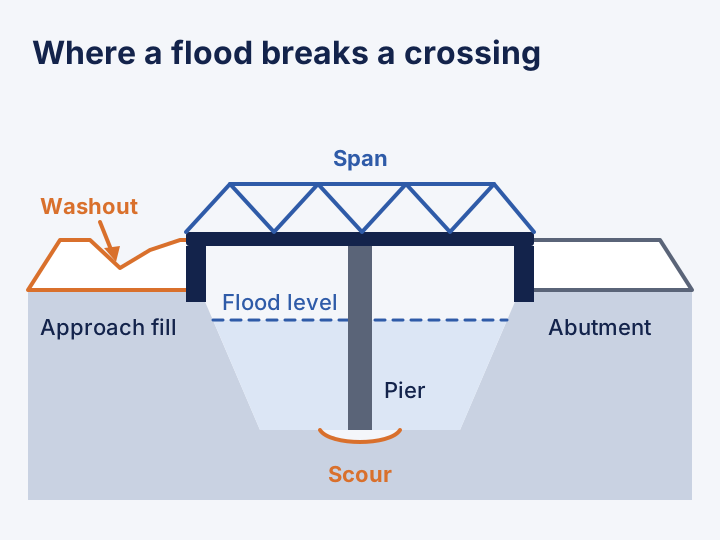
The Malunga case is the most common kind of failure and the easiest to miss. The bridge can be sound while the road to it is gone. Rebuilding the fill restores the crossing, but if water reached it through a blocked drain or by overtopping, the same thing can happen in the next storm unless drainage or bank protection is improved. The report does not describe the design used.
A suspension footbridge fails differently. Its deck hangs from steel cables that run over towers and are held at each end by heavy anchorages buried in the ground. If a flood erodes the bank around an anchorage, the whole bridge loses its support even though the deck looks fine. Inspecting cables, hangers, towers and anchorages is the core of a footbridge repair.
A Bailey bridge is a kit of standard steel panels that are pinned together on site and pushed across the gap. It goes up in days to weeks, not years, which is why it is the usual answer when a road must reopen fast. It still needs solid foundations on both banks, and it has a load limit, so a Bailey crossing is a recovery tool while a permanent bridge is designed.
The Syangja–Gulmi arrangement is a reminder that a structure built for one purpose is not automatically safe for another. A dam crest and a plant tunnel were designed for plant operations, which is why the route was opened to light vehicles only.
More damage, more work
The repair list grew on 11 October. NDRRMA’s Situation Report #3 says the Budhi Gandaki flash flood in Gorkha damaged nine bridges of four types: two permanent bridges, five suspension bridges, one Bailey bridge and one cantilever bridge. That one flood touched every kind of crossing described above.
Recovery work after a disaster usually moves in the same order seen here: open a temporary track, put up a modular bridge, repair what can be repaired, then design permanent replacements. The permanent stage needs river studies, ground investigation and structural design, and it is the slowest part.
What to study if this interests you
Theory of Structures I (ENCE 202) explains how a truss or a cable carries load, and Design of Steel Structures (ENCE 303) covers the steel members in Bailey panels and trusses. Design of RCC Structures (ENCE 352) covers abutments and piers. Engineering Hydrology (ENCE 306) is where design flood flows come from, and Transportation Engineering I (ENCE 304) covers approach roads and embankments.
A good exercise: pick one crossing from this story and sketch it from the side, labelling the span, the supports and the approach. Then mark where water reached each part and which repair the crews chose. You will see why the same flood produced four different fixes.
Words in this story
- Bailey bridge
- A bridge built from standard steel panels pinned together on site, used when a crossing must reopen quickly.
- Approach
- The raised road embankment that brings traffic up onto a bridge from each bank.
- Anchorage
- The heavy block in the ground at each end of a suspension bridge that holds its cables.
- Scour
- Fast water removing soil from around a pier or abutment, which can undermine its foundation.
Where this comes from
- Inner Circle Nepal, 16 Oct 2026
- OnlineKhabar English, 2 Oct 2026
- Ratopati English, 12 Oct 2026
- ABC Nepal TV, 6 Oct 2026
- NDRRMA, Situation Report #3, Gorkha Budhi Gandaki flash flood, 13 Oct 2026
Written in our own words; no sentence is copied from these reports. Researched with AI assistance and added 17 October 2026; no member of faculty has reviewed this story yet. If you spot a mistake, call 01-5091616 and we will correct it and say so.