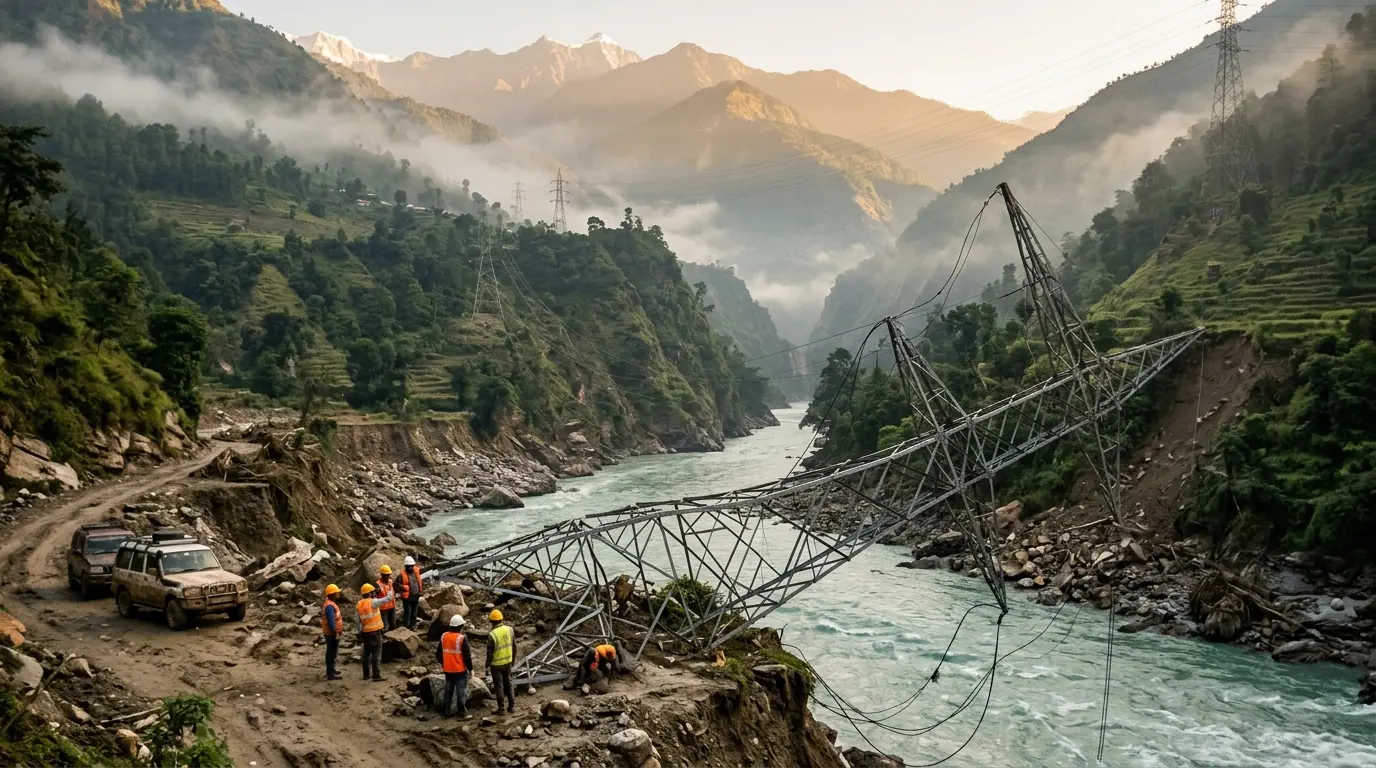
Nepal spent the weeks after its floods counting megawatts it could not use. On 30 September, Radio Nepal reported that about 430 MW was disconnected from the national grid after flood damage to hydropower projects on the Bhotekoshi. Two days later a different problem appeared in Myagdi: plants that were still able to generate had no line to send power through.
- 430 MWdisconnected from the grid, government figure, 30 September (Radio Nepal)
- 176 MWsix Myagdi and Mustang plants unable to connect, 2 October (OnlineKhabar)
- 4 towersfallen on the 220 kV Dana–Khurkot line (OnlineKhabar)
- 14 projectsdamaged by the August flood, about 783 MW (Energy Ministry, via OnlineKhabar)
- 3 facilitieshydropower facilities damaged by the 11 October Budhi Gandaki flood (NDRRMA)
- 30 MWKhani Khola, test generation from 4 October (The Kathmandu Post)
Four separate problems, one grid
The first problem was damage at the plants themselves. The Energy Ministry said the August flood damaged 14 hydropower projects with a combined capacity of about 783 MW, OnlineKhabar reported on 30 September. The Nepal Electricity Authority (NEA) separately said about 190 MW had been disconnected by the floods and landslides that followed the late-September rain. The 430 MW in Radio Nepal’s report was the government’s figure for capacity cut off on that day.
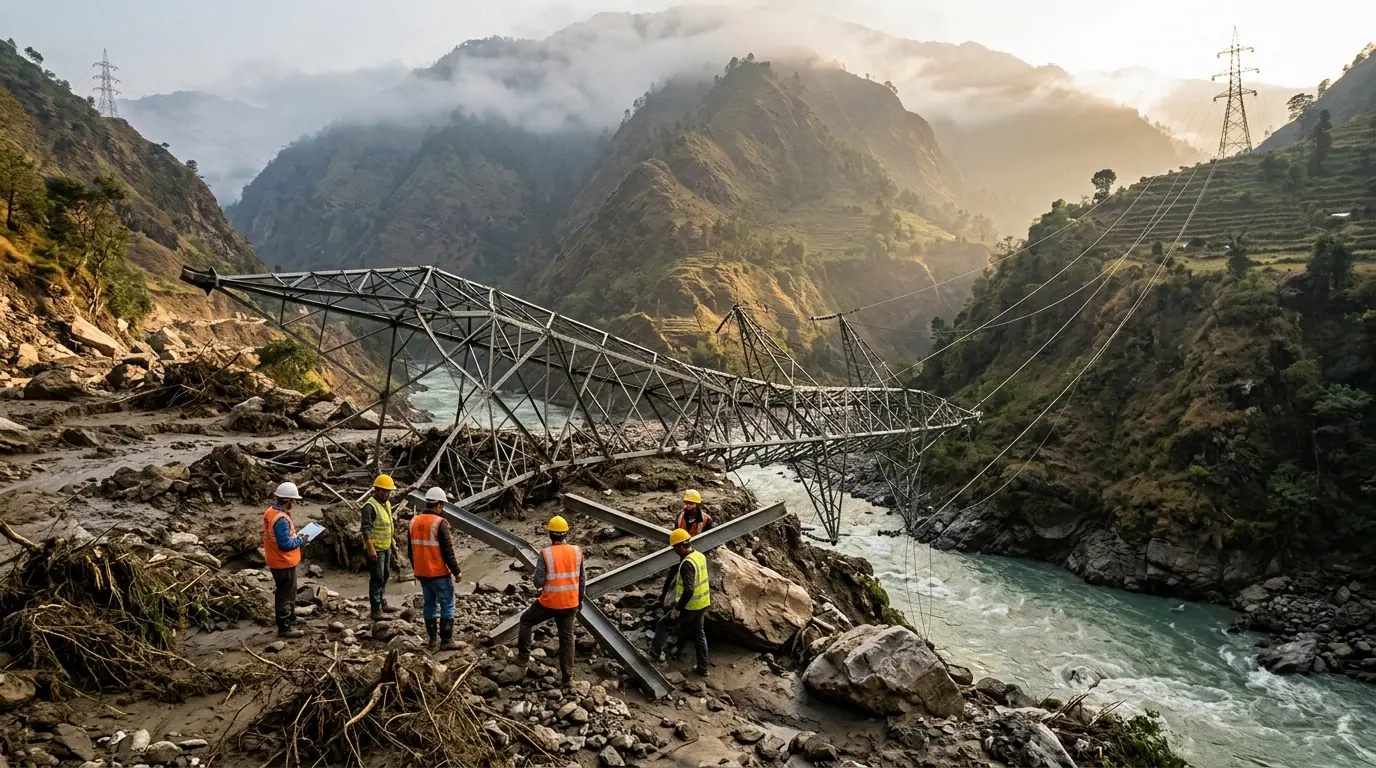
The second problem was the wires. Kaligandaki flooding brought down four towers on the 220 kV Dana–Khurkot transmission line, at Pokharebagar and Dhirchyang in Annapurna Rural Municipality and at Bhirkate in Dovan, Myagdi, OnlineKhabar reported on 2 October. Six hydropower projects in Myagdi and Mustang with a combined 176 MW could not connect to the national system, and supply to Mustang and Annapurna Rural Municipality was cut. The NEA began repairs and started preparing an alternative line.
The third problem was new. On 11 October a flash flood came down the Budhi Gandaki in Gorkha. NDRRMA’s Situation Report #3 of 13 October lists three hydropower facilities among the damage, along with nine bridges and one school. It attributes the flood to a snow avalanche and a major landslide involving glacier ice and debris in the upper Ungdilung Khola. Project-level damage figures had not been published in that report.
The fourth is the rules. The Electricity Regulatory Commission is drafting a disaster-resilient framework for energy infrastructure, and a Post Disaster Needs Assessment under the National Planning Commission is collecting data. A preliminary rapid assessment put energy-sector damage at about Rs 134 billion. Officials have discussed risk-based insurance premiums and concessional loans, but none of that was final when OnlineKhabar reported it.
The engineering behind it: a plant can run and still deliver nothing
A hydropower plant is one link in a chain. Water turns the turbine, the generator makes electricity, a step-up transformer raises the voltage, a transmission line carries it to a substation, and the grid shares it out. A break at any link stops the delivery. The Myagdi case shows the expensive version: the six plants were stranded because towers fell on the shared line, not because their turbines failed.
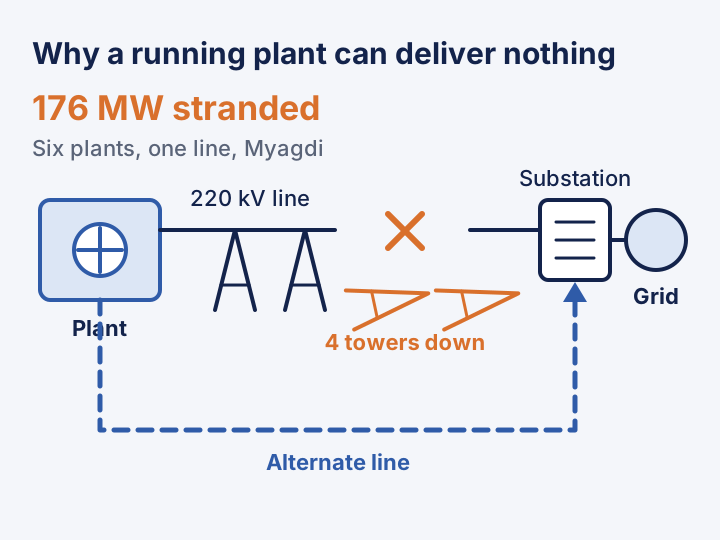
This is why engineers talk about a single point of failure. When several plants feed one corridor, that corridor carries all of their output and all of their risk. A second route, even a lower-capacity one, lets some power keep flowing while the main line is rebuilt. Before an alternate line is switched on, engineers still have to check conductor clearances, protection relay settings and how much load the new path can carry.
Repairing a tower in a river valley is slow for practical reasons. Crews must reach the site, often on damaged roads, inspect the foundation and the ground around it, and restring conductors safely with the line isolated and earthed. A tower that fell because the riverbank under it was washed away cannot simply be put back in the same place.
The numbers in the reports are snapshots. The 430 MW, 190 MW, 176 MW and 783 MW figures come from different dates, different agencies and different definitions: capacity disconnected, capacity unable to connect, capacity damaged. Adding them would count some plants twice. A careful reader keeps each number with its date and its source.
Signs of recovery
Some plants are coming back. The 30 MW Khani Khola Hydropower Project in Dolakha began test generation on 4 October and was feeding the grid, The Kathmandu Post reported on 16 October. Plant manager Ishwar Kandel said commercial operation was targeted for 19 October after a 15-day test period. Floods on 9 July 2024 had damaged its dam site, so the project is a working example of a plant finished after flood damage.
Test generation is the stage where operators prove that the plant and the grid work together: synchronising the generator, checking protection settings, and watching vibration and temperature under load. Those are standard commissioning checks, not a list the newspaper reported for Khani Khola. The 19 October date was a target when the Post reported it.
New investment is also moving. Investment Board Nepal approved Rs 10.75 billion for the 58.9 MW Nar Khola project and Rs 10.42 billion for the 46.72 MW Sani Bheri-3 project, Radio Nepal reported on 9 October. Both are semi-reservoir plants, together 105.62 MW. A semi-reservoir plant keeps a few hours of water behind a low dam so it can generate more in the evening peak. Approval is a milestone, not a sign that construction has started.
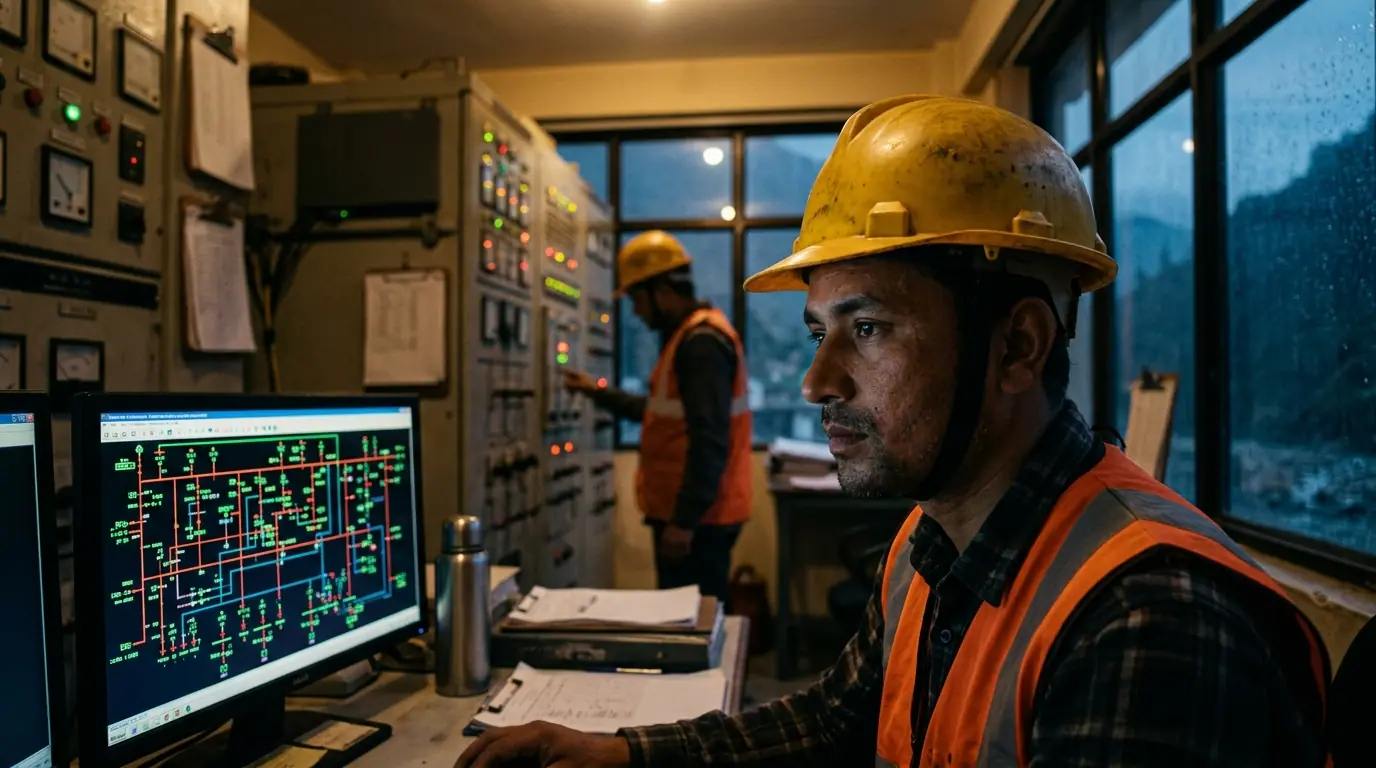
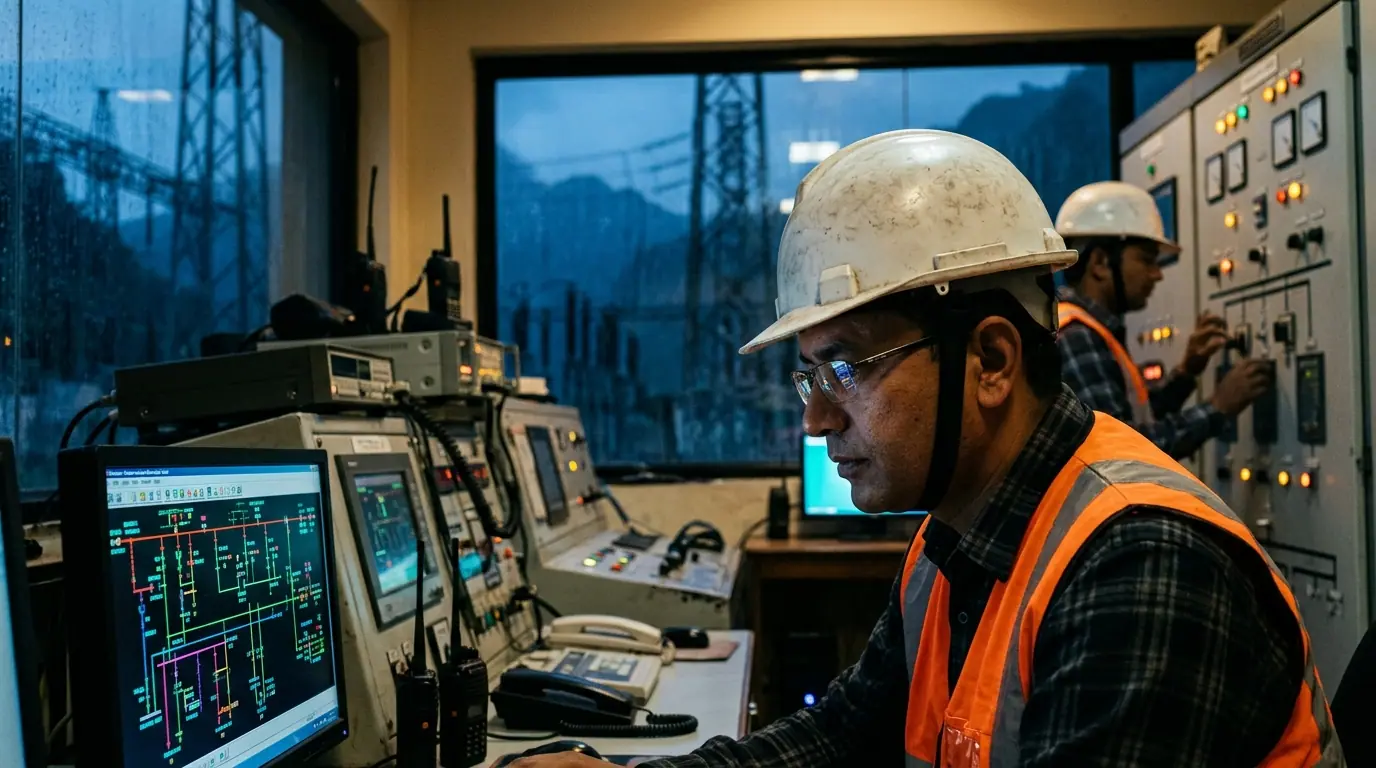
Bringing a plant back means proving it works with the grid (AI illustration)
What to study if this interests you
Hydropower Engineering (ENCE 403) covers how intakes, headworks and powerhouses are designed, and Engineering Hydrology (ENCE 306) covers the flood flows they must survive. Hydraulics (ENCE 251) is the base for both. For electronics students, Electrical Circuits and Machines (ENEE 154) explains the generators and transformers in the chain, and Engineering Economics (ENCE 307) is where questions like insurance, loans and who pays for stronger design are worked through.
A useful class exercise is to draw the chain for one real plant from this story: river, intake, powerhouse, line, substation. Mark each link, then ask which single failure would stop delivery and how long each would take to repair. That one sketch explains why a fallen tower in Myagdi mattered to six companies at once.
Words in this story
- Transmission line
- High-voltage wires on towers that carry electricity from power plants to substations far away.
- Single point of failure
- One part of a system whose failure alone stops the whole system from working.
- Test generation
- The trial period when a new plant first sends power to the grid so operators can check every system under load.
- Semi-reservoir plant
- A hydropower plant that stores a few hours of river flow so it can produce more power at the evening peak.
Where this comes from
- Radio Nepal, 30 Sep 2026
- OnlineKhabar English, 2 Oct 2026
- OnlineKhabar English, 30 Sep 2026
- NDRRMA, Situation Report #3, Gorkha Budhi Gandaki flash flood, 13 Oct 2026
- The Kathmandu Post, 16 Oct 2026
- Radio Nepal, 9 Oct 2026
Written in our own words; no sentence is copied from these reports. Researched with AI assistance and added 17 October 2026; no member of faculty has reviewed this story yet. If you spot a mistake, call 01-5091616 and we will correct it and say so.