

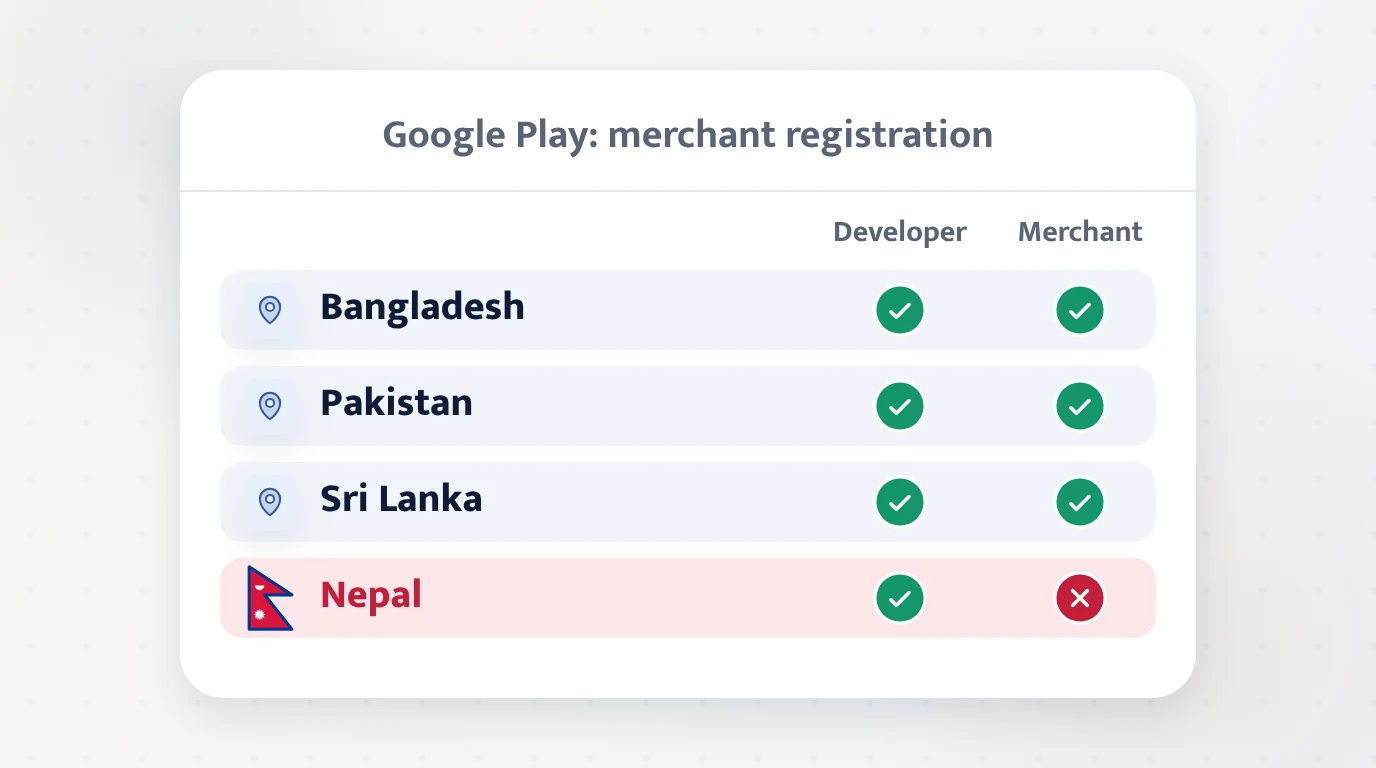
Google Play's table of supported locations has two columns that matter. Nepal has a tick in the first, for developer registration, and a cross in the second, for merchant registration. That means a developer living in Nepal can publish an app and earn from ads, but cannot sell a paid app, a subscription or an in-app purchase through Google's own billing. A Nepali game studio says Google has now named the likely reasons: the country's foreign exchange rules and the central bank's licensing of payment systems. This explainer sets out what is known, what has been proposed, and what it means for students.
- 1962year Nepal's Foreign Exchange (Regulation) Act was passed (2019 BS)
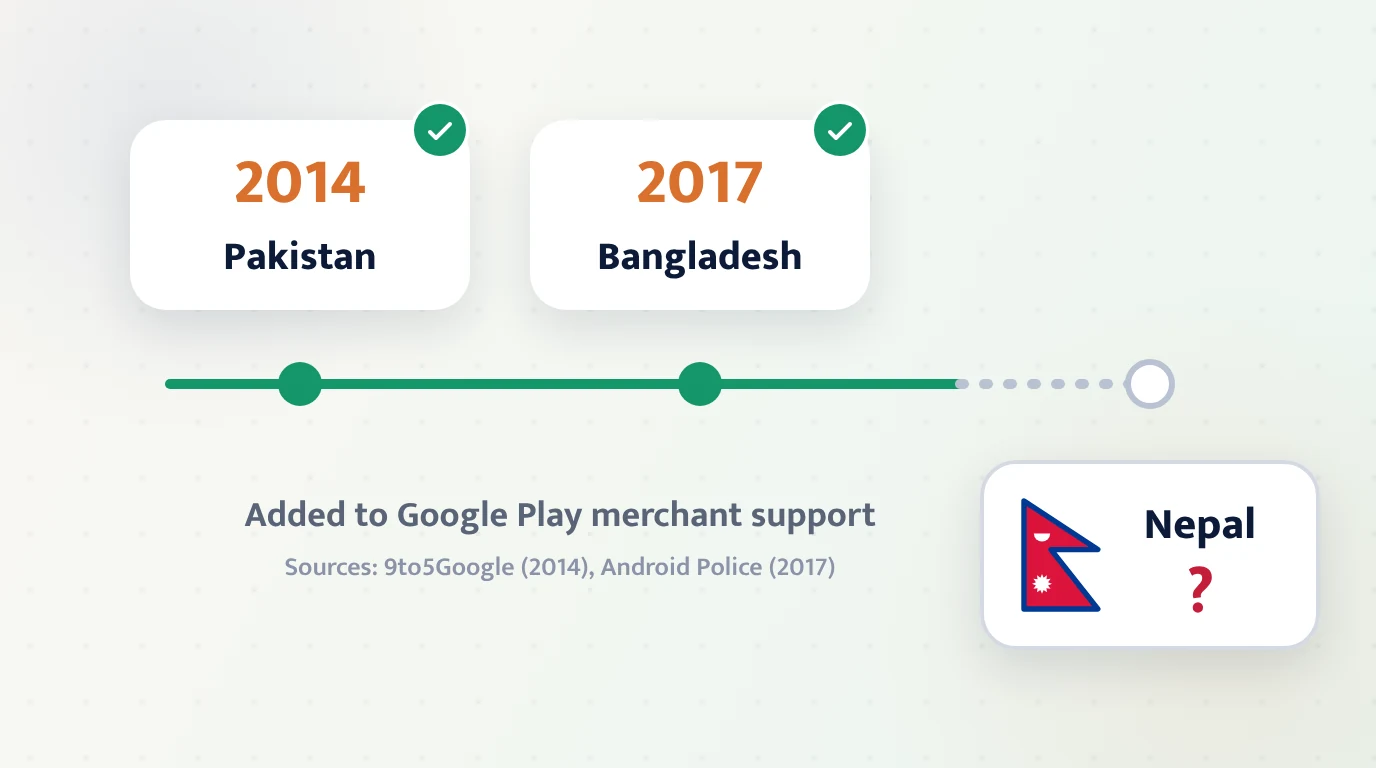
- 2014, 2017years Google added merchant support for Pakistan and Bangladesh
- USD 500annual dollar-card limit when the card arrived in March 2021
- USD 3,000annual limit of the IT prepaid card allowed in April 2026
- 5%flat tax on foreign-currency income for individual freelancers
What Google's own list says
The page is Google Play Console Help's list of supported locations for developer and merchant registration. Read on 2 November 2026, it shows Nepal as supported for developers and not for merchants, with a note that the location does not support merchants. A developer account lets someone publish. A merchant account, tied to a payments profile, is what lets Google collect money from buyers and pay it out to the seller.
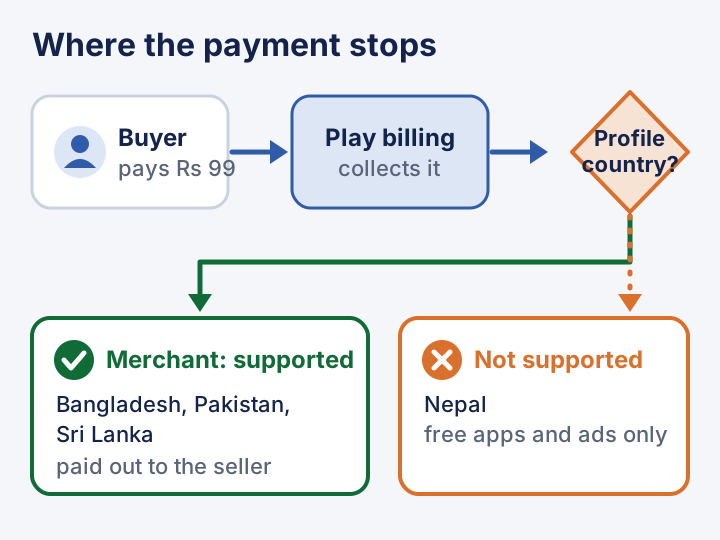
The practical line is simple. A Nepali developer can put a free app on the store and show advertising in it through Google's ad network. They cannot charge for the download, run a monthly subscription, or sell coins, lives or premium features inside the app using Google Play billing. On Android, Play billing is the standard route for digital goods sold inside apps distributed through the store.
The table governs the country of the merchant's payments profile, not where a developer lives or which bank receives the money. That is why some apps from Nepal-based developers still list in-app purchases on Google Play: what matters is where the payments profile is registered. Nepali developers have asked about merchant support for several years; what is new is a reported account of which Nepali rules are involved.
What Google reportedly told a Nepali studio
According to a post by the business news page Bajarko Chirfar, Google wrote to NJ Subedi, chief executive of the Nepali game studio Yarsa Labs, in reply to questions about merchant registration. The post says Google named difficulties with collecting international payments, converting currency and sending earnings home, and named Nepal Rastra Bank's licensing rules for digital payment systems as another possible barrier.
The wording matters. The post says Google pointed to these as possible reasons. It also says Google suggested modernising the Foreign Exchange (Regulation) Act and creating a licence route that would let a global app-store payment processor operate without setting up a full local banking entity. We could not read the email itself, and New Business Age's report on it was not reachable when this story was written, so these points rest on the post.
Ekantipur reported in 2024 that Yarsa Labs' Ludo game was one of two Nepal-made apps to pass 100 million users. Subedi plans to send a proposal to the Ministry of Finance and is collecting support from other developers.
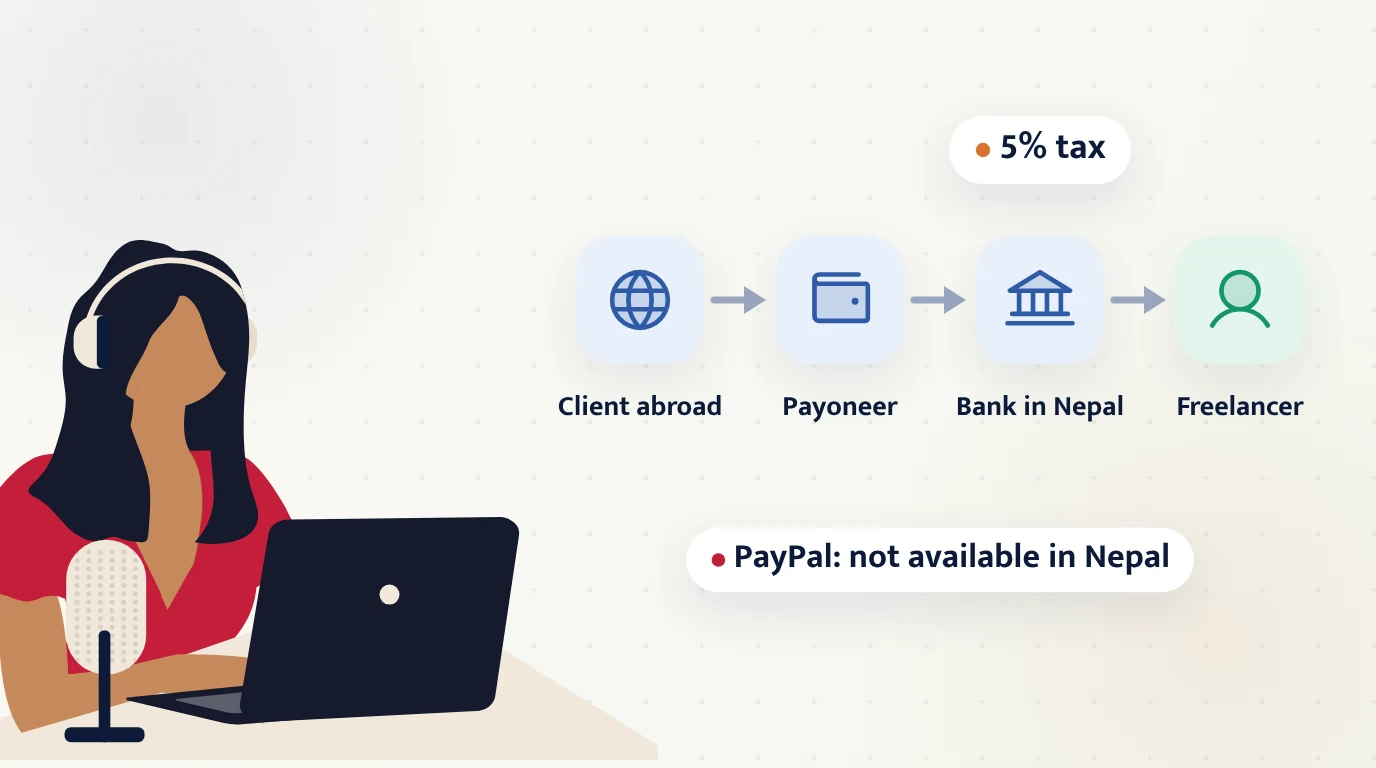
How a freelancer's foreign income typically reaches Nepal, and the 5% tax on it (illustration: ICE News)
How a 1962 law applies to app-store payments
Nepal's Foreign Exchange (Regulation) Act dates from 2019 BS, or 1962. It was written to manage foreign currency long before card payments, the internet or software exports existed. Under it, foreign exchange business needs Nepal Rastra Bank's permission, and the central bank has used that power to keep unlicensed foreign payment systems out. An app store that collects small payments from buyers worldwide, refunds some of them and pays a Nepali seller each month does not fit those categories neatly.
The central bank has eased some limits since then. In March 2021 it let banks issue prepaid dollar cards for online spending, capped at USD 500 a year. In April 2026 it allowed a separate IT prepaid card of up to USD 3,000 a year for buying IT and information-broadcasting services. Those are spending limits for people inside Nepal. They do not let a foreign store pay a Nepali seller.
Nepal's approach licenses each kind of foreign-currency transaction separately. A business model that the rules did not anticipate, such as a ten-rupee in-app purchase from a buyer abroad that may later be refunded, has no ready category. That is the gap the developers' proposal and Google's reported suggestion both point to.
Who is affected
Game and app studios earn mainly from advertising when they cannot sell inside their own apps. Advertising pays per view and favours very large audiences, while subscriptions and in-app purchases pay per committed user, which is how much mobile software earns.
Freelancers live with the same plumbing from the other side. PayPal does not operate in Nepal, so foreign clients pay through services such as Payoneer or bank transfers. ShareSansar reported on 29 October that an individual who is not a registered business pays a flat 5% on foreign-currency income received through a bank or licensed remitter, and cited a survey in which 57.9% of freelancers did not know the tax rules and average earnings were USD 4,723 a year. Developers describe the number of steps needed to be paid as the main practical difficulty.
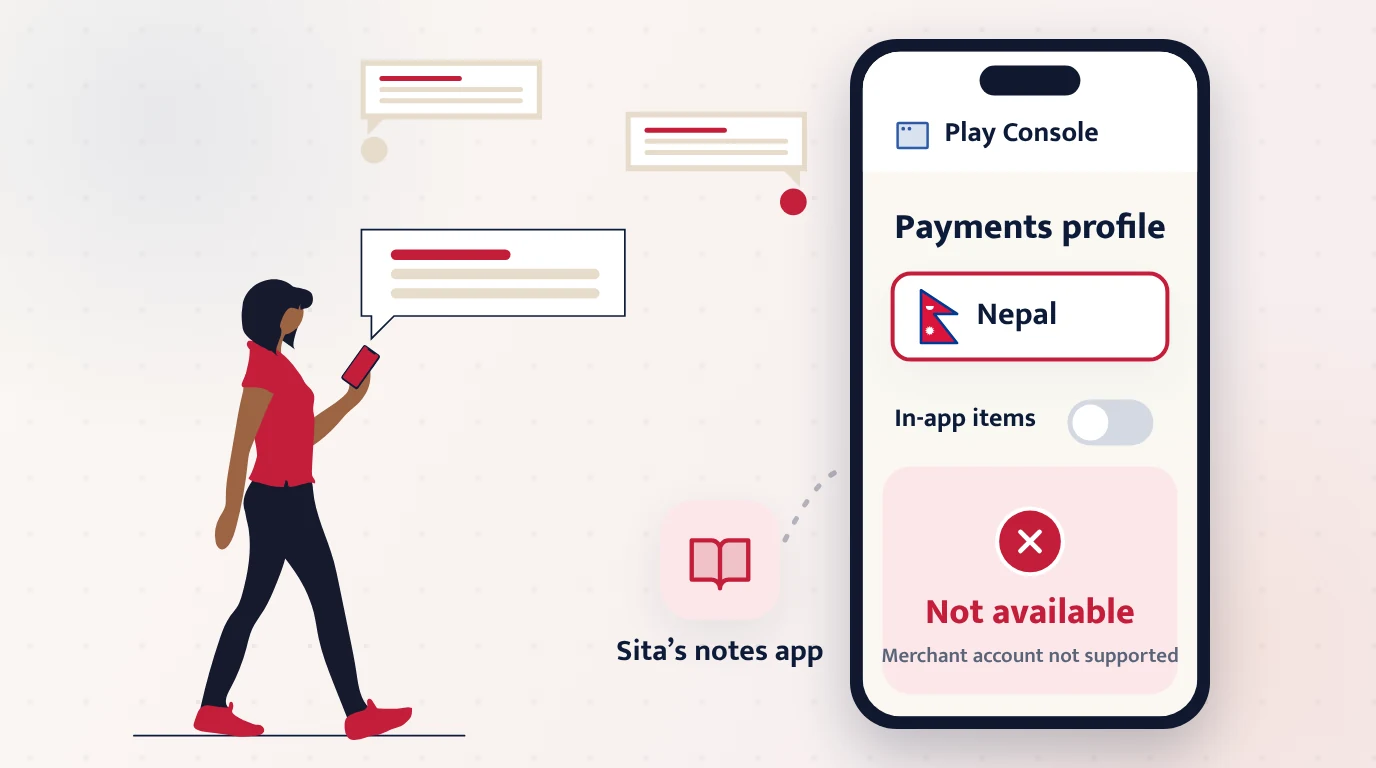
Students feel it in a concrete way. Take an illustrative case: Sita, an engineering student, builds a notes app and her friends download it. She wants to charge Rs 99 a month for premium notes. With a payments profile in Nepal, Play Console will not let her sell it, though she can still publish the free version and show ads. Some founders register a company abroad, often in the United States, to use Play billing. That route has its own costs, legal obligations and tax questions, and it moves the company's revenue outside Nepal.
What has been proposed
According to the Bajarko Chirfar post, Google suggested two directions: modernising the Foreign Exchange (Regulation) Act, and creating a licence route that would let a global app-store payment processor operate in Nepal without setting up a full local banking entity. Subedi plans to send a proposal along these lines to the Ministry of Finance and is collecting support from other developers.
The card changes described above cover spending from Nepal. A merchant licence route would be a different kind of change, because money would flow into Nepal from a foreign payment processor rather than out of it on a card. That is why the request is addressed to the Ministry of Finance, which proposes amendments to the Act, as well as to Nepal Rastra Bank, which issues the licences.
Neighbouring countries are already on the merchant list. Google's table shows Bangladesh, Pakistan and Sri Lanka as supported. Google added Pakistan, with six other countries, in November 2014, and Bangladesh, with South Africa, in November 2017, according to reports at the time. Pakistani developers had previously used foreign-registered accounts, as some Nepali developers do now.
Any change would have to balance the central bank's aims, such as tracking foreign-currency flows and preventing unlicensed payment channels, against the needs of software exporters. Other countries with foreign exchange controls license payment intermediaries in different ways. No decision has been announced, and the sources describe a request, not a policy.
What students can do now
Students do not need a merchant account to learn the engineering. Build the free version of an app and measure it properly: retention, crash rates and what users actually do. Those numbers matter whichever way an app later earns money.
Learn how payment systems handle refunds, currency conversion and fraud, because those are the problems regulators and payment providers work on, and engineers who understand them can contribute to compliant designs. Reading Google Play's billing documentation is useful even before it can be used from Nepal.
Developers who want to take part can follow the proposal to the Ministry of Finance through the industry groups and the post linked below. This news section will report any decision by the ministry or Nepal Rastra Bank when it is published.
Words in this story
- Merchant account
- The Google Play payments profile that lets a developer receive money from paid apps, subscriptions and in-app purchases.
- In-app purchase
- Digital goods or features bought inside an app, such as game currency or a premium tier, billed through the store.
- Foreign Exchange (Regulation) Act
- Nepal's 2019 BS (1962) law governing foreign currency dealings, administered by Nepal Rastra Bank.
- Dollar card
- A prepaid card in US dollars that Nepali banks may issue for online spending, within an annual limit set by Nepal Rastra Bank.
Where this comes from
- Google Play Console Help, 2 Nov 2026
- Bajarko Chirfar (LinkedIn), 1 Nov 2026
- New Business Age, 1 Nov 2026
- Techmandu, 7 Apr 2026
- Onlinekhabar English, 27 Mar 2021
- ShareSansar, 29 Oct 2026
- Ekantipur, 2 Jun 2024
- 9to5Google, 7 Nov 2014
- Android Police, 7 Nov 2017
- TechJuice, 7 Nov 2014
Written in our own words; no sentence is copied from these reports. Researched with AI assistance and added 17 October 2026; no member of faculty has reviewed this story yet. If you spot a mistake, call 01-5091616 and we will correct it and say so.