

How to Read Lalpurja Area Notation in Nepal
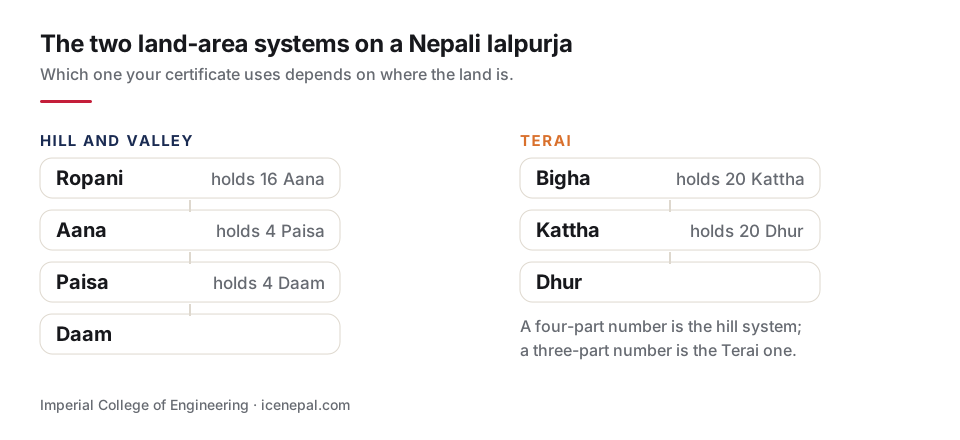
When you look at a lalpurja (land ownership certificate) in Nepal, the land area is typically not written in square feet or square metres. It is written as a four-number or three-number hyphenated format, and which one you are reading tells you where the land is.
The two land measurement systems
Nepal uses two distinct traditional systems to measure land, depending on the geography.
- Hill and valley: Ropani, Aana, Paisa, DaamFour numbers, read left to right
- Terai: Bigha, Kattha, DhurThree numbers, read the same way
- 1 Ropani is 16 Aana, 1 Aana is 4 Paisa, 1 Paisa is 4 Daam
- 1 Bigha is 20 Kattha, 1 Kattha is 20 Dhur
Reading Ropani-Aana-Paisa-Daam, for example 0-4-2-1
If your land is in the hills or in the Kathmandu valley, the area is recorded in four parts: Ropani, Aana, Paisa and Daam. A notation like 0-4-2-1 reads directly from left to right: 0 Ropani, 4 Aana, 2 Paisa, 1 Daam.
To understand the relative size, keep the divisions in mind: 1 Ropani is 16 Aana, 1 Aana is 4 Paisa, and 1 Paisa is 4 Daam.
Reading Bigha-Kattha-Dhur, for example 1-5-10
If your land is in the Terai, the area is recorded in three parts: Bigha, Kattha and Dhur. A notation like 1-5-10 means 1 Bigha, 5 Kattha and 10 Dhur. The conversion works the same way: 1 Bigha is 20 Kattha, and 1 Kattha is 20 Dhur.
Convert your lalpurja area instantly
You do not need to do the arithmetic by hand. There is a converter on this site where you can enter the area from your lalpurja and read it back in square feet, square metres, hectares and the other standard units used in Nepal.
Last reviewed by Imperial College of Engineering. Every figure on this page is cited to the document it came from.