About the subject
What Engineering Mathematics I is for
Most students arrive knowing how to differentiate and integrate. This course asks for something different: using those tools to describe real shapes and real change. Curvature tells a road designer how sharply a curve bends, the area and volume of revolution give the size of a tank or a dome, and a first-order differential equation describes how a capacitor charges or a body cools.
The course is shared by all three programmes, so the class you sit with in Semester 1 is the widest you will have. Every later mathematics course, and much of physics and mechanics, assumes you are fluent in what is taught here.
To equip the students with the essential mathematical skills and techniques that are relevant to the engineering fields and enable them to solve engineering problems using mathematical methods.
IOE's course objective for ENSH 101
- Taught to
- BCE, Semester 1 (Year I, Part I), BCT, Semester 1 (Year I, Part I) and BEI, Semester 1 (Year I, Part I)
- Weekly
- 3 lecture, 2 tutorial, 0 practical hours
- Marks
- Theory 40 internal + 60 final (3-hour exam); 100 in total
Where the marks are
ENSH 101 chapters, hours and final exam marks
IOE prints no chapter marks table for this course, so the share of lecture hours is the best guide to where the 60 final marks will fall.
Scroll the table sideways for hours, marks and share.
Full syllabus
The complete ENSH 101 outline, with how to study each chapter
All 5 chapters and 24 topics as IOE lists them, each with ICE's advice on approaching it.
1Derivatives and its Applications10 hours
Start with the mean value theorems and L'Hospital's rule, which are short and reliable. Asymptotes, pedal equations and curvature reward drawing the curve before calculating anything.
- 1.1 Review of derivative and differentiability, mean value theorems with interpretations
- 1.2 Indeterminate forms, types and their real life examples, L-Hospital's rule
- 1.3 Power series of single valued functions
- Taylor's series
- Maclaurin's series
- 1.4 Asymptotes to Cartesian and Polar curves
- 1.5 Pedal equation to Cartesian and Polar curves
- 1.6 Curvature and radius of curvature for Cartesian curves
2Antiderivatives and its Applications11 hours
The longest chapter by hours. Beta and Gamma functions look new but follow a small set of identities; learn those identities and most improper integrals become routine. Area, arc length and volume of revolution are the applied half.
- 2.1 Review of definite and indefinite integrals
- 2.2 Differentiation under integral sign
- 2.3 Improper integrals
- 2.4 Application of Beta and Gamma functions
- 2.5 Area, arc length, volume and surface of revolution in plane for Cartesian curves
- 2.6 Centroid and moment of inertia under area of curve
3Ordinary Differential Equations and its Applications10 hours
Classify the equation first: separable, linear, Bernoulli, Clairaut, or second order with constant coefficients. Choosing the method is most of the work, and the engineering applications at the end use the same methods on physical problems.
- 3.1 Review of order, degree, solution of first order first degree differential equations by variable separation method and solution of homogeneous equations
- 3.2 Linear differential equation and equations reducible to linear differential equation of first order Bernoulli’s equation, modeling electric circuit
- 3.3 First order and higher degree differential equations; Clairaut’s form
- 3.4 Linear second order differential equations with constant coefficient and variable coefficients reducible to constant coefficients, Cauchy’s equations and modeling mass spring system
- 3.5 Application in physical sciences and engineering
4Plane Analytic Geometry4 hours
A short chapter on moving and rotating axes and identifying conics. Practise recognising a conic from its general equation.
- 4.1 Transformation of coordinates: Translation and rotation
- 4.2 Equation of conic in Cartesian and Polar form, identification of conics
5Three dimensional geometry10 hours
Three-dimensional geometry is where visualisation matters. Sketch the line, plane or sphere before writing equations; shortest distance and tangent planes are far easier to set up from a diagram.
- 5.1 The straight line: Symmetrical and general form
- 5.2 Coplanar lines
- 5.3 Shortest distance
- 5.4 Sphere: General equation, plane section by planes, tangent planes
- 5.5 Introduction to right circular cone and right circular cylinder
Tutorials
Practising Engineering Mathematics I
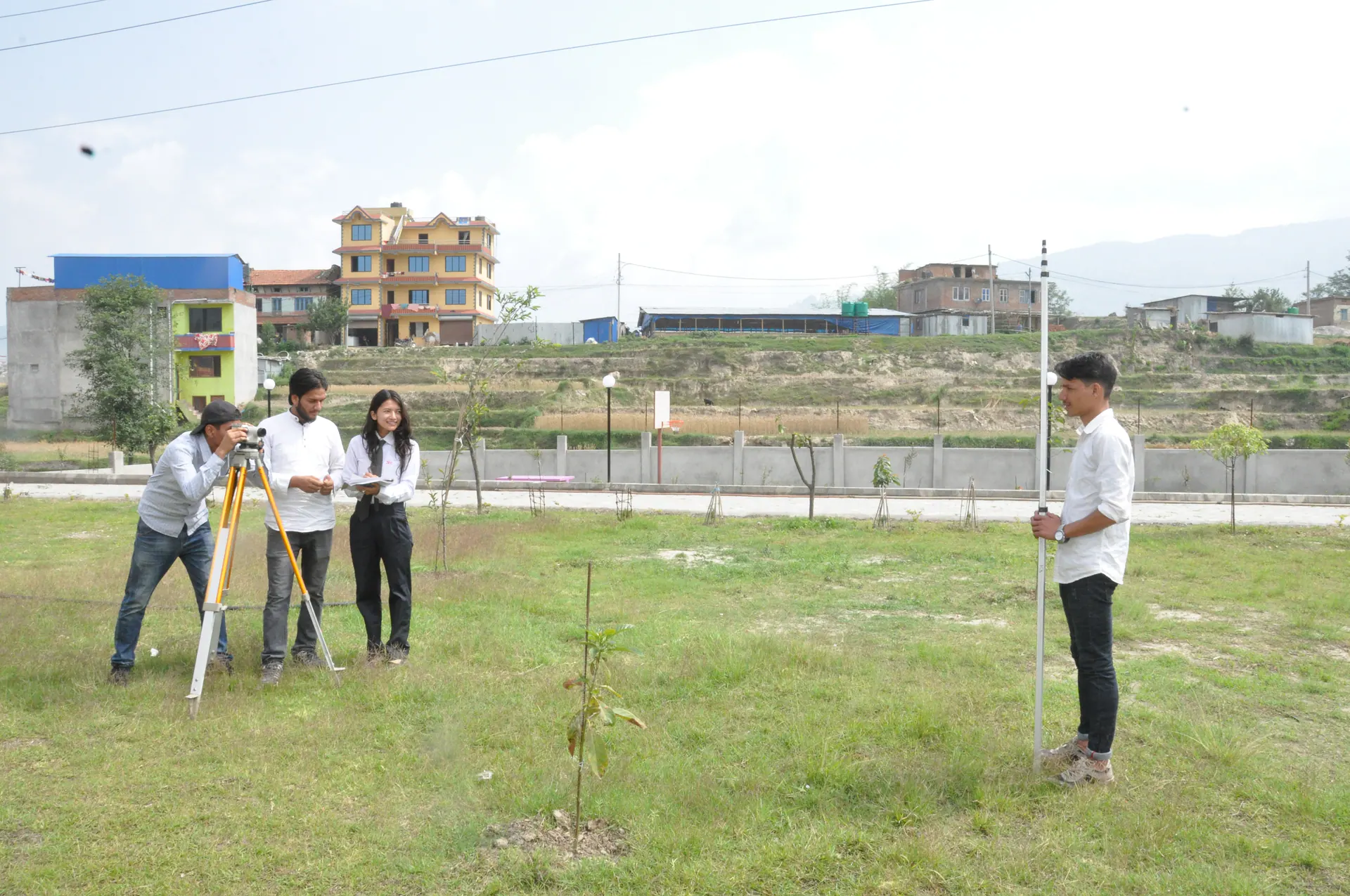
The course carries two tutorial hours a week and no laboratory, so the tutorials are where practice happens. Working problems by hand every week matters more here than in almost any other subject, because the later mathematics courses assume this material without revisiting it.
Before and after
How Engineering Mathematics I connects to other courses
Leads to
Mathematics II continues directly from it in Semester 2. Physics and Civil's Engineering Mechanics use its derivatives, integrals and differential equations from the first weeks.
Reference books
Books IOE lists for ENSH 101
- Jeffery, A., (2001), Advanced Engineering Mathematics. Academic Press.
- O’Neill, P.V., (2003), Advanced Engineering Mathematics. Thomson Learning.
- Kreyszig, A. (1993), Advanced engineering Mathematics (Latest Edition). John Wiley & Sons.
- Sastry, S.S. (2008), Engineering Mathematics Volume I and II. PHI India.
- Wylie, C., Barrett, L.(1995), Advanced Engineering Mathematics (Latest Edition), McGraw-Hill College.
- Thomas, T., Finny, R. (1984), Calculus and Analytic Geometry (Latest Edition.), Addison-Wesley.
Quick answers
Engineering Mathematics I questions
Is Engineering Mathematics I the same for Civil, Computer and BEI?
Yes. All three programmes take ENSH 101 in Semester 1 with the same outline, the same credits and the same 40 internal and 60 final marks.
Which chapter of Engineering Mathematics I has the most teaching hours?
Antiderivatives and its Applications, at 11 of the 45 lecture hours, followed by derivatives, differential equations and three-dimensional geometry at 10 hours each.
What is the best way to prepare for Mathematics I?
Keep up with the weekly tutorial problems and revise +2 calculus in the first weeks. The course builds on differentiation and integration from the start.
How many credits and marks is ENSH 101 Engineering Mathematics I?
3 credits and 100 marks: 40 internal and 60 in a 3-hour IOE final for theory. It is taught 3 lecture, 2 tutorial and 0 practical hours a week.
Source
Checked against IOE
The outline, references and marks are IOE's own, from the ENSH 101 syllabus PDF and IOE's curriculum structure. The study advice is ICE's. If IOE revises the course, its syllabus is what counts. IOE's BCE curriculum page.