


Abstract
At 08:37 on 26 August 2026 a bedrock and glacier mass of 100 to 200 million cubic metres failed about 20 km inside China, dropped 1,200 m into the Lhende Khola and became a debris flow that ran down the Bhote Koshi and the Trishuli. It killed at least 1,451 people in Nepal. A month later, four days of forecast rain closed the Prithvi and BP highways again but killed few people.
We put one question to two AI research agents arguing opposite sides, and checked their work against the sources: was the loss preventable? After a brief and a rebuttal each, the two sides agreed on more than they disagreed. The hazard was natural and its day could not be predicted. It was detected within seconds, but the warning chain took longer than the flood. Exposure in the river channel was the result of decisions. The disagreement narrowed to one quantity: what share of the dead could a working warning have reached. We find that the evidence supports a middle position. Little could have been done in the upper gorge. Much more could have been done downstream. The September road closures came from a weakness that was known for years and could have been fixed.
Rasuwa flood 2026: key facts
| When | 26 August 2026, collapse registered at 08:37 Nepal time |
|---|---|
| Cause | Bedrock and glacier failure of 100 to 200 million m³ about 20 km inside China, which became a debris flow (ICIMOD). Not a glacial lake outburst. |
| Rivers | Lhende Khola, Bhote Koshi, Trishuli, and on to the Narayani |
| Dead | 1,451 (NDRRMA, 21 to 26 September) |
| Missing | 5,285 (NDRRMA via Republica, 26 September) |
| Most bodies recovered | Chitwan 367, Rasuwa 236, Nawalparasi East 232 |
| Warning | Detected in seconds. DHM learned by phone about 16 minutes after the flood crossed the border. SMS reached about 679,000 phones at 09:15 by DHM's account. |
| Infrastructure | 41 bridges and about 40 km of road damaged; 431 MW of hydropower offline |
| Damage | USD 2.66 billion (government rapid assessment); recovery need USD 4.71 billion |
SECTION 1
Method
The Imperial Research Team at Imperial College of Engineering wrote this report, with AI-assisted research and drafting. Three separate AI research agents worked from the same starting file of verified facts, and the team checked every figure against the sources listed below. One compiled a neutral fact base. One built the strongest honest case that the loss was largely preventable. One built the strongest honest case that it was driven by an extreme, poorly predictable hazard, met by a response about as good as Nepal's means allowed. Each had to cite a source for every factual claim, mark what it could not verify, name the three weakest points in its own case, and anticipate the other side. Each then read a summary of the other's brief and wrote a rebuttal.
This is an adversarial method borrowed from legal and policy review. Its value is that each side's evidence is tested by someone motivated to break it, and that the concessions each side makes under pressure are more informative than its opening claims.
How to read the figures
Two official series exist for the toll. This report uses the National Disaster Risk Reduction and Management Authority (NDRRMA) throughout. Nepal Police published higher counts in early September that included 532 partial remains. They are a different series and are not mixed in here. The missing count has fallen as well as risen, because district offices have removed duplicates and matched identified bodies, so a falling number means records were corrected, not that people were found.
SECTION 2
What happened in the Rasuwa flood on 26 August 2026?
The mechanism
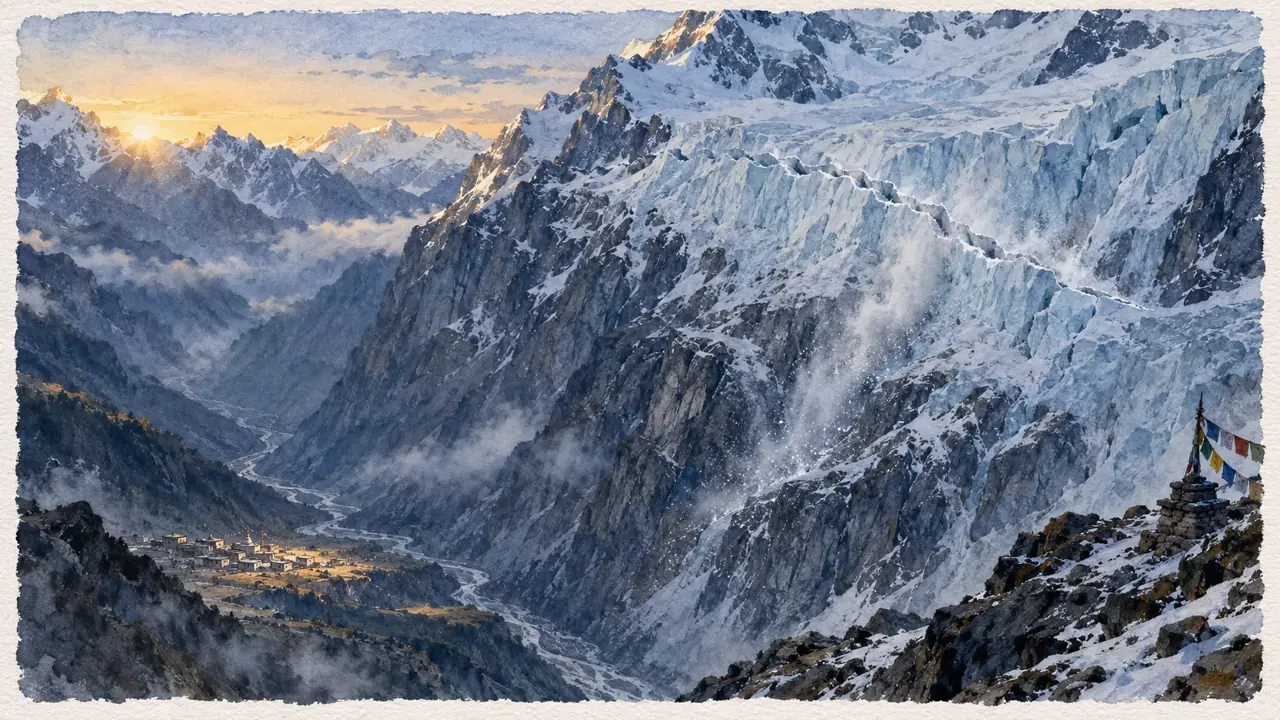
ICIMOD classes the event as an ice and rock avalanche that became a debris flow, not a glacial lake outburst, although early reports called it a GLOF. The failure began in fractured gneiss and schist at about 5,000 to 5,500 m near a fault, in a summer running 1.5 to 2 °C above normal. The failed face was about 600 m across. The flow travelled at roughly 190 km/h over its first 22 km. It raised a wall of water about 100 m high at Timure, lifted the Trishuli 9 m in 30 minutes at Galchhi and 7 m at Malekhu, damaged settlements along 72 km, and carried bodies 240 km downstream into India.
The warning chain
- The collapse registers as a Ms 5.2 seismic event at Jilong (12 km) and Zhangmu, both on the Chinese side. USGS later attributes the signal to the collapse.
- Nepal's border gauges stop reporting.
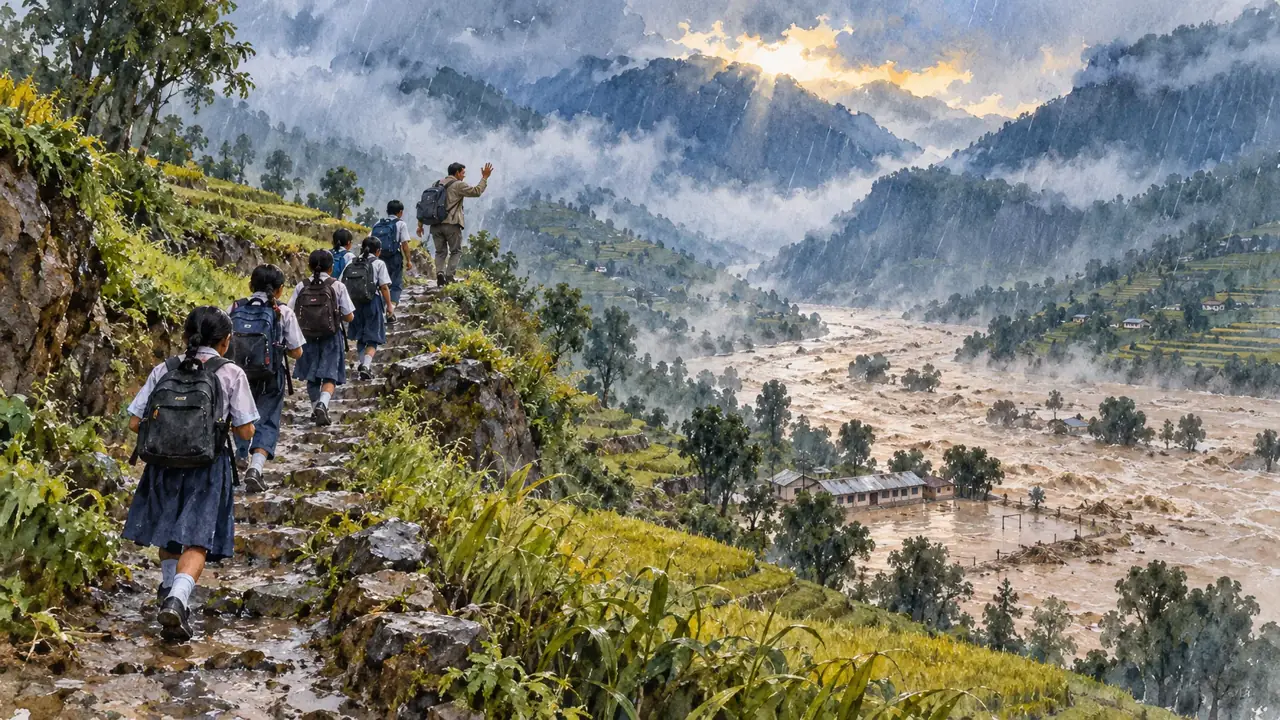
- Phone calls from upstream reach a head teacher downstream, who moves about 900 students uphill. The school floods ten minutes later.
- The flood crosses into Nepal, about 35 minutes after the collapse. The clock time is 08:37 plus 35 minutes, not a reported reading.
- DHM's mass SMS goes to about 679,000 phones, by DHM's account. The Prime Minister told Parliament 09:35. Neither time has been independently verified.
- DHM learns of the flood by telephone, relayed from the Rasuwa district office through NDRRMA, about 16 minutes after it crossed the border. The full human relay took about 51 minutes.
Times from ICIMOD, the Kathmandu Post reconstruction of 28 August, Mongabay (15 September) and Nepalnews. ICIMOD records a disputed alternative sequence in which the river was dammed for 18 to 19 hours after a collapse on the afternoon of 25 August.
The toll over time
| Date (2026) | Dead | Missing | Rescued | Source |
|---|---|---|---|---|
| 31 Aug | 903 | 4,247 | 10,451 | NDRRMA, 09:00 |
| 3 Sep | 1,259 | 5,083 | 12,038 | NDRRMA press conference |
| 4 Sep | 1,294 | 5,053 | 13,095 | NDRRMA, evening |
| 8 Sep | 1,357 | 5,326 | 13,583 | NDRRMA, 13:00 |
| 9 Sep | 1,369 | 5,132 | 13,646 | NDRRMA, 18:00, via Ratopati |
| 19 Sep | 1,411 | 5,875 | 13,784 | SitRep #18 |
| 21 Sep | 1,451 | 5,745 | 13,784 | SitRep #20 |
| 26 Sep | 1,451 | 5,285 | 13,795 | NDRRMA via Republica |
The 16 September jump in the missing followed a district data reconciliation, not new loss. SitRep #20 counts two deaths during treatment in Kathmandu inside 1,451.

Where the bodies were recovered
SitRep #20 (21 September) lists: Chitwan 367, Rasuwa 236, Nawalparasi East 232, Nawalparasi West 222, Nuwakot 203, Gorkha 79, Dhading 72, Tanahun 38, and 2 who died in treatment in Kathmandu. Two charts in the same report swap the Rasuwa and Nuwakot figures, and the totals agree. Rasuwa and Nuwakot hold almost all of the missing (about 3,500 and 1,700 before deductions), with 636 foreign nationals.

A caution both debaters missed
A body recovered in Chitwan did not necessarily die in Chitwan. Bodies were carried 240 km. The district table therefore says where the river left people, not where the flood reached them. The upstream districts hold the missing, and the missing are overwhelmingly people who were in the upper gorge. This matters for Section 6.
SECTION 3
Why did the Prithvi Highway close again at Krishnabhir in September?
On 20 September a meteorologist, Binod Pokharel, used the ECMWF, GFS and ICON models to warn of exceptionally heavy rain from 24 to 28 September. On 22 September DHM forecast heavy to extremely heavy rain for 25 to 27 September and the Nepal Tourism Board issued a travel advisory. The rain began on 24 September.
- Deaths. Nepal Police counted 6 dead in four provinces and 407 rescued by 27 September. The government BIPAD portal recorded 3 rain-related deaths and 1 missing. BIPAD entries lag, so it is a floor.
- Rivers. The Narayani reached 9.23 m at Devghat at 05:15 on 27 September (danger level 9.0 m). The Riu reached 3.92 m (danger 3.8 m). The Tinau crossed its danger mark at 20:00 on 26 September and swept six houses away in Butwal, where about 1,000 people were evacuated overnight.
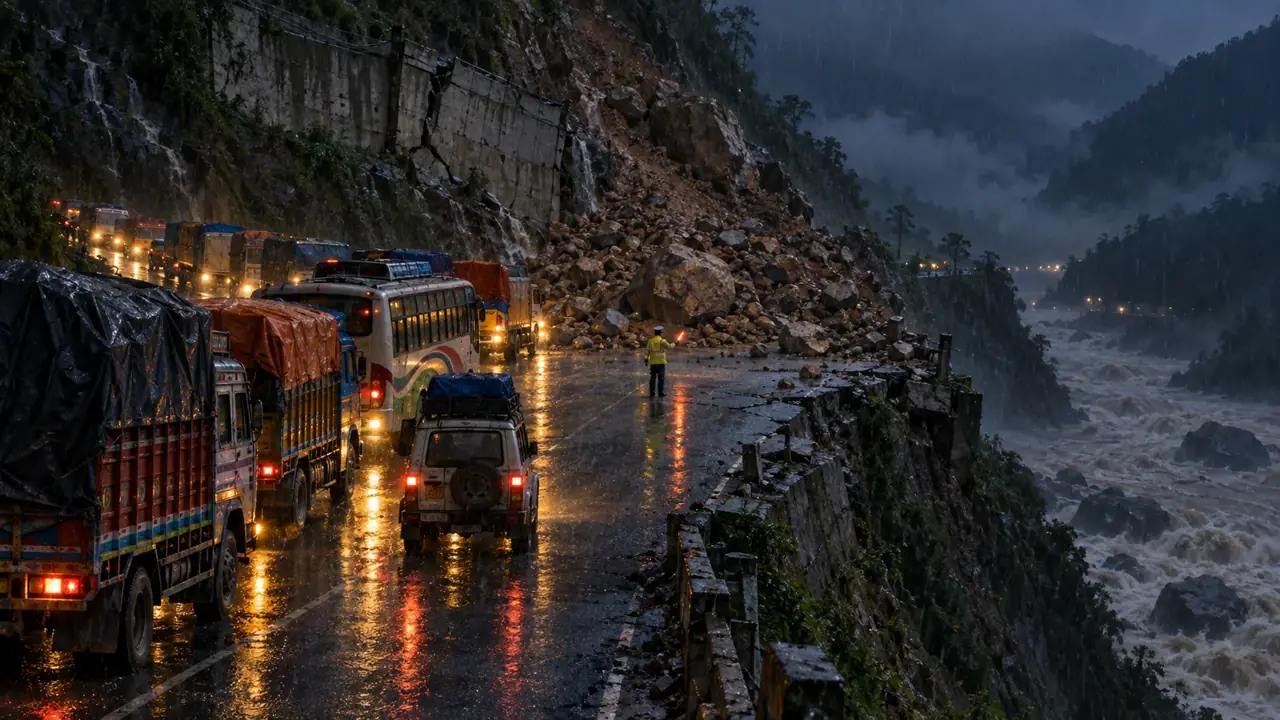
- Roads. The Prithvi Highway was blocked at Krishnabhir, Chaukibhir, Jawang Khola and Fisling, and the Dhading administration stopped traffic until the rain eased. The BP Highway lost its temporary diversions to the Roshi. The Kathmandu to Hetauda roads were restricted. On 27 September the Narayanghat to Muglin road was blocked at Dharapani and Simaldhara.
Krishnabhir had reopened to two-way traffic only on 17 September, on a newly cut track, after the August flood undercut it. The slope first failed in 1999 and blocked the highway for more than 11 days in 2000. Its protective works had a design life of about 20 years, and it began moving again in October 2025.
Why September matters to the August argument
September is a natural experiment. The same agencies faced a hazard that could be forecast days ahead, and deaths stayed in single figures, against about 250 in the comparable rain event of September 2024. The same roads still failed. The warnings worked, and the roads still failed.
SECTION 4
The debate, point by point
Each row pairs the strongest form of each side's argument after rebuttal, followed by our reading of where the evidence leaves it.
4.1 Could it have been seen coming?
Preventable
Sentinel-1 radar shows the rock and ice mass creeping about 10 mm a month from January and accelerating in the weeks before it failed. ICIMOD cites about 30 cm of displacement in prior weeks. The same corridor flooded in July 2025, and a 2025 Stimson paper warned the Bhotekoshi to Trishuli hydropower cascade could be hit by "a single extreme flow event".
Unavoidable
The precursor was found after the collapse, by researchers who note 10 mm a month is easy to miss when glaciers move 10 to 200 m a year. The slope is in China, where Nepal has no mandate to instrument. The 2025 flood was a supraglacial lake outburst and 2026 was a bedrock failure, and lake monitoring would not have watched a rock face.
Our reading. The day could not have been predicted with any operational confidence, and both sides accept that. The prosecution's stronger point is not prediction but that the corridor had been named as a hazard in advance.
4.2 Was it detected, and did the warning work?
Preventable
The collapse was a Ms 5.2 event detected in seconds. Nepal's own border gauges went dark at 08:40 on a morning without rain, which is an alarm in itself. DHM still learned by telephone 16 minutes after the flood crossed. The SMS was generic, Nepali only, and fighting alert fatigue. A worker in Rasuwa described about 30 seconds between the alert and the water.
Unavoidable
The seismometers are Chinese. An automatic trigger needed a live cross-border feed that nobody has shown existed. Chamoli in India, in 2021, gave no warning over a comparable window. The SMS failings are real and cheap to fix, which argues for reform, not for blame for the whole toll.
Our reading. This is where the prosecution is strongest, and the defence conceded the relay was too slow. A rule that treats a dead border gauge as an alarm would not have needed China. The 2025 data-sharing understanding with China produced nothing on the day.
4.3 Who put people in the channel?
Preventable
Ten to fifteen hydropower projects were damaged and 431 MW went offline. The run-of-river design puts intakes, powerhouses, camps and shifts on the valley floor, with tunnel exits back toward the river. Hundreds of hydropower workers are among the missing. Design against a 50-year flood ignores cascading hazards.
Unavoidable
Conceded as the strongest structural point. But it is a question of land use, not of warning or response, and the army brought 350 workers out of the Upper Trishuli-1 tunnel alive.
Our reading. Agreed by both sides. Exposure was a decision, made project by project, with no body responsible for the cumulative risk of a cascade on one river.
4.4 Was the response adequate?
Preventable
Every response figure is accepted and the people who did the work deserve credit. A large rescue shows how large the loss was. It does not show that the loss was unavoidable.
Unavoidable
About 20,600 security personnel, 394 helicopter sorties by early September, Rs 5.2 billion mobilised, more than 13,600 rescued by 10 September, and tunnel teams from India, China and South Korea. For a country facing a bill of about 10% of GDP, that is a large response.
Our reading. The two sides answer different questions. The response was large and effective after the fact, but it is not evidence about prevention.
4.5 Money
Preventable
A Green Climate Fund early-warning project had USD 36.16 million committed and was not built by September 2026. Against damage of USD 2.66 billion, that is a trade Nepal did not make. Tsho Rolpa's sirens, built for USD 3.2 million in 2002, fell out of service the same year for lack of upkeep.
Unavoidable
An unbuilt donor project points to procurement pipelines, not neglect. Nepal's loss-and-damage claim was USD 20 million against USD 2.7 billion in damage, about 0.7%. More than USD 820 million has been pledged, and no source shows how much has been paid.
Our reading. Money to build was not the main limit. The main limit was that nobody owned the systems once they were built.
4.6 The comparison with richer states
Preventable
That richer states fail too shows the failure is common, not that it is natural. The lesson is to act on any sudden anomaly, whatever its cause.
Unavoidable
Chamoli (2021, about 204 dead, no warning), Sikkim (2023, a lake flagged for years, no warning, Teesta III dam lost) and Melamchi (2021) show well-funded systems missing this class of hazard. The 2026 source volume was five to seven times Chamoli's.
Our reading. The comparisons show the problem is regional. They do not excuse a missing gauge-silence rule or the Krishnabhir slope.
SECTION 5
Where both sides agree
Common ground after rebuttal
- The hazard was natural, originated in China, and its day could not be predicted.
- It was detected within seconds, and the human relay of about 51 minutes was longer than the 35-minute window.
- The official SMS was poorly designed, and community phone networks saved lives and should be built into the formal system.
- Hydropower in the channel and a single-route highway concentrated the exposure.
- Tsho Rolpa shows that warning systems without a named owner for maintenance fail.
- Nepal needs an automated seismic and gauge trigger, shared with China, and alerts that tell people what to do, in more than one language.

The single remaining disagreement is quantitative: how many of the 1,451 dead, and of the 5,285 missing, sat within reach of a warning that worked.
SECTION 6
Was the Rasuwa flood preventable? Our assessment
Neither side can compute the preventable share, and we will not invent one. But the evidence bounds it.
In the upper gorge, from the source to Timure and Rasuwagadhi, the flow arrived within minutes of the collapse at close to 190 km/h. Even an automatic trigger would have given seconds to a few minutes, and workers deep in tunnels could not have used them. Most of the missing were here. Both sides accept that little was preventable in this reach once the rock failed.
Downstream, the arithmetic changes. The river took tens of minutes to hours to reach Galchhi, Malekhu and beyond. A head teacher with a phone call emptied a school with ten minutes to spare. A system that fired on a dead border gauge at 08:40 would have reached this corridor well before the water. The prosecution's claim is strongest here, and the defence did not contest it.
The roads are the clearest case. Krishnabhir has been a documented failure for 26 years, and the September closure happened during a well-forecast event in which few people died. That is a failure of infrastructure planning, not of hazard.
Illustrative only. The widths show the shape of the argument, not a measured share of the toll.
Our position is this. The hazard could not have been prevented. A meaningful part of the loss could have been. The useful question now is which office owns each of the systems listed below.
SECTION 7
Recommendations
- Make silence an alarm. Any border gauge that stops reporting on a dry day should trigger downstream sirens automatically, without waiting for a human relay. This needs no Chinese cooperation.
- Turn the 2025 understanding into a live feed. Seismic and gauge data from Jilong and Zhangmu should reach DHM machine to machine, with an agreed trigger threshold.
- Rewrite the alert. Location-specific, action-first messages ("move uphill now, the river will rise in 20 minutes"), in Nepali, Tamang and English, sent by an office with the legal authority to order evacuation.
- Wire in the community network. The phone calls that saved 900 students should be a designed part of the system, with named upstream contacts in every river settlement.
- Assess cascades, not projects. Hydropower approvals on one river should be tested against the cumulative risk of a single extreme flow, and worker camps and shift rosters moved out of the channel.
- Give every system an owner for its whole life. Before donor money builds a warning system, name the office that will run and pay for it in year five. Tsho Rolpa is the cost of skipping this.
- Build a second road. A tunnel or bridge alignment at Krishnabhir, and a real alternative corridor into the Valley, so one slope cannot close the capital's link to the west.
SECTION 8
Open research questions
For students and researchers in engineering, hydrology and public policy, these are unanswered and within reach.
- Can routine InSAR monitoring detect precursor creep at operationally useful lead times across the transboundary Himalaya, and at what false-alarm rate?
- What is the travel-time profile of the 26 August flow at each gauge, and what warning time did each downstream settlement actually have?
- How should run-of-river projects in a cascade be designed and staffed against a debris flow of this size?
- Which alert wording, languages and channels change behaviour in Nepali mountain communities?
- What is the residual life of the Krishnabhir protective works, and what is the cost comparison between repeated repair and a tunnel?
- How should a missing-person count be reconciled across districts, and how should it be communicated while it is still moving?
No peer-reviewed study of the 26 August event had been published as of 27 September 2026. The government's Post Disaster Needs Assessment is due in mid-October.
SECTION 9
Limits of this report
- It was compiled within a month of the event, from official releases, news reports and preliminary institutional analysis. Figures will move.
- Several figures come from single sources and are marked in the source list: the 30-second account, the 933 missing hydropower workers, the GCF project status, and the government rapid damage figures.
- The timing of the official SMS is disputed and unverified.
- The rival sequence in which the river was dammed for 18 to 19 hours on 25 August has not been resolved.
- The two debating positions were assigned, not chosen. Their arguments are the strongest honest versions we could build, not the view of the college.
CORRECTIONS
Corrections log
The Imperial Research Team corrects this report in the open. Every change of fact is listed here with its date, what the report said before, and what it says now. To report an error, please call 01-5091616 or write to [email protected] with the section and your source.
- 27 September 2026: first published. No corrections yet.
SOURCES
Sources
Read between 21 and 27 September 2026. Single source marks figures that one source carries and we could not check against a second.
- NDRRMA, Situation Report #20, 21 Sept 2026. https://ndrrma.gov.np/mediafiles/rasuwa/SitRep_ENG_20_21092026.pdf
- NDRRMA, Situation Report #18, 19 Sept 2026. https://ndrrma.gov.np/mediafiles/rasuwa/SitRep_ENG_18_19092026.pdf
- NDRRMA, first situation report, 1 Sept 2026. https://ndrrma.gov.np/mediafiles/rasuwa/Rasuwa_Flood_SitRep_Temp_ENG_01_01092026.pdf
- Republica, "5,285 people still unaccounted for in Bhotekoshi floods", 26 Sept. https://myrepublica.nagariknetwork.com/news/5285-people-still-unaccounted-for-in-bhotekoshi-floods-52-56.html
- Republica, "Six killed, 407 rescued in floods and landslides in three days", 27 Sept. https://myrepublica.nagariknetwork.com/news/six-killed-407-rescued-in-floods-and-landslides-in-three-days-61-39.html
- Republica, "Rain, floods and landslides paralyze highways across Nepal", 26 Sept. https://myrepublica.nagariknetwork.com/news/rain-floods-and-landslides-paralyze-highways-across-nepal-27-17.html
- Republica, "Long rain spell easing", 27 Sept. https://myrepublica.nagariknetwork.com/news/long-rain-spell-easing-heavy-rain-threat-nearly-over-meteorologist-pokharel-82-59.html
- Kathmandu Post, "Heavy rains cut off key roads to Kathmandu", 26 Sept. https://kathmandupost.com/national/2026/09/26/heavy-rains-cut-off-key-roads-to-kathmandu
- Kathmandu Post, "Relentless rain triggers floods, landslides across Nepal", 27 Sept. https://kathmandupost.com/national/2026/09/27/relentless-rain-triggers-floods-landslides-across-nepal
- Kathmandu Post, "Heavy rain threat looms from Thursday", 20 Sept. https://kathmandupost.com/national/2026/09/20/heavy-rain-threat-looms-from-thursday
- Kathmandu Post, "What triggered the Rasuwa flood", 28 Aug. https://kathmandupost.com/national/2026/08/28/what-triggered-the-rasuwa-flood-scientists-piece-together-a-complex-chain-of-events
- Kathmandu Post, Krishnabhir alternatives, 2 Sept. https://kathmandupost.com/national/2026/09/02/authorities-scramble-for-alternatives-after-krishnabhir-road-cave-in
- Kathmandu Post, Krishnabhir link restored, 17 Sept. https://kathmandupost.com/national/2026/09/17/prithvi-highway-blockage-ends-thursday-as-krishnabhir-link-restored
- Kathmandu Post, PDNA panel, 5 Sept. https://kathmandupost.com/national/2026/09/05/panel-formed-to-conduct-pnda-has-six-weeks-to-prepare-report
- ICIMOD, Kyirong–Rasuwa flood 2026 hub. https://www.icimod.org/kyirong-rasuwa-flood-2026-nepal-china-border/
- ICIMOD, press release, 26 Aug. https://www.icimod.org/press-release/major-flash-flood-sweeps-through-nepals-rasuwa-district-raising-fears-of-further-downstream-flooding/
- ICIMOD, glacial lake inventory. https://www.icimod.org/new-glacial-lake-inventory-report-released-47-potentially-dangerous-glacial-lakes-ranked/
- Mongabay, "During Nepal floods, decentralized, community-based warning saved lives", 15 Sept. https://news.mongabay.com/2026/09/during-nepal-floods-decentralized-community-based-warning-saved-lives/
- Nature, satellite precursors. https://www.nature.com/articles/d41586-026-02746-4
- Nature India, early warning. https://www.nature.com/articles/d44151-026-00167-w
- Gizmodo, Sentinel-1 creep. https://gizmodo.com/satellites-watched-a-himalayan-glacier-speed-up-for-weeks-before-it-unleashed-a-flash-flood-that-killed-over-1000-people-2000806385
- Nepalnews, limits of the warning system. Single source for GCF status https://english.nepalnews.com/s/long-reads/bhote-koshi-catastrophe-exposes-limits-of-nepals-flood-warning-system/
- Nepalnews, state response figures. https://english.nepalnews.com/s/nation/bhote-koshi-floods-over-9400-rescued-rs-5-2-billion-mobilized-in-massive-state-response/
- OnlineKhabar, the early warning system. https://english.onlinekhabar.com/rasuwa-flood-early-warning-system.html
- ThePrint, "An SMS alert gave workers 30 seconds to run". Single source https://theprint.in/feature/an-sms-alert-gave-workers-in-flood-hit-rasuwa-30-seconds-to-run-water-was-rushing-in/3027397/
- Stimson Center, transboundary glacial floods, 2025. https://www.stimson.org/2025/investigating-an-emerging-climate-hazard-transboundary-glacial-floods-on-the-china-nepal-border/
- IWMI, cascading disasters. https://www.iwmi.org/blogs/a-warning-from-a-changing-himalaya-on-the-growing-risk-of-cascading-disasters/
- Makalu Khabar, Krishnabhir history. https://english.makalukhabar.com/krishna-bhir-landslide-revives-an-old-threat-on-nepals-key-highway/
- Ministry of Foreign Affairs, daily update, 10 Sept. https://mofa.gov.np/content/1883/daily-update-10-september-2026/
- US News / Reuters, grants not loans, 24 Sept. https://www.usnews.com/news/world/articles/2026-09-24/nepal-seeks-grants-not-loans-for-flood-recovery-after-deadly-glacier-disaster
- Carbon Brief, loss and damage claim. https://www.carbonbrief.org/analysis-nepals-20m-loss-and-damage-claim-only-covers-0-7-of-flood-costs
- Nepal Economic Forum, rapid damage assessment. Single source https://nepaleconomicforum.substack.com/p/bhotekoshi-floods-latest-damage-assessment
- UNDP, Nepal floods 2026. https://www.undp.org/asia-pacific/nepal-floods-2026
- Science, Chamoli 2021. https://www.science.org/doi/10.1126/science.abh4455
- Mongabay India, Sikkim 2023. https://india.mongabay.com/2023/10/no-early-warning-system-and-insufficient-dam-safety-turned-sikkim-flood-deadly/
- Nature Geoscience, Melamchi 2021. https://www.nature.com/articles/s41561-024-01596-x
- BIPAD portal incident API. https://bipadportal.gov.np/api/v1/incident/