TE launches Mini FAKRA for faster vehicle data links
The new connector system is rated for RF performance up to 9 GHz and data transmission up to 24 Gbps, aimed at cameras, ADAS and connected vehicles.
TE Connectivity introduced a compact Mini FAKRA connector system on 15 October, positioning it for data-heavy vehicle electronics. The manufacturer gives two headline figures: radio-frequency performance up to 9 gigahertz and data transmission rates up to 24 gigabits per second. Those numbers describe different properties, and neither alone proves how a finished camera or antenna link will perform in a specific car.
- 9 GHzRF performance limit stated by TE for the system
- 24 Gbpsmaximum data rate stated by TE, subject to the final configuration
- 15 October 2026date of TE's product announcement
What TE announced
The company says the new connector is intended for connected, automated and software-defined vehicles. It lists advanced driver assistance systems, camera systems, vehicle-to-everything communication, antenna modules and digital cockpit platforms as possible applications. A vehicle-to-everything link, often shortened to V2X, lets a vehicle exchange information with other vehicles or infrastructure through a radio system. The connector carries the signal between components; it does not itself provide the radio, camera processing or driving decisions.
TE describes the design as compact and says it is meant to fit increasingly crowded vehicle architectures. The release also highlights mating robustness, an anti-stubbing feature, controlled insertion force and protection against contact damage during assembly. These are manufacturing and reliability concerns as well as packaging concerns. A connector must reach the correct electrical contact without bending or damaging its parts as workers or automated equipment join it on a production line.
The launch notice gives maximums rather than a test report for one installed vehicle. TE says RF performance can reach 9 GHz and data rates can reach 24 Gbps. It also says the system is designed to be compatible with established Mini FAKRA interfaces and cavities. The release does not name a vehicle model, show a production deployment, or describe a complete cable-and-transceiver test result. Those limits matter when reading a supplier announcement: a design target is useful news, but it is not the same as a verified end-to-end performance result.
What the connector does in a vehicle
A connector is the removable boundary between two pieces of equipment. In this case the system is part of a coaxial radio-frequency connection. Coaxial cable has a central conductor surrounded by insulation and an outer conductive shield. That geometry helps carry a high-frequency signal while reducing how much of the signal leaks out or outside interference couples in. The connector has to preserve a suitable electrical path across the join between cable, plug, socket and the device at the other end.
This path matters when vehicle makers add more cameras and sensors. A camera can produce a stream of pixels that must reach an electronic control unit quickly enough for the software to use it. A radio module may send or receive data through an antenna. In both cases, a data link needs enough bandwidth, reliable electrical contact and predictable signal quality. A smaller connector can help fit more connections into a limited space, but making a part smaller does not automatically make the signal faster or more reliable.
At the vehicle level, the connector sits inside a larger chain. A camera sensor creates an electrical signal, a transmitter encodes it, the cable carries it, and a receiver or processor decodes it. The link may also need to survive vibration, temperature changes, humidity and repeated service work. Engineers choose the connector, cable and electronics together so the whole path meets its requirements. The product announcement describes one component in that chain, not a complete vehicle network.
Why the frequency and data-rate figures differ
Gigahertz describes cycles per second. It is a frequency unit. Gigabits per second describes how many binary digits cross a link in a second. It is a data-rate unit. A signal can use a particular range of frequencies to represent digital information, but the usable data rate depends on how the complete system encodes that information, how much noise it can tolerate and what protocol the devices use. The two figures are related in the physics of communications, but they are not interchangeable specifications.
TE's phrase 'up to' also matters. The maximum may depend on the connector configuration, cable, signal standard, circuit board layout, transceiver and test setup. A buyer designing a camera network needs to confirm which versions of the connector and cable assembly have been qualified together. They also need to check how performance changes after vibration, temperature cycling and assembly. The launch release does not provide those full qualification tables, so it should be read as an introduction to the product family rather than a substitute for its engineering datasheet.
The mechanical details deserve the same attention as the electrical headline. If a connector is hard to align, a contact can be bent or incompletely seated. If it requires too much force, assembly can become slower or less consistent. If it is easy to disconnect accidentally, a vehicle can lose a camera or radio link. Anti-stubbing geometry and controlled insertion force are intended to address such problems, but the release does not report comparative failure rates. The engineering claim is a design aim; production data would be needed to measure the result.
What this means for an engineering student in Nepal
This is a global supplier announcement and it does not report a Nepal installation. A student should not infer that local vehicles are using this particular connector because the company names applications that could matter to future vehicles. The useful connection is the engineering method: follow a signal from sensor to processor, list every interface in between, and check that each one can carry the required data under the conditions it will face.
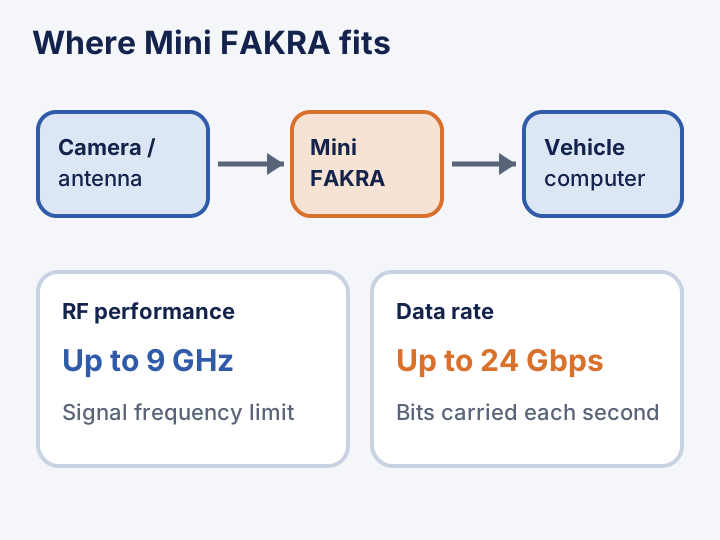
For a BEI student, that means connecting circuit theory to communication signals and practical measurement. A lab exercise could compare how a signal changes through different cable lengths, bends and connector joins, while keeping the transmitter and receiver settings fixed. The experiment should state the instrument bandwidth and termination used, because a measurement that exceeds the test equipment's limits can look like a property of the connector when it is actually a property of the setup.
The same discipline is useful beyond cars. Cameras, telecom equipment, industrial robots and medical devices all combine sensors, signal paths and processing. A device can have a high-resolution sensor and still be limited by the link carrying its output. The lesson is to evaluate the complete channel rather than choosing a part from one maximum number.
What to study and what to watch next
Two BEI subjects provide a starting point. Advanced Electronics, ENEX 202, builds on electronic circuits and signal handling. Instrumentation, ENEX 252, concerns measurement systems and how signals are observed. Together they help a student ask whether a measured waveform came from the device under study, the probe, the cable or the instrument. A small project could build a repeatable test jig that records signal quality across several connector arrangements without claiming to reproduce an automotive certification test.
The next evidence to look for would be a technical product datasheet, qualification conditions, connector and cable part numbers, and named vehicle programmes that have completed validation. Production use would answer a different question from a launch: whether a manufacturer selected the system for a real vehicle. Until those details are published, the careful summary is that TE has announced a component family with high stated limits and vehicle-network applications, while installed performance remains specific to the final configuration.
Words in this story
- RF (radio frequency)
- An alternating electrical signal used to carry radio or high-frequency data.
- Coaxial cable
- A cable with a central conductor and a surrounding conductive shield.
- V2X
- Communication between a vehicle and other vehicles, road equipment or networks.
- Data rate
- The amount of digital information carried each second, measured here in bits per second.
Where this comes from
The news itself rests on one source; any other link is background or from the same publisher. Written in our own words; no sentence is copied from these reports. Researched with AI assistance and added 17 October 2026; no member of faculty has reviewed this story yet. If you spot a mistake, call 01-5091616 and we will correct it and say so.