US grid plan combines wire upgrades with live line ratings
DOE says the Virginia and West Virginia project could add an estimated 290 MW on Appalachian Power's Virginia system by upgrading existing corridors.
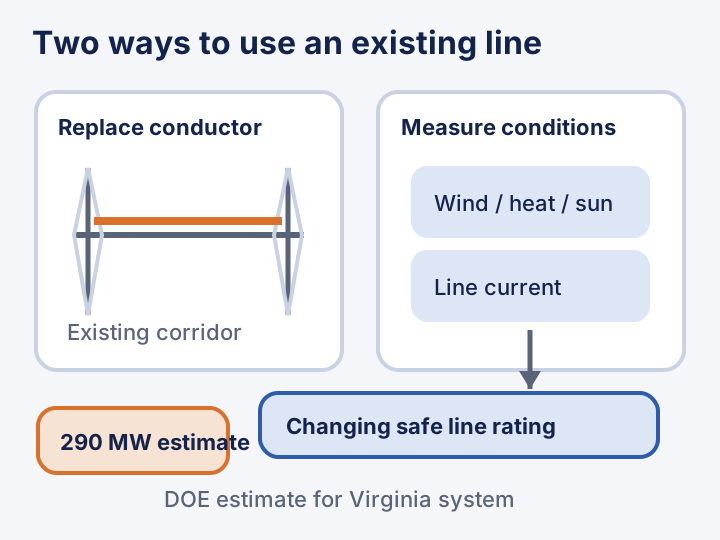
A U.S. Department of Energy announcement on 16 October describes a proposed way to increase power transfer on existing transmission corridors. The plan pairs reconductoring, which replaces line conductors, with Dynamic Line Rating, which adjusts an operating limit using changing conditions. DOE estimates that the project could add 290 megawatts across Appalachian Power's Virginia system. That is a project estimate, not measured capacity already in service.
- 290 MWDOE estimate for added capacity on Appalachian Power's Virginia system
- Up to $50 millionfunding DOE says it intends to deploy for the project
- 1 to 4 yearsDOE's estimated time advantage over conventional upgrades
- 16 October 2026date of the Department of Energy announcement
What the funding announcement says
DOE said it intends to deploy up to $50 million in Defense Production Act funding for Virginia Energy's Grid Enhancing Technologies for Virginia and West Virginia Large Load Growth project. The work is proposed along existing transmission corridors. The department says the combination of advanced reconductoring and Dynamic Line Rating could add an estimated 290 MW of capacity across Appalachian Power's Virginia system. The project name covers Virginia and West Virginia, while the 290 MW estimate in the announcement is specifically attached to the Virginia system.
DOE also says the proposed approach could be completed one to four years faster than conventional transmission upgrades. That comparison is the department's estimate. The announcement does not provide a construction schedule for each line, an itemized list of conductors or sensors, the final funding agreement, or a completion date. It therefore describes an intended investment and an expected result. It does not confirm that the money has already been transferred or that the new capacity is operating.
The project responds to rising electricity demand in the region, according to DOE. A transmission line can limit how much electricity moves between generators and users even when there is enough power available to produce. In engineering terms, the line's operating limit must account for the conductor's temperature, its clearance above the ground, the capacity of equipment at substations and the rules operators use to keep the system reliable. The announcement addresses one part of that problem: how much existing corridors can carry and how soon that capability might be increased.
What reconductoring changes
An overhead transmission line carries current through metal conductors suspended from towers or poles. Reconductoring replaces those wires, usually along an existing route, with conductors selected to carry more current or tolerate different operating conditions. It can reuse some of the corridor and supporting structures, but a replacement is not automatically a simple wire swap. Engineers must check tower strength, attachment points, electrical clearances, vibration, joints, insulators and the condition of the rest of the line.
Current heats a conductor. A hotter conductor expands and can sag farther between supports. The ground clearance and the distance from buildings, vegetation and other equipment must remain within design limits. A conductor can also be limited by thermal damage or by the ratings of substation equipment at either end of the line. Increasing the conductor's current-carrying capability may require work beyond the wire itself, depending on the existing assets and the project design.
This means the useful capacity gain depends on which constraint is limiting the line. If the old conductor is the bottleneck and towers can accept a replacement, a new conductor may help. If clearance, a transformer, a protection setting or another line segment is more restrictive, replacing one wire alone may not raise the safe limit for the whole route. A system study has to trace the path through connected equipment rather than treating a transmission line as an isolated component.
How a dynamic line rating works
A traditional static rating is calculated using conservative assumptions about the line's operating environment. A Dynamic Line Rating, or DLR, uses more current information to estimate the safe current-carrying limit. DOE technical material describes measurements such as ambient temperature, wind speed and direction, sunlight, humidity, conductor temperature and line current. Sensors, weather data and software can feed an estimate to system operators, who remain responsible for using an approved operating limit.
Wind can cool an exposed conductor, while warm air and strong sun can heat it. The same line can therefore have different thermal limits at different times and locations. A rating based on measured or forecast conditions can sometimes be higher than a conservative fixed rating. It can also be lower when the conductor is hot, wind is weak or system conditions are unfavourable. Dynamic rating is not a promise of extra capacity in every hour; it is a way to make the limit respond to conditions while preserving safety margins.
The challenge is that the weather and the line do not behave uniformly along a long route. A valley may have less wind than a nearby ridge. One span can be the weakest point because it has less cooling or less clearance. A rating tool needs data that reflect the parts of the route that determine the operating limit, along with reliable communications, sensible alarm handling and procedures for when a sensor or forecast is unavailable.
Operators also need to understand the recommendation. A number on a display is not a physical upgrade by itself. The control room must know how the rating was calculated, what margin remains, what conditions trigger a change, and how to fall back if the measurement system fails. Training, validation and operational rules are part of deployment, alongside the sensors and software.
Why put the two techniques together
Reconductoring can create a stronger physical path, while dynamic rating can make the operating limit more responsive to conditions. In principle, doing both can address two different constraints: the conductor itself and the conservative assumption used to rate it. The DOE announcement presents this combination as a way to raise capacity on existing routes without waiting for a conventional expansion to be built from scratch. The department's one-to-four-year comparison is a forecast, not a measured outcome.
The pairing still has trade-offs. A new conductor may cost money and require tower work or outages. DLR needs sensors or dependable weather inputs, communications and trained operators. Any change must preserve clearance, protect equipment and coordinate with the protection system that detects faults. A project cannot claim a reliable capacity increase by adding together the maximum rating of a new wire and a favourable weather reading; it must model the complete network and use limits that remain safe under credible operating conditions.
This is why the DOE figure is best treated as a project estimate. The announcement does not publish the line-by-line calculation behind 290 MW, the weather profile that will be used, or the final designs. Those details would be needed to compare the estimate with operating data after construction. Until they are available, the reliable fact is that the agency has announced an intended project and the capacity increase it expects the work to deliver.
What this means for an engineering student in Nepal
The project is in the United States, so it should not be presented as a Nepal transmission decision. The underlying questions are relevant to any engineer who studies power networks: where is the bottleneck, what physical condition sets the safe operating limit, which measurements would reduce uncertainty, and what must the control room know before the limit changes? Nepal's line routes, weather, elevation, tower design and utility rules require their own data and engineering checks.
A BEI student can build a safe classroom model that plots a conductor's heat balance under different current, air temperature, wind and solar inputs. The model should state its assumptions and should not be used to set a real operating limit. Comparing a fixed rating with a condition-based estimate shows why a dynamic method may use existing infrastructure better on some days but offer little or no extra margin on others.
For a student project, the interesting part is not drawing a sensor icon on a transmission tower. It is asking how trustworthy the input is, how the weakest span is identified, how uncertainty is converted into a safety margin, and what happens if a measurement disappears. These are the same kinds of questions that connect electronics, instrumentation and power engineering.
What to follow next
The next useful updates would be a signed funding agreement, the line segments selected, the conductor and sensor designs, a construction timetable, and the commissioning data. Those would show whether the announced intention became a funded project and whether the modeled capacity appeared in operation. A report that uses the 290 MW figure should keep calling it DOE's estimate until post-project measurements support a different description.
Electrical Circuits and Machines, ENEE 154 in the BEI curriculum, gives students part of the foundation for understanding current, voltage and electrical equipment. Later study in networks and power systems builds the analysis needed to connect a conductor's thermal behaviour to a whole grid. The main takeaway is methodological: measure the line conditions, identify the limiting component, and publish the assumptions behind any added-capacity number.
Words in this story
- Reconductoring
- Replacing the conductors on an existing transmission route.
- Dynamic Line Rating (DLR)
- A line limit adjusted using measured or forecast operating conditions.
- Conductor sag
- The downward curve of an overhead wire between its support points.
- Transmission corridor
- The route and right-of-way used by transmission infrastructure.
Where this comes from
- U.S. Department of Energy, 16 Oct 2026
- U.S. Department of Energy, Advanced Transmission Technologies Report, 2020
- U.S. Department of Energy, Dynamic Line Rating report to Congress, 2019
The news itself rests on one source; any other link is background or from the same publisher. Written in our own words; no sentence is copied from these reports. Researched with AI assistance and added 17 October 2026; no member of faculty has reviewed this story yet. If you spot a mistake, call 01-5091616 and we will correct it and say so.