
Diamer-Bhasha dam starts moving pozzolan for its RCC main dam
Extraction of natural pozzolan at Gini began for the 272 m roller-compacted concrete dam, which WAPDA plans as the tallest of its type.
Pakistan's Diamer-Bhasha dam project formally began extracting and moving pozzolan from Gini, in Diamer district, in late September 2026, Dawn reported on 26 September. The material will be processed and mixed into the roller-compacted concrete (RCC) of the main dam. The Water and Power Development Authority (WAPDA) plans the dam at 272 m.
- 4,500 MWplanned installed generating capacity
- 8.1 MAFgross storage, in million acre-feet
- 18 billionunits of electricity expected each year
- 1.23 millionacres of land to be irrigated
- 2030WAPDA's scheduled completion year for the dam
What happened
The Diamer-Bhasha dam is being built on the Indus river, about 40 km downstream of the town of Chilas, in Gilgit-Baltistan. According to Dawn and the state news agency APP, the formal start of pozzolan extraction and transport at Gini was treated as a major step towards building the main dam. The pozzolan will be processed first. After that, according to the reports, placement of roller-compacted concrete in the main dam will formally begin.
The work followed directions from WAPDA's chairman, Lieutenant General (retired) Muhammad Saeed, and the chief secretary of Gilgit-Baltistan, Arshad Majeed Mohmand. Officials from the district administration, WAPDA, the Diamer Basha Development Company, consultants and contractors attended the event at Gini. Local elders and religious leaders also attended and said they supported quick completion of the dam.
The milestone comes later than first planned. In September 2025, International Water Power and Dam Construction reported WAPDA's plan to start RCC work on the main dam in early 2026. In February 2026, WAPDA said placement would begin during 2026, once excavation of the right abutment was complete. At that time, it reported that excavation of the left abutment and the dam pit was substantially finished, and that RCC trials for the main dam had been successful. WAPDA has scheduled completion of the dam for 2030.
The dam has several purposes. WAPDA says it will store about 8.1 million acre-feet of water, irrigate about 1.23 million acres, and generate about 18 billion units of electricity a year from 4,500 MW of installed capacity. It also involves large spending on people living near the site. In 2025 the magazine reported Rs 78.5 billion for resettlement of affected communities and local health, education and infrastructure projects, and Rs 2.1 billion for a cadet college built at Chilas.
The engineering behind it
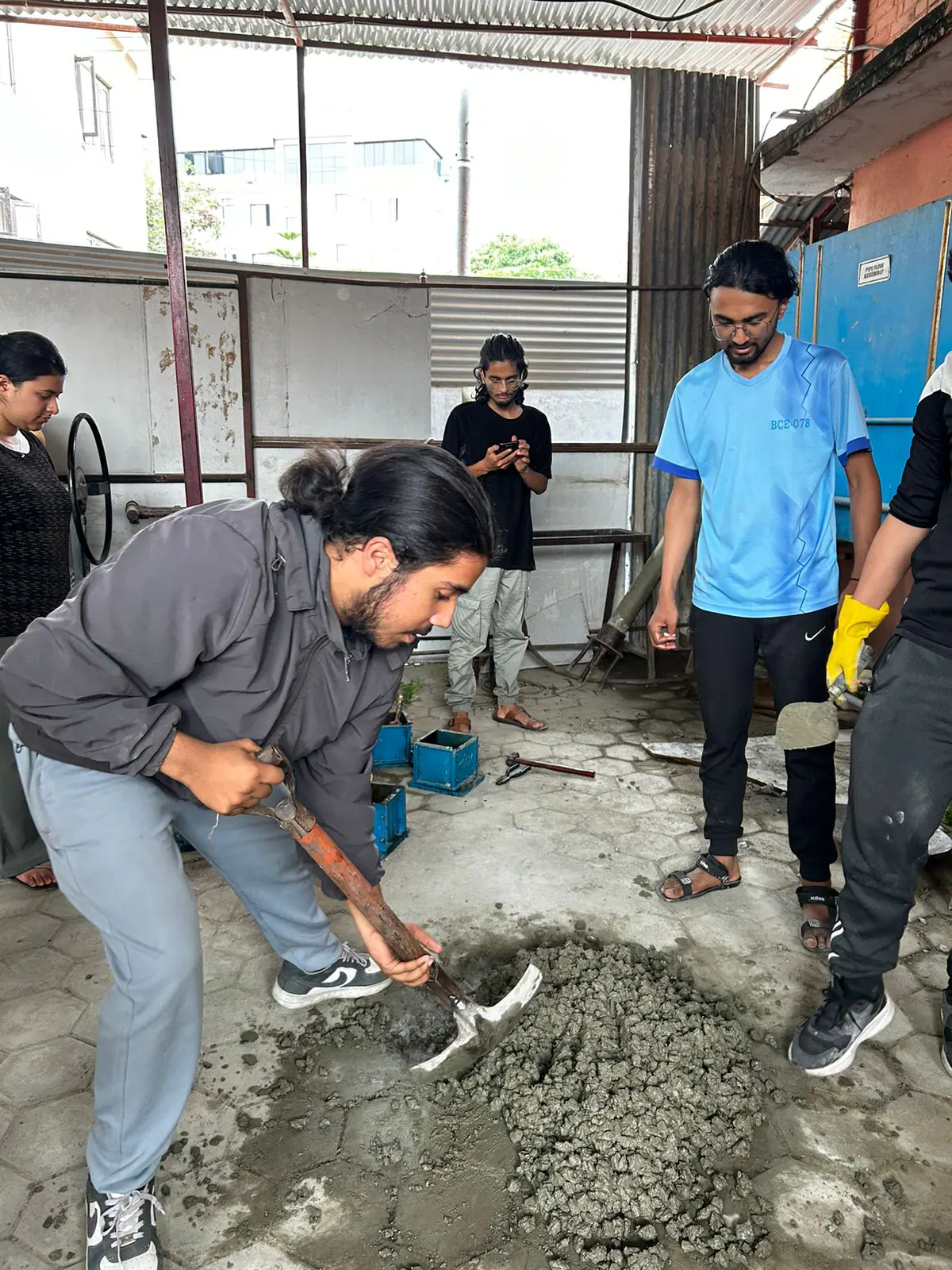
WAPDA describes the main dam as a roller-compacted concrete structure. RCC is a very dry, stiff concrete. Instead of being poured into forms and vibrated, it is delivered by trucks or conveyors, spread in thin layers with bulldozers, and compacted with vibrating rollers, much like the base of a road. Each layer is usually around 30 cm thick. This general method allows a large dam to rise faster and at lower cost than one built from conventional mass concrete.
Large concrete dams face a special problem with heat. When cement reacts with water, it releases heat. In a thin slab, this heat escapes quickly. In a dam tens of metres thick, the inside can become much hotter than the surface. When the concrete later cools and shrinks, the difference in temperature can cause cracking. Controlling this heat is one of the main tasks in designing a mass concrete mix.
This is where pozzolan comes in. A pozzolan is a natural or artificial material rich in reactive silica. On its own it does not harden with water. When mixed with cement, it reacts slowly with the calcium hydroxide that cement produces and forms extra binding compounds. Replacing part of the cement with pozzolan lowers the heat released, can reduce cost, and often improves long-term strength and durability. Volcanic ash, fly ash from power plants and some processed natural materials can act as pozzolans.
Using a local source matters for a dam of this size. Bringing large amounts of cement or fly ash to a remote mountain site is expensive and slow. If a suitable material can be quarried nearby and processed on site, the project gains a steady supply. The reports do not give the quantity of pozzolan needed or the processing method, so these points describe the general reasons engineers choose pozzolans for RCC dams.
What it means in Nepal
The sources do not discuss Nepal, so this section is about the skills behind the story. A project like Diamer-Bhasha shows how much of dam engineering happens before the main structure begins. Engineers must find and test suitable materials, design a mix that limits heat and cracking, and run trial sections to check that the concrete can be placed and compacted properly. WAPDA's reports of RCC trials and a site laboratory show this preparation stage.
It also shows the scale of work around a large dam. In September 2025, WAPDA reported construction on 13 work fronts, including diversion tunnels, cofferdams, a flushing tunnel, crushing and batching plants and conveyor tunnels. By February 2026, it reported 20 active sites. Each of these needs civil engineers for design, quality control and supervision. Delays at one front, such as abutment excavation, can hold back the whole project.
For a student, the main lesson is that concrete for a dam is designed, not simply ordered. Choosing the cement, the pozzolan, the aggregate and the water content is an engineering decision. It affects cost, heat, strength and the life of the structure. The same thinking applies at smaller scale, in any thick foundation, retaining wall or weir where heat and cracking could shorten the life of the concrete.
The neighbouring Dasu project on the same river shows that this skill is in steady use. WAPDA reported in February 2026 that crushing and batching plants for Dasu's main dam were complete and that RCC pouring there would also begin during the year. Two large RCC dams being prepared on one river at the same time means many engineers working on materials testing, mix design and quality control.
What to study if this interests you
Civil Engineering Materials, ENCE 103, in the first semester of BCE, introduces cement, aggregates and pozzolanic materials. Concrete Technology, ENCE 205, in the third semester, covers hydration, heat of hydration, mineral admixtures such as pozzolans, and mix design. Hydropower Engineering, ENCE 403, in the seventh semester, covers dams, intakes and powerhouses, and places a project like this in the context of water storage and power generation.
Words in this story
- Roller-compacted concrete
- A very dry concrete that is spread in thin layers and compacted with vibrating rollers, like a road base.
- Pozzolan
- A silica-rich material that reacts with the by-products of cement to form extra binder, lowering heat and often improving durability.
- Heat of hydration
- The heat released when cement reacts with water, which can crack very thick concrete if not controlled.
- Abutment
- The rock on each side of a valley against which a dam is built and supported.
Where this comes from
- Dawn, 26 Sep 2026
- International Water Power and Dam Construction, 15 Sep 2025
- WAPDA, 15 Feb 2026
- Associated Press of Pakistan (APP), 25 Sep 2026
The news itself rests on one source; any other link is background or from the same publisher. Written in our own words; no sentence is copied from these reports. Researched with AI assistance on 11 October 2026; no member of faculty has reviewed it yet. If you spot a mistake, call 01-5091616 and we will correct it and say so.