

How many BE seats does Purbanchal University have, and where are they?
The Faculty of Engineering publishes a seat count for every programme at every college, totalling 2,498 seats across eighteen institutions. Civil Engineering is 1,356 of them, more than half. It is the most detailed seat data any non-IOE system in Nepal publishes, and the document carries no date of its own; its filename places it in July 2024, so it is at least one cycle old.
Purbanchal University does something almost no engineering provider in Nepal does: it publishes how many seats each of its colleges has, programme by programme, in one document. Eighteen institutions, thirty-eight programme rows and 2,498 seats. The document is a two-page list headed "List of Colleges offering undergraduate programs under Purbanchal University Faculty of Engineering", and it is the single most useful published artefact in this university system.
The 2,498 seats, by programme
| Programme | Seats | Colleges offering it |
|---|---|---|
| Bachelor in Civil Engineering | 1,356 | 15 |
| Bachelor in Computer Engineering | 440 | 8 |
| Bachelor in Architecture | 196 | 3 |
| Bachelor in Electronics, Communication & Automation Engineering | 170 | 3 |
| Bachelor in Electrical Engineering | 144 | 3 |
| Bachelor in Bio-Medical Engineering | 144 | 1 |
| Bachelor in Geomatic Engineering | 48 | 1 |
| Total | 2,498 | 18 |
Scroll the table sideways for Colleges offering it.
Civil is 54 per cent of every published seat in this system, and it is taught at fifteen of the eighteen institutions. Two programmes exist at exactly one college each and are worth knowing about for that reason. Bio-Medical Engineering, 144 seats, is the largest single-programme figure here and is taught only at the Kupondole college that appears under two names. Geomatic Engineering, 48 seats, is taught only at the Geomatic Institute of Technology at Thapathali. The faculty's course-structure page names seven bachelor programmes, which matches the seven above.
By college, largest first
| Institution | Seats | Programmes as the faculty names them |
|---|---|---|
| PU School of Engineering, Biratnagar | 300 | Civil 96, Computer 96, Electrical 48, ECA 60 |
| Khwopa Engineering College, Bhaktapur | 296 | Architecture 60, Civil 96, Computer 60, ECA 80 |
| Acme Engineering College, Kathmandu | 244 | Architecture 40, Civil 144, Computer 60 |
| Himalayan WhiteHouse International College | 192 | Civil 144, Computer 48 |
| Kantipur International College | 192 | Architecture 96, Civil 96 |
| Kantipur City College | 184 | Civil 144, Computer 40 |
| Eastern College of Engineering, Biratnagar | 174 | Civil 96, Computer 48, ECA 30 |
| College of Biomedical Engineering and Applied Science | 144 | Bio-Medical 144 |
| Hillside College of Engineering | 144 | Civil 96, Electrical 48 |
| Nepal Polytechnic Institute, Chitwan | 144 | Civil 96, Electrical 48 |
| Aryan School of Engineering and Management | 96 | Civil 96 |
| Pathivara Center for Advanced Studies, Jhapa | 96 | Civil 48, Computer 48 |
| Himalayan Institute of Science & Technology | 60 | Civil 60 |
| Central Engineering College, Janakpur | 48 | Civil 48 |
| College of Information Technology and Engineering | 48 | Computer 40 |
| Geomatic Institute of Technology | 48 | Geomatic 48 |
| Morgan Engineering and Management College | 48 | Civil 48 |
| Dhulabari Campus, Jhapa | 48 | Civil 48 |
Scroll the table sideways for Programmes as the faculty names them.
One row above needs its own line, because the arithmetic in it is the document's and not ours. The College of Information Technology and Engineering is listed with Computer Engineering at 40 seats, which is the figure printed against it. Every other total on this table is the sum of the programme figures beside it.
The caveat, and it is a large one
This list carries no date inside it. Its filename places it on 23 July 2024, and the entrance portal's front page no longer links it under the Faculty of Engineering at all. Three things confirm it has fallen behind. It does not carry Mega College of Engineering, approved by the regulator in Kartik 2082, or Mansarowar Institute, approved in Falgun 2082. And it lists the biomedical college under the name the regulator does not use while omitting the name the regulator does use, which is the same college twice over rather than two colleges.
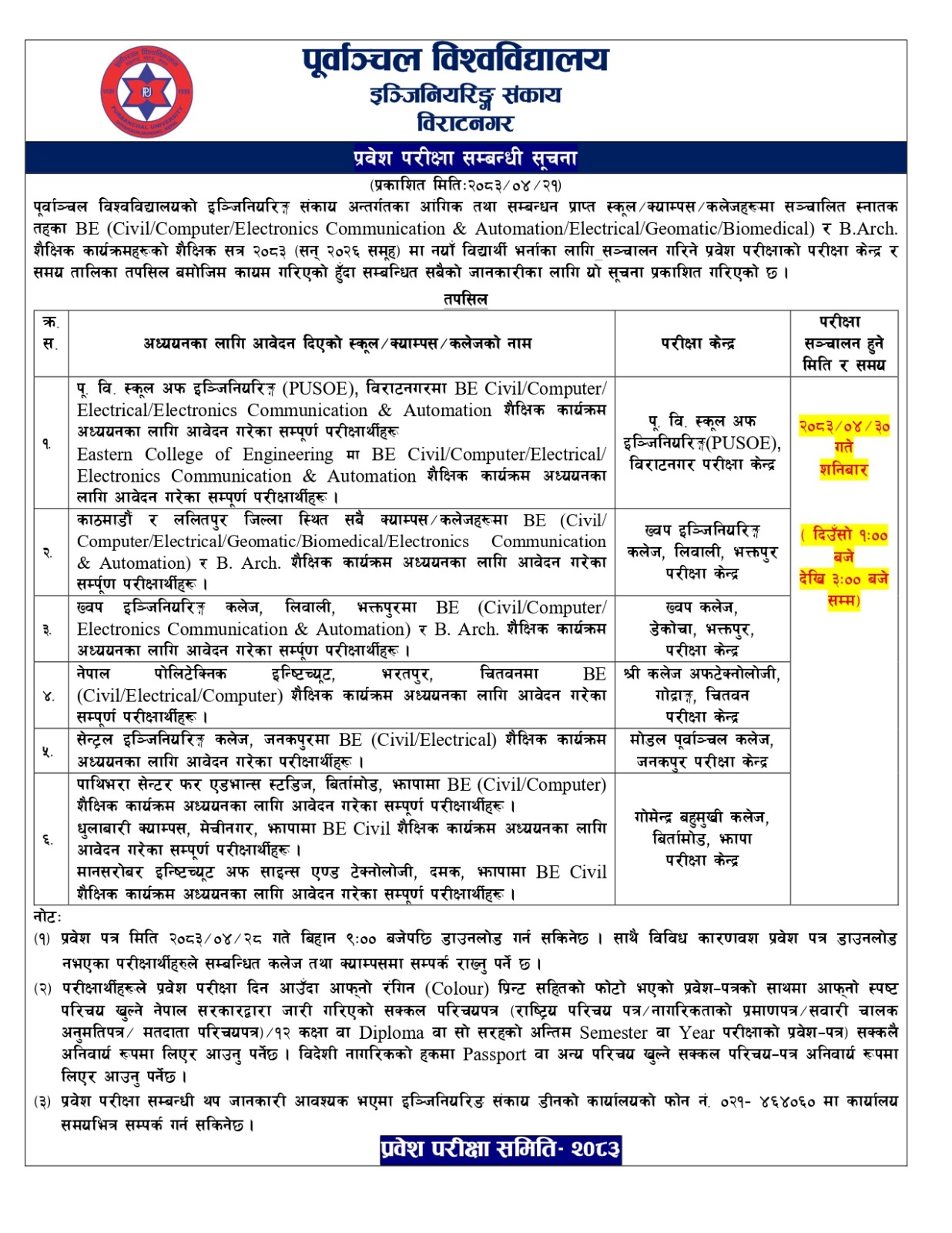
The faculty's 2083 entrance notice, published two years later, names programmes for eight colleges and disagrees with this list at three of them: it adds Electrical at Central Engineering College and at Eastern College of Engineering, and Computer at Nepal Polytechnic Institute. In each case the newer notice matches the regulator's programme count and the older list falls one short. So treat the seat numbers as the best published figures anyone has and the programme lists as a floor rather than a ceiling.
Every figure is from the faculty's own list of colleges offering undergraduate programs. The seat column is misaligned by two rows in the extracted text, the same multi-column failure the IOE booklet has, so all thirty-eight figures were read off the rendered page image instead. The total was then reconciled twice, by college and by programme, and both routes give 2,498. Programme counts per college are from the Nepal Engineering Council's register, which prints a count and no names; the three additions are from the faculty's entrance-centre notice of 2083-04-21.
Read next
Sources
- Purbanchal University Faculty of Engineering, List of Colleges offering undergraduate programs, 2 pages · published 23 July 2024 (from the filename; the document carries no date) · read 2 September 2026
- Nepal Engineering Council, registered colleges under Purbanchal University · read 2 September 2026
- Purbanchal University Faculty of Engineering, Course Structure · read 2 September 2026
- Purbanchal University Faculty of Engineering, notice on the BE/B.Arch entrance examination centres and timetable 2083 · published 6 August 2026 (2083-04-21) · read 2 September 2026
Last reviewed by Ram Raj Thapa, Admissions Officer, Imperial College of Engineering. Every figure on this page is cited to the document it came from.