

How much does a BE at Kathmandu University cost in 2082/83?
Rs 9,60,000 across four years for every BE programme, and Rs 10,97,000 across five for Architecture, on KU’s own 2082/83 fee structure. Rs 2,21,000 was payable on admission day in August 2026, and the fee has risen from Rs 8,50,000 for the 2022 batch.
A four-year BE at Kathmandu University costs Rs 9,60,000 for a Nepali student on the university’s own fee structure for the academic year 2082/83, and the figure is the same for every engineering programme: Civil, Computer, Mechanical, Chemical, Mining, Geomatics, both Electrical and Electronics tracks and the BTech in Artificial Intelligence. The five-year Bachelor of Architecture is Rs 10,97,000. Both figures are the whole programme, not a year, and they come from a document the Executive Council approved on 2082/02/07 with effect from 2082-04-01. SAARC and corporate-sponsored students pay 1.5 times these amounts and students from outside SAARC pay double. On admission day in August 2026 the School of Engineering collected Rs 2,21,000 from every undergraduate entrant, or Rs 2,23,000 for Architecture, including Rs 10,000 of caution money and a Rs 1,000 Nepal Engineering Council fee. Three years earlier the same degree was Rs 8,50,000, so the price has risen by about 13% since the 2022 batch.
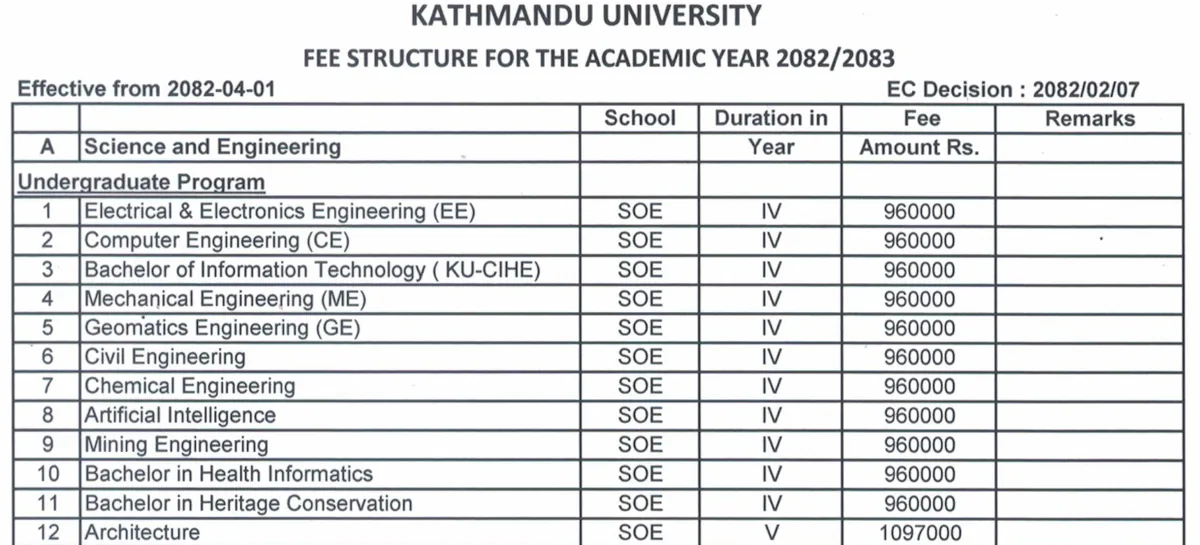
Three years of the same table
KU keeps its earlier fee structures on the same page, which makes it the only university in Nepal where the direction of the price can be read from primary documents rather than guessed. The three most recent are below. Each is the full-programme fee for a Nepali national.
| Academic year | Four-year BE | Architecture (5 years) | Approved |
|---|---|---|---|
| 2079/80 (2022 batch) | Rs 8,50,000 | Rs 9,70,000 | EC meeting 663, 2079-3-24 |
| 2081/82 | Rs 9,15,000 | Rs 10,45,000 | EC decision 2081/02/18, effective 2081-04-01 |
| 2082/83 | Rs 9,60,000 | Rs 10,97,000 | EC decision 2082/02/07, effective 2082-04-01 |
Scroll the table sideways for Architecture (5 years) and Approved.
That is a rise of about 7.6% between the first two rows and about 4.9% between the second and third. The 2079/80 document also printed the SAARC and non-SAARC columns in full, at Rs 12,75,000 and Rs 17,00,000 for a BE; the 2082/83 document states the same multiples as a note instead of printing the columns.
What is due on admission day, and what comes back if you leave
The first admission notice of 4 August 2026 sets the admission-day payment at Rs 2,21,000 for all undergraduate programmes at the School of Engineering and Rs 2,23,000 for Architecture, to be paid into the school’s account at Nepal Investment Mega Bank only after your documents have been verified, not before. The refund rule is a single dated cliff: a student who withdraws by 15:00 on 20 August 2026, with a guardian’s consent, gets back 50% of the caution money and 70% of the remaining fees paid; any application after that date gets 50% of the caution money and nothing else. The notice also states that the KU undergraduate academic scholarship applies to the tuition fee only.
Fee structure is not fee schedule
Two different KU documents get confused. The fee structure, quoted above, is the total for the programme. The fee payment schedule on the School of Engineering site, which splits that total into semester instalments, was last published for the 2022 to 2026 batch and carries the 2022 total of Rs 8,50,000. If you are working out what is due each semester, ask the school for the current schedule rather than reading the one on the site.
Fee figures are read off the rendered pages of three scanned PDFs on ku.edu.np/fee-structure; the 2082/83 file is linked there as "Fiscal Year 2082/83". Admission-day amounts and the refund rule are from pages 2 and 3 of the 4 August 2026 notice. Percentages are arithmetic on the published totals. The bank account number is printed in the notice and is deliberately not repeated here.
Read next
At Imperial College of Engineering
For the same degree in the Tribhuvan University system, IOE publishes its own four-year totals for constituent campuses and this library reproduces them, Regular seat and Full Fee seat side by side. Private TU-affiliated colleges, this one included, publish their own figures, and the rank-banded table for this college is on its fees page. The comparison worth making is the whole four years against the whole four years, which is what both tables give you.
Sources
- Kathmandu University, Fee Structure for the Academic Year 2082/2083 (EC decision 2082/02/07, effective 2082-04-01) · read 2 September 2026
- Kathmandu University, Fee Structure for the Academic Year 2081/2082 (EC decision 2081/02/18) · read 2 September 2026
- Kathmandu University, Fee Structure for the Academic Year 2079/2080, 2022 batch (EC meeting 663, 2079-3-24) · read 2 September 2026
- Kathmandu University School of Engineering, Document Verification and Admission Notice, first admission list · published 4 August 2026 · read 2 September 2026
Last reviewed by Ram Raj Thapa, Admissions Officer, Imperial College of Engineering. Every figure on this page is cited to the document it came from.