
What is on the Purbanchal University BE entrance paper?
One hundred marks of objective questions in two hours, split Mathematics 40, Physics 30, Chemistry 20 and English 10. The faculty publishes the full topic list for all four subjects in one seven-page document, and a model question paper beside it. Nothing it publishes states a negative-marking rule or a pass mark for the entrance itself.
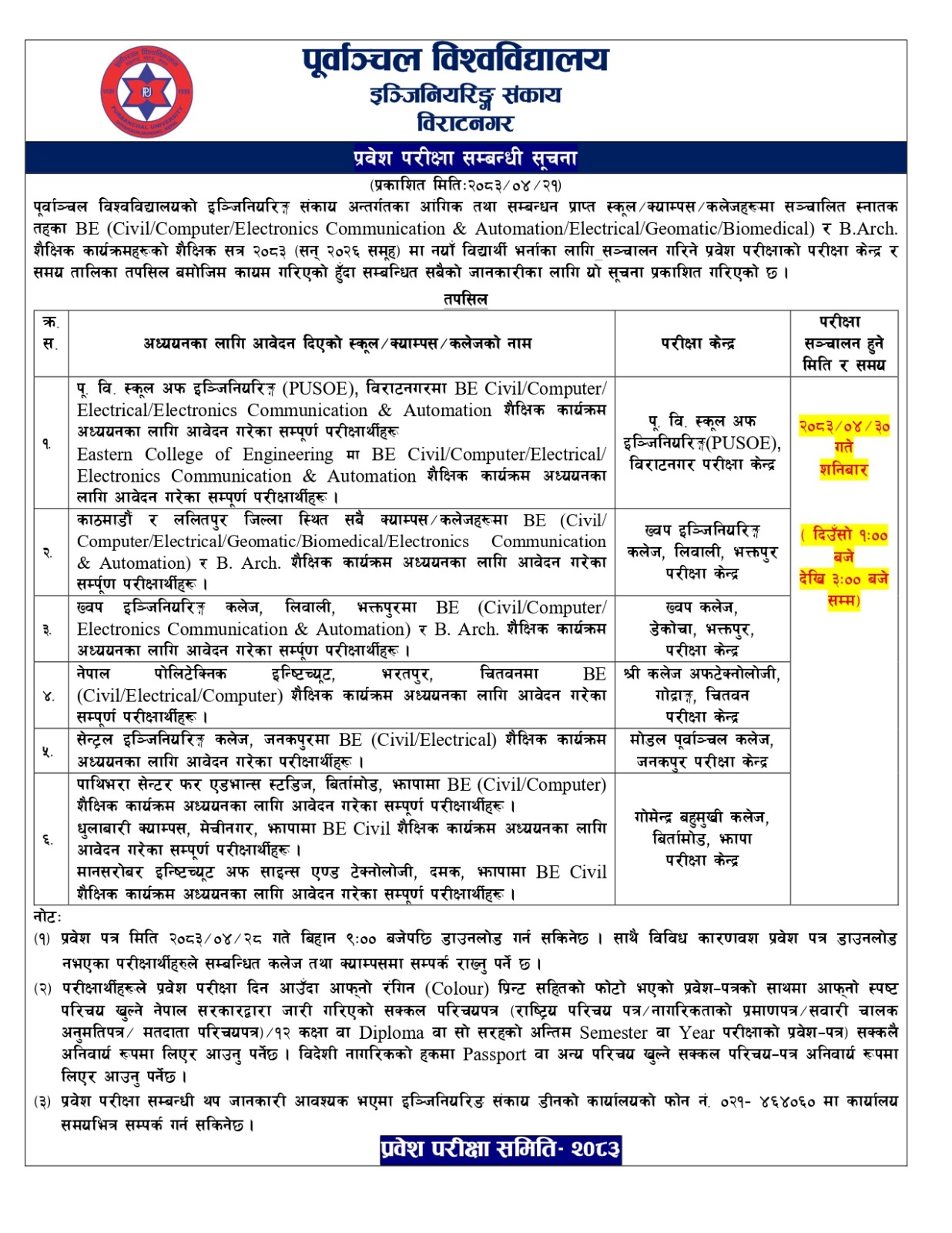
Purbanchal University publishes a marks distribution and a full syllabus for its BE and B.Arch entrance examination, which is more than the other private-college system in this library does. The paper is entirely objective. The university's Unified Procedure 2082 fixes the total at 100 marks of objective questions for every entrance examination at every level, and the faculty's own syllabus document splits those 100 marks across four subjects. The 2083 timetable gave two hours, 1:00 pm to 3:00 pm.
| Subject | Marks | Share of the paper |
|---|---|---|
| Mathematics | 40 | 40% |
| Physics | 30 | 30% |
| Chemistry | 20 | 20% |
| English | 10 | 10% |
| Total | 100 | 100% |
Scroll the table sideways for Share of the paper.
The shape of that split is the thing to plan around. Mathematics and Physics together carry 70 of the 100 marks, so a revision plan giving four subjects equal time is already the wrong plan. English carries ten marks and is the smallest block in any Nepali engineering entrance documented in this library.
The topics, as the faculty lists them
Each subject is set out as numbered chapters with sub-chapters. The full document runs to seven pages; what follows is its chapter list, which is what a revision plan is actually built from.
- Mathematics, 7 chapters
- Set, logic and functions; algebra including matrices, complex numbers, sequences and the binomial theorem; trigonometry; coordinate geometry including conic sections and coordinates in space; calculus including differential equations; vectors and their products; statistics and probability including Bayes' theorem and the binomial distribution.
- Physics, 6 chapters
- Mechanics; heat and thermodynamics; geometric and physical optics; waves and sound; electricity and magnetism; modern physics. The modern-physics chapter closes with a "recent trends" section covering particle physics, the universe, seismology, telecommunication, the environment and new materials.
- Chemistry, 3 chapters
- Physical chemistry; inorganic chemistry, split into non-metals, metals and the extraction of metals; organic chemistry from fundamental principles through to nitro compounds and amines.
- English, 5 chapters
- Vocabulary; grammar; reading comprehension; writing; and sounds of English, which covers phonemes, phonemic symbols, word stress and intonation.
The English section is worth a second look, because it is the one part of this syllabus that is visibly not Purbanchal's own. The document describes it as a proficiency test based on general English and then says that each university may decide the distribution of weightage across each chapter and sub-chapter. That sentence belongs to a shared national text rather than to this faculty, and it means the ten English marks are the least predictable part of the paper.
What the university does not publish about this paper
Three things a candidate would reasonably expect are absent from everything read for this page. There is no statement anywhere that a wrong answer is penalised, and no statement that it is not, so whether this paper carries negative marking is not a published fact. There is no pass mark for the entrance itself; the only threshold the university publishes is a scholarship one, and it is a 35 per cent floor in the entrance below which no scholarship of any kind is awarded. And there is no published question count, only a mark total, so how 100 marks divide into questions is not stated.
What does exist is a model question paper for 2026, linked from the entrance portal under the Faculty of Engineering. It is a six-page scan with no text layer, which is worth knowing before you try to search it.
The marks distribution and the topic lists are from the faculty's own "Marks Distribution and Syllabus for BE/B.Arch Entrance Examination 2026", a seven-page document with a text layer. The 100-mark objective rule is dafa 6.1 of the Unified Procedure 2082; the 35 per cent scholarship floor is dafa 12.1 of the same document, read off the rendered page. The two-hour duration is from the entrance-centre notice of 2083-04-21. The absences in the last section are absences in those documents and on the entrance portal, not a claim that no such rule exists.
Read next
Sources
- Purbanchal University Faculty of Engineering, Marks Distribution and Syllabus for BE/B.Arch Entrance Examination 2026, 7 pages · read 2 September 2026
- Purbanchal University, Unified Procedure on the Entrance Examination, Scholarship Arrangements and Scholarship Entrance Examination 2082, 23 pages · published 22 August 2025 (2082-05-06), approved by the Executive Council · read 2 September 2026
- Purbanchal University Faculty of Engineering, notice on the BE/B.Arch entrance examination centres and timetable 2083 · published 6 August 2026 (2083-04-21) · read 2 September 2026
- Purbanchal University entrance application portal · read 2 September 2026
Last reviewed by Ram Raj Thapa, Admissions Officer, Imperial College of Engineering. Every figure on this page is cited to the document it came from.