

How does the KUCAT-CBT entrance exam work, and how is it scored?
Two hours, 120 multiple-choice questions, 40 each in Physics, Chemistry and Mathematics (or Biology). The test adapts: a right answer raises the next question’s difficulty, a wrong one lowers it, and harder questions are worth more. Scores run from 0 to 2220.
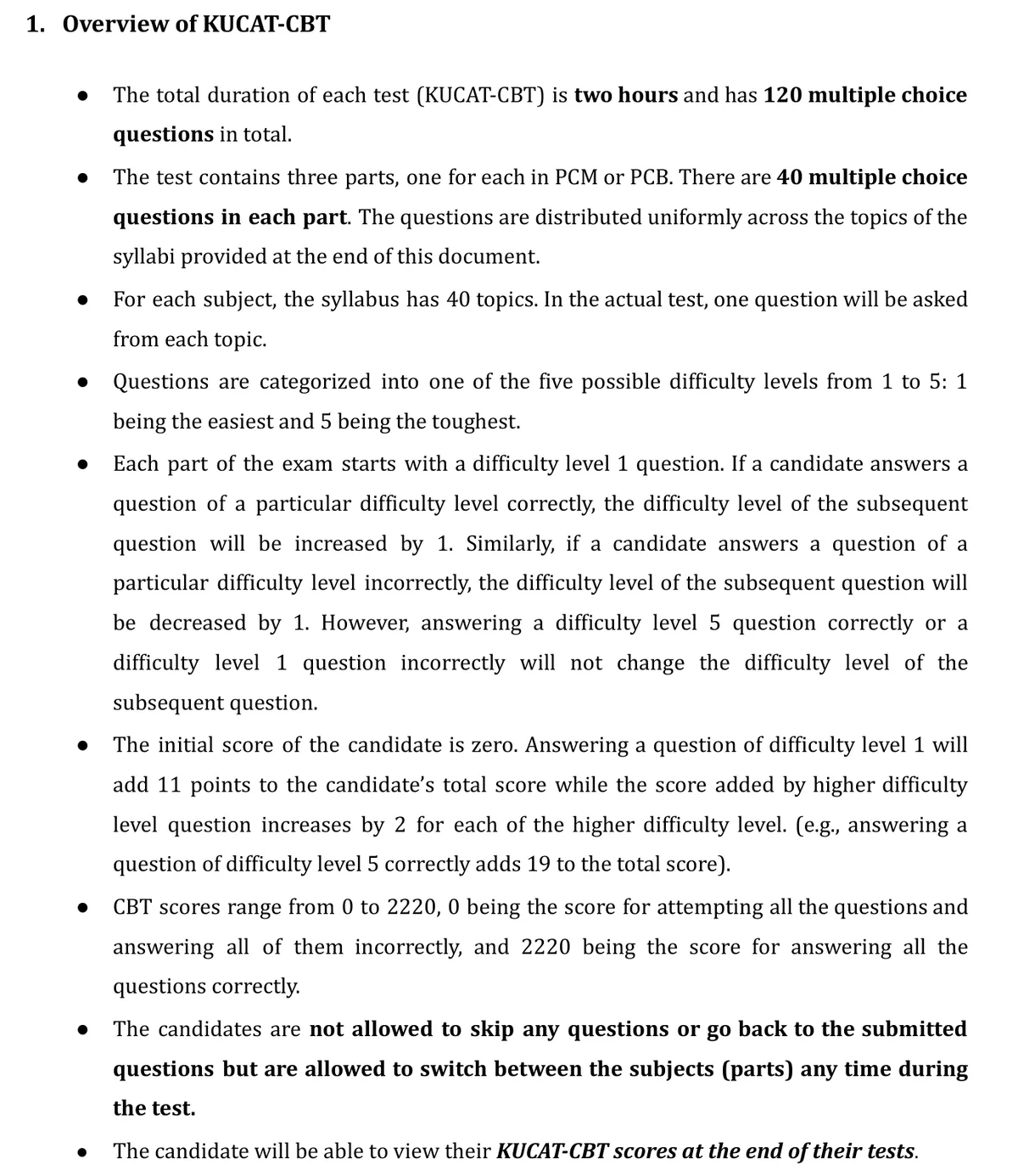
The KUCAT-CBT is Kathmandu University’s single entrance exam for every undergraduate programme in its School of Engineering and School of Science, and it is scored in a way no other Nepali entrance uses. The test runs two hours on a computer and asks 120 multiple-choice questions, 40 in each of three subjects: Physics, Chemistry and Mathematics for the PCM group, or Physics, Chemistry and Biology for PCB. Each subject’s syllabus has exactly 40 topics and the test asks one question from each. The paper is adaptive: every subject starts at difficulty level 1, a correct answer makes the next question one level harder and a wrong one makes it one level easier, on a scale from 1 to 5. A correct level-1 answer adds 11 points and each level above adds 2 more, so a level-5 question is worth 19; nothing is deducted for a wrong answer. The scale therefore runs from 0 to 2220, and you see your own score on screen the moment you finish.
What the adaptive rule means for how you sit it
Because the difficulty of your next question depends on your last answer, and the points depend on the difficulty, the test rewards a run of correct answers far more than the same number of correct answers scattered through the paper. Reaching level 5 and staying there is worth 19 points a question against 11 at level 1. Getting a level-5 question right does not raise the level further, and getting a level-1 question wrong does not lower it further; those are the only two places the rule stops.
| Difficulty level | Points for a correct answer | What happens next |
|---|---|---|
| 1 | 11 | Correct: level 2. Wrong: stays at 1 |
| 2 | 13 | Correct: level 3. Wrong: level 1 |
| 3 | 15 | Correct: level 4. Wrong: level 2 |
| 4 | 17 | Correct: level 5. Wrong: level 3 |
| 5 | 19 | Correct: stays at 5. Wrong: level 4 |
Scroll the table sideways for What happens next.
Two rules follow from the design and both are in the document. You cannot skip a question and you cannot go back to one you have submitted, because the next question has not been chosen until you answer the current one. You can, however, switch between the three subjects at any time, and the test begins the moment you click the first one.
The 2220 ceiling, worked through
A candidate who answers every question correctly climbs from 11 to 19 in the first five questions of a subject (75 points) and then scores 19 on each of the remaining 35 (665), for 740 a subject and 2,220 across three. That is where the published maximum comes from. Zero is the score for attempting everything and getting everything wrong, since nothing is deducted. For comparison, the top Computer Engineering candidate on the 2026 programme-wise list scored 1,607 and the top Civil candidate 1,474, so in practice the scale runs to about three quarters of its ceiling.
What is and is not allowed in the room
- Arrive at least 30 minutes early. Arriving late shortens your own two hours; the clock is not extended.
- Bring the colour-printed admit card and the original of the identity document you uploaded when applying. A photocopy or a photo on a phone is not accepted as identity.
- No calculator of any kind. If you need one, there is a calculator on the computer’s desktop.
- Only pens and pencils go in. Phones and every other electronic device are prohibited.
- The restroom is allowed only after the first 30 minutes and not within the last 15.
- When you finish you show your score to an invigilator, who records it by hand, and you sign against it before logging out.
One application, one sitting
The test document is explicit that a candidate may hold one application and sit the KUCAT-CBT once. A second application under the same or a different identity document, or a second sitting, cancels the exam and disqualifies the candidate from admission. The test is also not available online: it is taken at a centre, on the university’s computers, on the date and time printed on the admit card, with no rescheduling.
Format, scoring and room rules are from sections 1 and 3 of KU’s Information on KUCAT-CBT and Test Syllabus 2026. The scale worked through above is arithmetic on the document’s own figures. The two top scores are from the Civil and Computer programme-wise score lists of 3 August 2026.
Read next
Sources
- Kathmandu University, Information on KUCAT-CBT and Test Syllabus 2026 (KUCAT-CBT Committee, June 2026) · published June 2026 · read 2 September 2026
- Kathmandu University, SoE/SoS Call for Application for Admission in Undergraduate Programs 2026 (apply.ku.edu.np) · published 17 June 2026 · read 2 September 2026
- Kathmandu University, Procedure for Application and Admission 2026 (Admission and KUCAT-CBT Committee, June 2026) · published June 2026 · read 2 September 2026
Last reviewed by Ram Raj Thapa, Admissions Officer, Imperial College of Engineering. Every figure on this page is cited to the document it came from.