

How do you actually take a seat at Pokhara University’s School of Engineering?
In person, on the day, in your rank band. The School of Engineering fills its BE seats by merit-based spot admission at Block B, Pokhara-26, Bijayapur, calling merit ranks in blocks with a clock time against each, with a bank at the venue to take the fee. In 2083 it ran on 13 and 14 August 2026 and the seats were gone before the third session.
Once the School of Engineering publishes its BE entrance merit list, there is no portal, no priority-order form and no waiting for a second list. Seats are filled by merit-based spot admission: the school names a date, calls merit ranks in blocks with a clock time against each block, and admits whoever turns up in their slot until the approved quota is full. The notice calling the 2083 candidates says a bank will be available at the admission venue so the fee can be paid there and then. The venue was School of Engineering Block B, Pokhara-26, Bijayapur. This is the practical difference between this system and the IOE one that costs people most: a rank on a Pokhara list is only worth something if you are physically at the venue during your own time band, and the seat you wanted can be gone by the time the next band opens.
The 2083 rank bands, as the notice printed them
By 13 August 2026 the school had admitted from the top of its list and still had seats in BE Civil, BE Mechanical, BE Electrical and Electronics and BE Information Technology. It published a notice that day calling merit ranks 501 to 900 to spot admission on 14 August, in four bands.
| Merit rank | Admission time on 14 August 2026 |
|---|---|
| 501 to 600 | 9:00 to 10:30 |
| 601 to 700 | 10:30 to 12:00 |
| 701 to 800 | 12:00 to 1:30 |
| 801 to 900 | 1:30 to 3:00 |
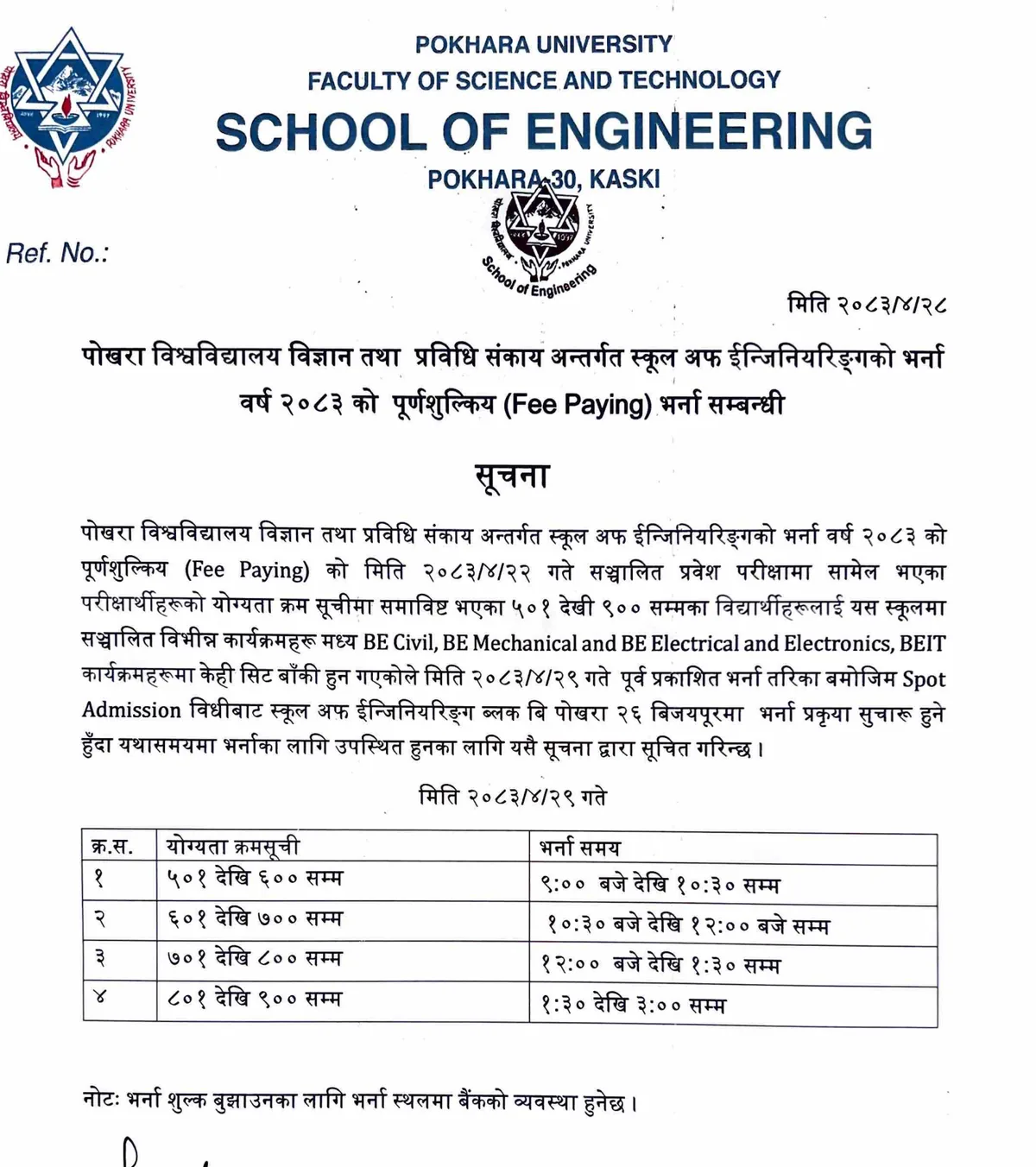
The next day the school published a second notice saying the admission process for the 2083 fee-paying intake was complete. It had run on 13 and 14 August across six programmes — BE Civil, BE Mechanical, BE Electrical and Electronics, BE Information Technology, BE Computer and BE Software — and had filled the approved quota. The same notice cancelled the further admission session that had been scheduled for 17 August.
What that tells you about the odds
The merit list carried 1,246 names and the school stopped calling at rank 900, so roughly the bottom quarter of the list was never reached in this cycle. It is also worth reading the direction of travel: the school was still calling ranks 501 to 900 for four programmes on the second-to-last day, which means seats in Civil, Mechanical, Electrical and Electronics and Information Technology were available well down the list, and then went in a single day. Neither notice publishes how many seats each programme had left when it was written, so how far down any one programme reached is not knowable from what is published.
From the School of Engineering’s two fee-paying admission notices of 13 and 14 August 2026, both scanned images read off the rendered page, with their Bikram Sambat dates converted using the repository’s own converter. The merit-list total is a count of the rows in the published list. Neither notice states a per-programme seat count, and none is published elsewhere; the intake figures on the school’s fee page are for the programme as a whole rather than for what remained on the day.
Read next
Sources
- Pokhara University School of Engineering, fee-paying admission notice for merit ranks 501–900 · published 13 August 2026 · read 2 September 2026
- Pokhara University School of Engineering, notice that the 2083 fee-paying admission is complete · published 14 August 2026 · read 2 September 2026
- Pokhara University School of Engineering, BE Entrance Examination 2083 — Merit List (Fee Paying), 29 pages · published 8 August 2026 · read 2 September 2026
- Pokhara University School of Engineering, Admission procedures · read 2 September 2026
Last reviewed by Ram Raj Thapa, Admissions Officer, Imperial College of Engineering. Every figure on this page is cited to the document it came from.